
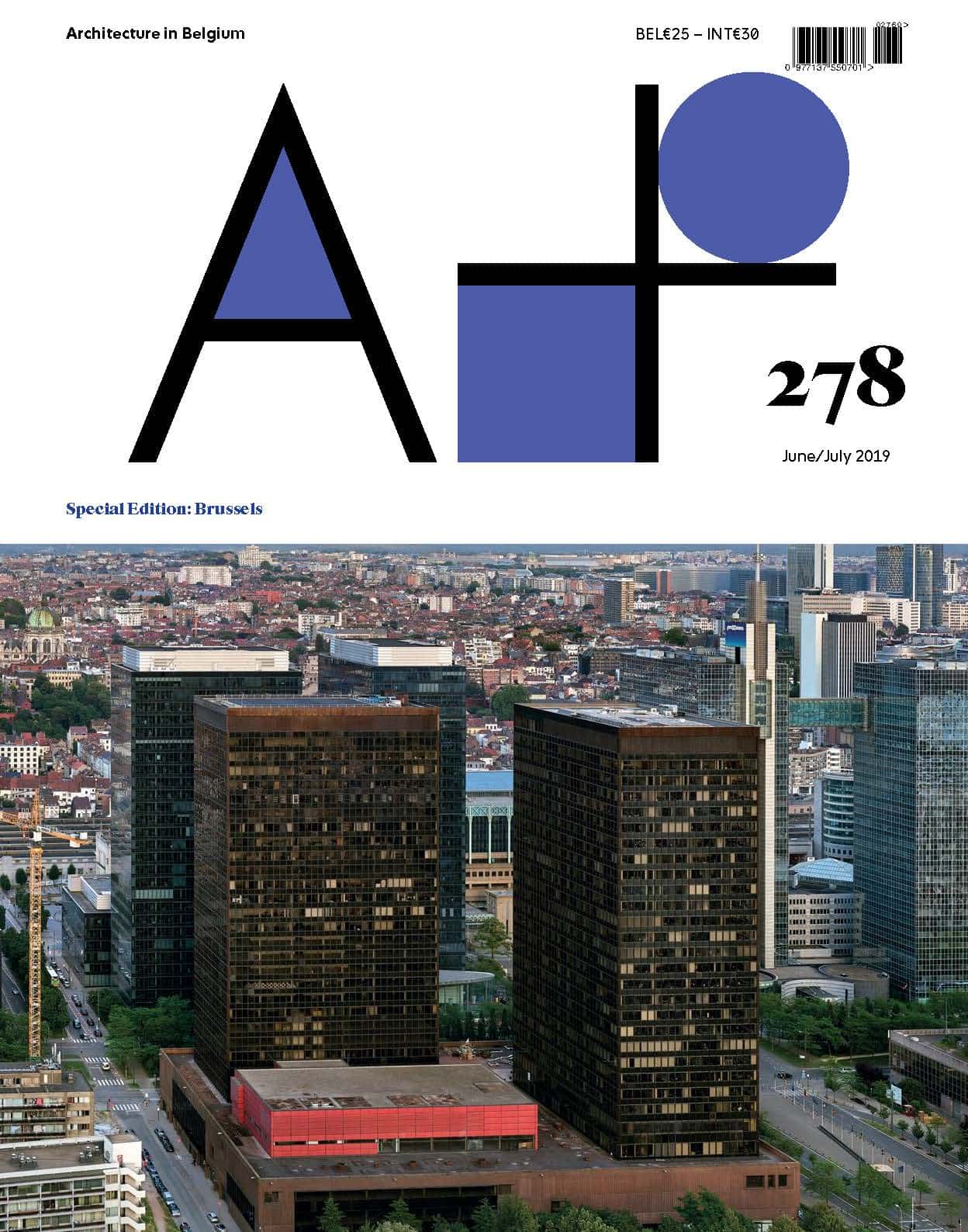
Edito
Lisa De Visscher
Editor-in-Chief
#Bruxellesmabelle. If Instagram is anything to go by, thousands of people think Brussels is beautiful. Although these opinions aren’t always entirely without irony, as amongst the must-see photos of sunsets over the old town taken from the Palais de Justice or the idyllic summer pop-up bars, there’s also a proliferation of images of dirt, poverty, rubbish and traffic jams. It has long been known that Brussels is a love-hate relationship. Thousands of commuters from Flanders and Wallonia, whilst willing to work there, would never want to live there. European civil servants, for their part, want to earn money there but not necessarily invest in it. (Trans)migrants come and go. The population is growing rapidly (20 per cent in ten years) within a limited and non-expandable area. Every year, many households leave the capital to settle in the Flemish suburbs. There’s a lot of movement – except on the Ring, where traffic comes to a standstill! Everyone knows this; it’s everyday life for Brussels residents. But that is not the focus of this issue.
We are dedicating this first special edition of A+ to Brussels – Belgium’s only city with a metropolitan character – for its richness and diversity. Because the Brussels Region, in the context mentioned above, is resolutely pursuing territorial development and tackling demographic, social and economic challenges by implementing spatial solutions. Because there is renewed large-scale reflection on the strategic projects that shape the city. Because we dare to speak of spatial quality as an antidote to economic and political interests. Because, in the meantime, topics such as the circular economy and temporary occupation have taken centre stage at an international property fair such as MIPIM.
Brussels is a city-state with many masters. As well as being the capital of Europe, Belgium and Flanders, it is also a Region that works on a daily basis with 19 municipalities and two (linguistic) communities. This ‘lasagne’ of governance inevitably complicates and slows down decision-making processes. Yet, since its creation in 1989, the Brussels-Capital Region has undergone an impressive evolution in terms of spatial planning, diversity and participation.
I am a ‘true Brusseleir’. Brussels is my city, even though I wasn’t born here. My children are growing up surrounded by Dutch, French, German, English, Turkish and Arabic. Cultural diversity is part of their everyday lives and being part of a minority is the norm. Of course, when I cycle to work, I grumble about the state of the roads, the lack of cycle paths and the behaviour of some drivers, but I also see the efforts being made and the determination to catch up. Brussels is a young and progressive city. A red-and-green enclave in a Flanders that leans to the right – or even the far right. An island in an increasingly conservative Europe.
‘We don’t need Brussels at all; we want Brussels,’ declared the architect Julien De Smedt in A+221. That was ten years ago. Since then, we have needed Brussels more than ever, and some of our desires have been fulfilled. Because it shows us how things can be done differently. Brussels is a test tube in Europe’s laboratory.
Table of contents
Village des matériaux, Brussels
Robbrecht et Daem – Dierendonckblancke – V+ – MDW – Baukunst – Bruther
Brussels, european capital
Ludovic Lamant
Brussels : urban governance for a metropolis
Lisa De Visscher
A glass Trojan horse
Roeland Dudal
Brussels, productive city
Mark Brearley
Kicking the car habit
Laurent Vermeersch
From sustainable to circular Brussels
Pieter T’Jonck
Brussels, compact city
Julie Mabilde
