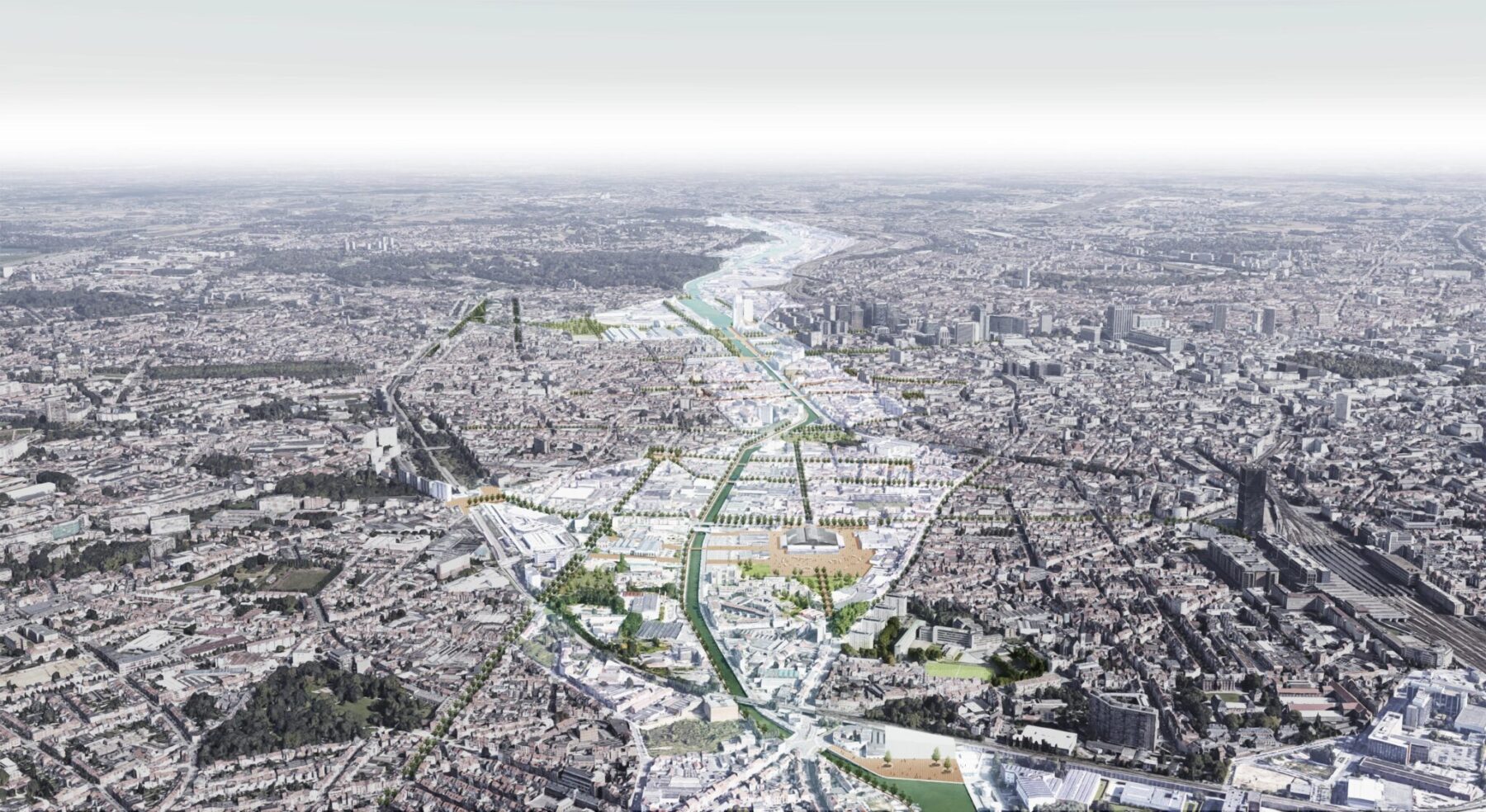
Over a period of 30 years, the Brussels-Capital Region has evolved from a body responsible for regulation to a player that is shaping a metropolis. In addition to the municipalities that supervise and direct many projects, the Region is also seizing the initiative when it comes to large-scale urban development. What instruments does it use to ensure that spatial quality takes precedence over political and economic interests? What are the merits of ‘soft-power mechanisms for design improvement’ and in which kind of climate can they thrive?
The Brussels-Capital Region is a relatively young entity. It did not become a fully fledged region until 1989, when it took its place alongside its Flemish and Walloon counterparts. In just 30 years, however, the Region has been compelled to develop a robust policy by which to address the challenges faced by many cities: strong demographic growth, increasing multi-culturalism, challenging mobility, and a lack of services. The complex political and administrative structure, also known as the ‘Brussels lasagna’, does not make the situation any easier: in addition to the Region, there is also, on the one hand, federal level involvement, and, on the other, 19 municipalities, two (linguistic) communities and a series of agencies.