Edito
Lisa De Visscher – Editor-in-chief
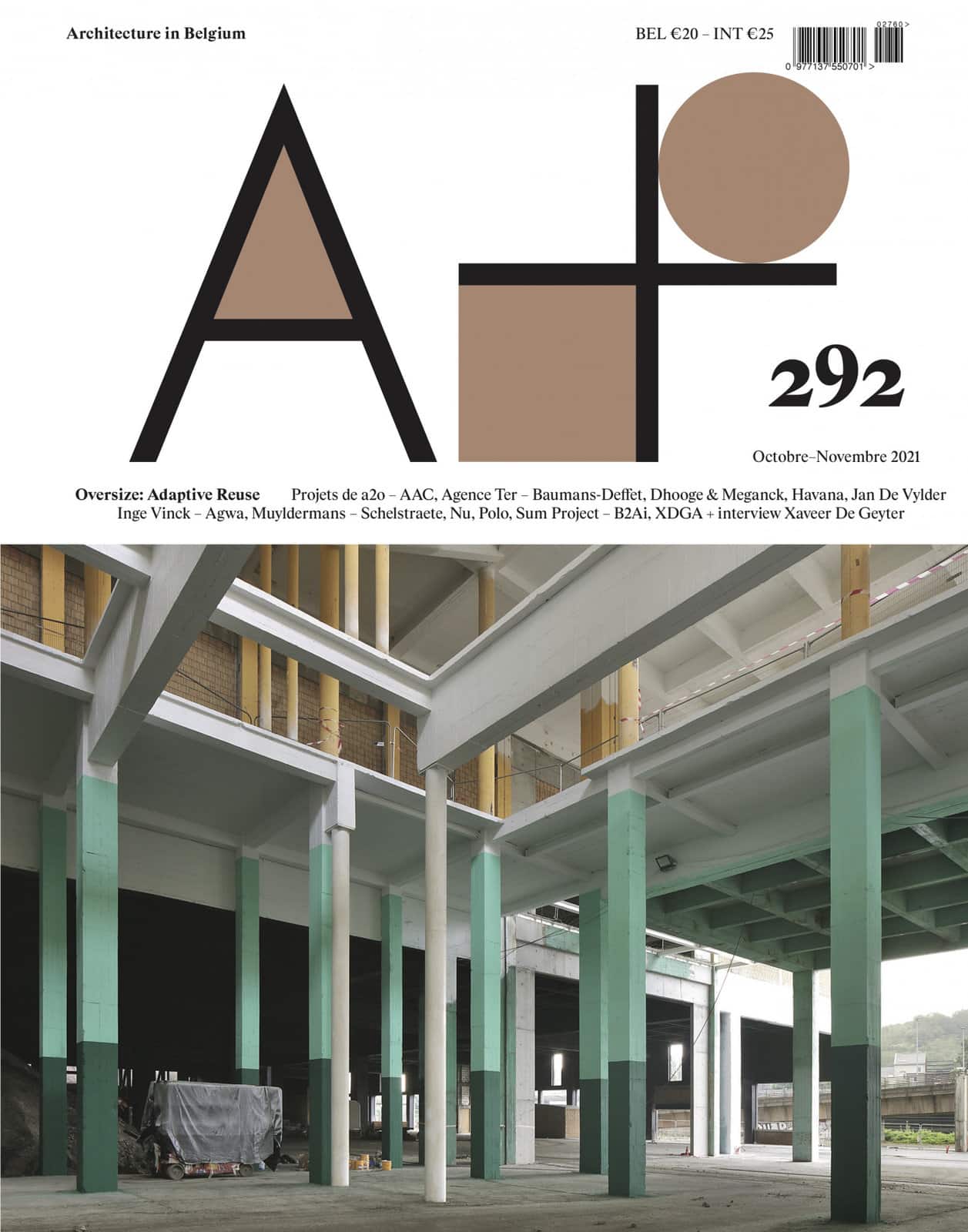
Excess. The word speaks for itself. There is too much of everything! Too much volume, too much space, too much structure—in short, excess reigns supreme.
When buildings are repurposed, there is often a clash between a programme and a space that is never suitable as it is. Ceilings that are too low, staircases in the wrong place, too many windows, or not enough… and in any case, never where we would like them to be! Excess seems to exacerbate the problem. The reuse of very large buildings – former factories, postal sorting centres, exhibition halls, garages – immediately raises economic and ecological questions. Indeed, where can we still find the budget to renovate and adapt thousands of empty cubic metres to current standards? And do we really need to insulate them completely? When it comes to reusing oversized buildings, Benoit Vandenbulcke and Harold Fallon, in the current context of recession and degrowth, see precisely the possibilities of a burning issue: “How can we do more with less? (…) The spatial margin freed up by Oversize invites other forms of space occupation. It is a programmatic opportunity, an invitation to appropriation. The approach adopted by Baumans-Deffet architects for the central workshops in Seraing is a fine example of this. This former site has been transformed into a transport hub, with a car park overlooking a public square and an events hall. Here, the industrial scale has led to greater quality.
Beyond the existing buildings, the new buildings also accommodate a little more space. When we want to build in a sustainable and forward-looking way, when we start from the principle that the building we are constructing today could accommodate a completely different programme in 100 years’ time, we need to allow for spatial margin. And it is mainly in the structure that we find it. The Vlaamse Bouwmeester already emphasised this in his ambition statement and, in collaboration with Bulk Architecten, has dedicated a BWMSTR label to it. ‘The study carried out for the Construct project, making way for change,’ writes Bart Tritsmans, ‘is a plea for the reuse and creation of buildings that stand the test of time, embrace excess and offer flexibility of use.’
The Xaveer De Geyter Architects firm put this approach into practice with the Mobilis project. In this complex of workshops and car showrooms, thanks to the principle of excess, more than a third of the floor space has not been allocated to a specific programme. ‘And yet Mobilis is not a generic structure,’ explains Véronique Patteeuw. “A grid organises the logistics at all levels and translates the excessiveness of the structure into a concept based on four levels of scale, each with a specific lifespan: S, M, L and XL. “In this project, the excess lies not only in the dimensions and potential of the structure, but also in the circulation, techniques, standardisation and regulations.
Excess is a matter of scale, large volumes and precision in detail. Excess is not a pretext for a generic structure, but rather an invitation to create with generosity.
Table of contents
OVERSIZE: ADAPTIVE REUSE
Lisa De Visscher
Jan De Vylder
Straf! KABO, Beringen
Masterplan for the ArcelorMittal sites, Liège
Architects Inge Vinck and Jan De Vylder – Agwa
Palais des Expositions, Charleroi
Filip Dujardin
St-Michel, Sint-Jans-Molenbeek
Mobilis, Brussels
Lisa De Visscher
Maakleerplek, Leuven
OPEN CALL
Repurposing of Strobbe, Izegem
Maarten Van Den Driessche
ACTUA
A+ Talk: Flores & Prats and Kaan
Lisa De Visscher
A+ Lecture: Lütjens Padmanabhan
Gitte Van den Bergh
BWMSTR Label: Construct, space for change
Bart Tritsmans
PROJECTS
Reception buildings for the Botanical Garden, Meise
Laura Muyldermans – Arian Schelstraete
Geraard, Gontrode
Nursery and sheds, Zwijndrecht
Lampernisse Columbarium, Diksmuide
INTERVIEW
Véronique Patteeuw
STUDENT
Atelier Oversize (KU Leuven – ULiège – UCLouvain – ULB, TU Wien)
Benoît Vandenbulcke and Harold Fallon
OPINION
Michiel De Cleene