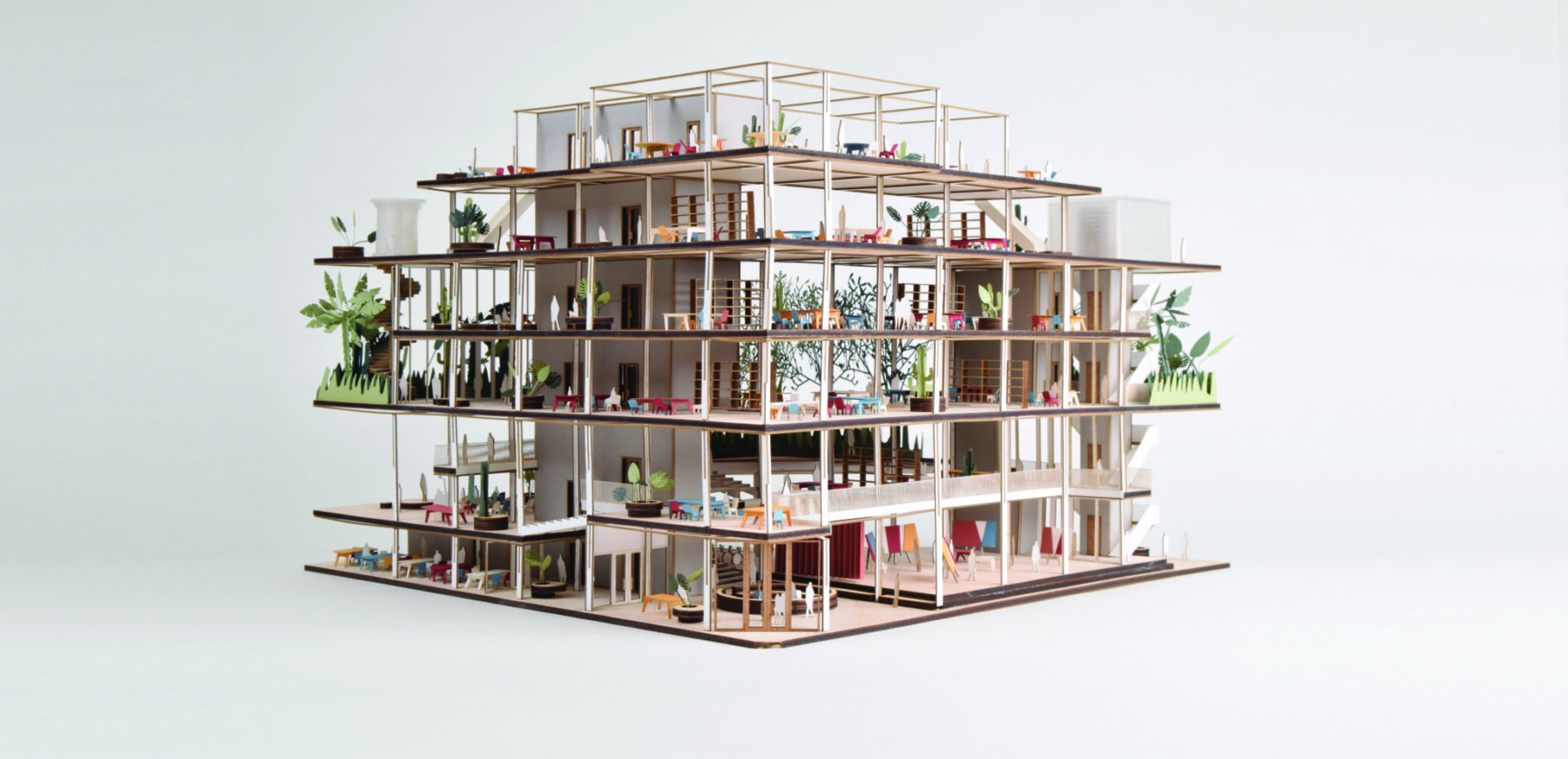
In an interview with Oase in 2011, fifty years after the publication of *De dragers en de mensen*, John Habraken reflected on the relevance today of the distinction between a building’s structural framework and its programme. He argued that people shape their own environment, and that the structural framework must offer flexibility to accommodate changes in use and programme. The temporal dimension introduced by Habraken into architecture is highly relevant in contemporary building culture. One of the key ambitions in the policy document by Flemish Chief Architect Erik Wieërs is the reuse of existing structures and the construction of future-proof buildings, conceived not from a programme but from a structure.
A few years ago, Bulk Architecten were faced with the challenge of designing a building as a flexible carrier during a competition for the Cadix district in Antwerp. They did not win the competition, but they did realise that the wider construction sector is not (yet) adapted to this approach, which led to a curiosity about the history and future possibilities of robust, open buildings. A BWMSTR label from the Flemish Government Architect provided the impetus for the project ‘Construct, space for change’. The research makes a case for the reuse and creation of robust buildings that embrace excess and allow for flexible use. The structures offer a potential answer to the sustainability challenge, which is increasingly being framed by regulations, reports and standards that create an overly restrictive framework for the transition to future-oriented building.