Edito
Lisa De Visscher (A+)
Roeland Dudal (Architecture Workroom Brussels)
Dear David,
You ask me what we architects should do about the unmistakably impending environmental catastrophe. About social inequality. About poverty. About the degradation of this planet’s resources. About the pandemic, which has placed us in an almost surreal mode that begs description.
Dear David, the answer is: nothing.*
Jacques Herzog begins an open letter to David Chipperfield – recently published in *Domus* – with this provocative statement. In it, he defends the rather cynical assumption that architects neither should nor can make any contribution to social change. As pawns of their clients, architects can only adapt their practice to the ‘signs of the times’. Herzog, as a leading figure of the ‘age of the starchitect’, seems to take great delight in this provocative contribution to the debate. The actual impact of his successful architectural practice on society is unlikely to cause him too many headaches.
Architecture with a capital ‘A’ has indeed dominated the aesthetics of the built environment in recent decades, often in the service of a profit-driven economic system, detached from social concerns. Meanwhile, a shift in mindset is noticeable on an international scale. This was evidenced last year by the Oslo Triennial, which focused on ‘Degrowth’, and the Lisbon Triennial, curated by Sébastien Marot. As early as 2016, the Venice Biennale had already highlighted the socio-political dimension of architecture with ‘Reporting from the front’. In each case, the focus was not necessarily on what that architecture looks like, but on its impact and how this was achieved.
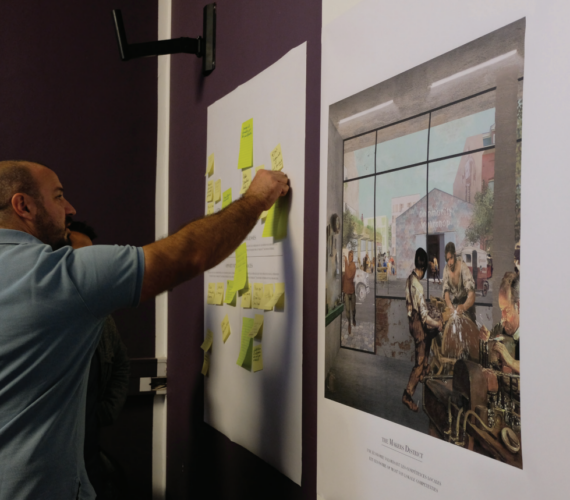
In Belgium, too, we see that architects no longer limit themselves to formulating the most creative and effective possible response to the design brief. An increasing number of designers are involved in devising processes that challenge the brief or actively engage end-users in refining the design brief. Design research and co-creative design show the stakeholders what is possible: environments where living and production are more closely intertwined; healthcare institutions where the patient is at the centre; vacant buildings that breathe new life into a neighbourhood through temporary use; streets that are de-paved to make way for more water and greenery; or urban landscapes where wind turbines and water buffers are given a place.
“Today there is a tremendous opportunity to use spatial design as a lever to accelerate social transitions,” write Hanne Mangelschots and Serafina Van Godtsenhove in the opening article. “That is why we need an architectural practice that drives change rather than one that adapts to change.”
Various practices are taking that step further and integrating change into their own organisations. For instance, in response to the challenges of the circular economy, Rotor DC is, on its own initiative, creating a new role and a new market centred on the dismantling of building elements. RE-ST, drawing on a sharp critique of the inefficient built environment, is developing a practice of ‘not building’. And finally, Miss Miyagi, as an alternative developer, connects unassigned heritage properties with new, cooperative owners who have unconventional ideas.
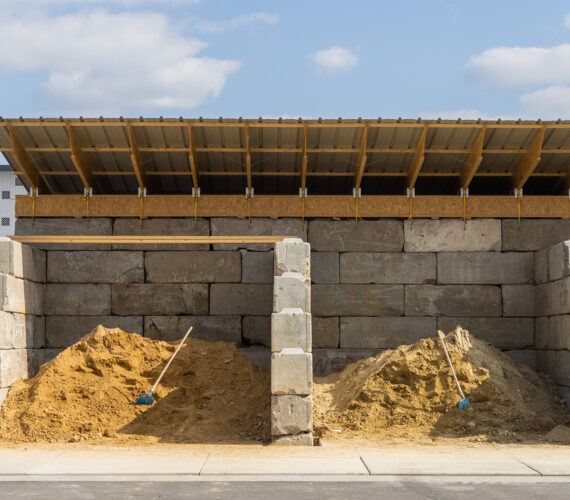
Designers can act as key figures in these processes of social change. This special edition of A+ demonstrates how this can be achieved. In the ‘Tuinen van Stene’ project by Technum-Tractebel and Maat-ontwerpers, for example, 35 hectares of polder landscape on the outskirts of Ostend is protected as agricultural land because it simultaneously functions as a city park. In the energy neighbourhood in Eeklo, Plusoffice demonstrates – as part of the IABR–Atelier Oost-Vlaams Kerngebied – how to tackle the energy issue in a way tailored to the neighbourhood. Zinneke in Brussels and De Schuur by Timelab have been designed around the model of The Commons so that new jobs and skills can emerge. And finally, 51N4E is taking charge of the construction and management of a new ‘living street’ in the Redingenhof through the removal of paving. The practice of change is a call for spatial thinkers and designers not to wait for new commissions, but to help reimagine, shape and provoke them themselves. Is the architectural practice ready for this? The answer is: yes!
* Read the full letter at: https://www.domusweb.it/en/architecture/2020/10/13/jacques-herzog-letter-from-basel.html
Table of contents
EDITO
Lisa De Visscher and Roeland Dudal
SUBJECTS
Building bridges: designing processes for acceleration
Hanne Mangelschots and Serafina Van Godtsenhoven
‘Commons’ to change the city
Nathalie Cobbaut
Rediscovering sustainable commissioning
Michiel Van Balen
New governance strategies for urban design
Sigita Simona Paplauskaite
ROUND-TABLE DISCUSSION
‘We need to set the agenda for what is being built’
Lisa De Visscher
PROJECTS
BC Architects and Studies
Circular and modular production hall, Brussels
ZINNEKE, Brussels
a2o architecten
Timelab, Ghent
NU architectuuratelier
Centers, Antwerp
51N4E – Plant- en Houtgoed
Atelier Oost-Vlaams Kerngebied
Eeklo – Lievegem – Merelbeke
Tractebel – Maat-ontwerpers
Tuinen van Stene, Ostend
Vlaamse Landmaatschappij, Water + Land + Schap
Klein Veldekens, Geel
Dethier Architectures
HOSOMI, Outrewarche
Stéphane Beel – BLAF – DENC!