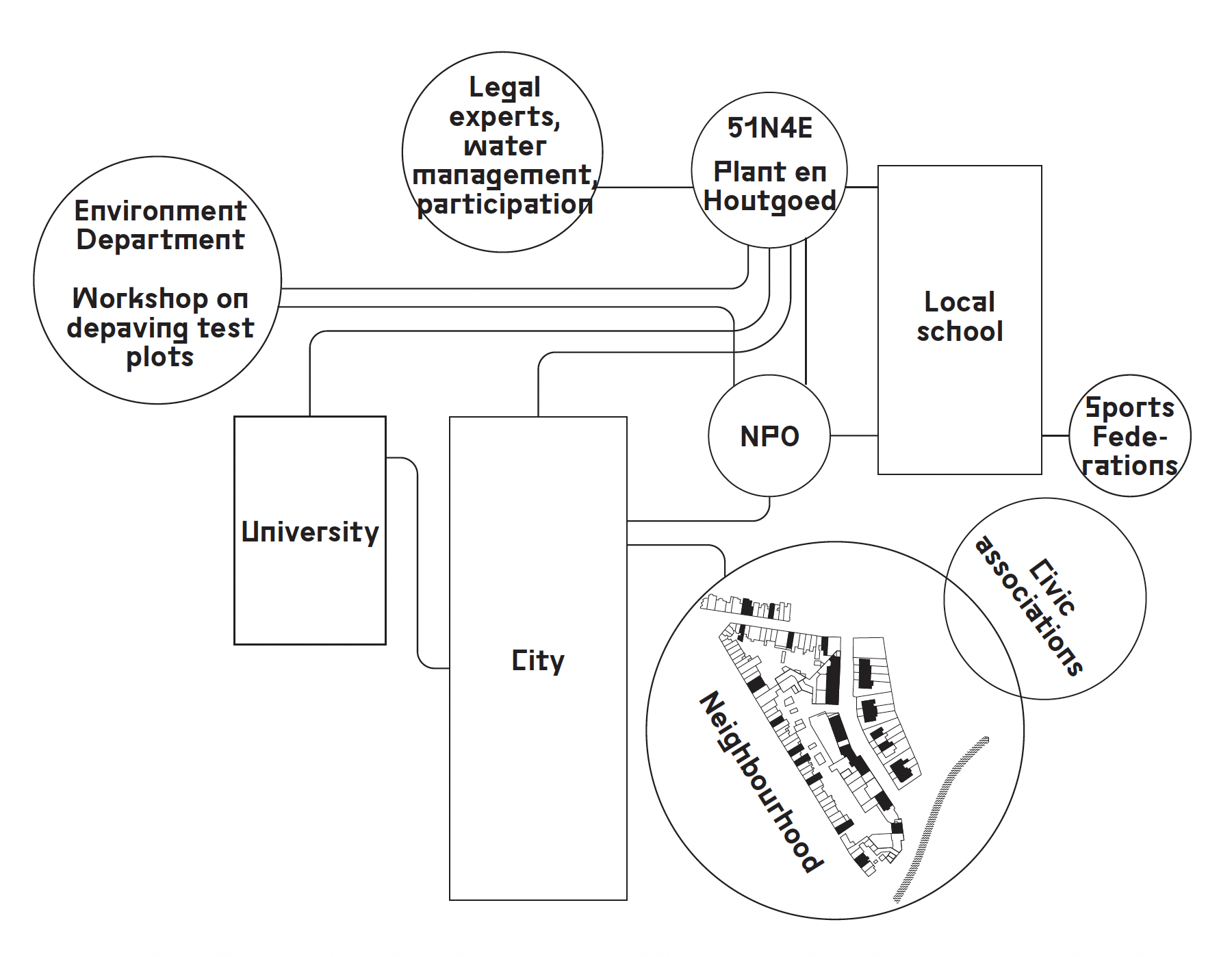
The Redingenhof project encompasses the redevelopment of two streets in a residential area and the adjacent school grounds in Leuven. After a call for projects issued by the Flemish authorities to depave more and to set up test beds, the inhabitants themselves took things into their own hands. Together with the school, the city authorities and the design team made up of 51N4E and Plant en Houtgoed, they are working on the greening of the playground, the catchment of rainwater, and the creation of vegetable gardens –and this, over and beyond private and public plot borders. A test set-up in 2019 showed what the direct impact could be of more greenery and biodiversity, and as such bolstered support for a permanent depaving.
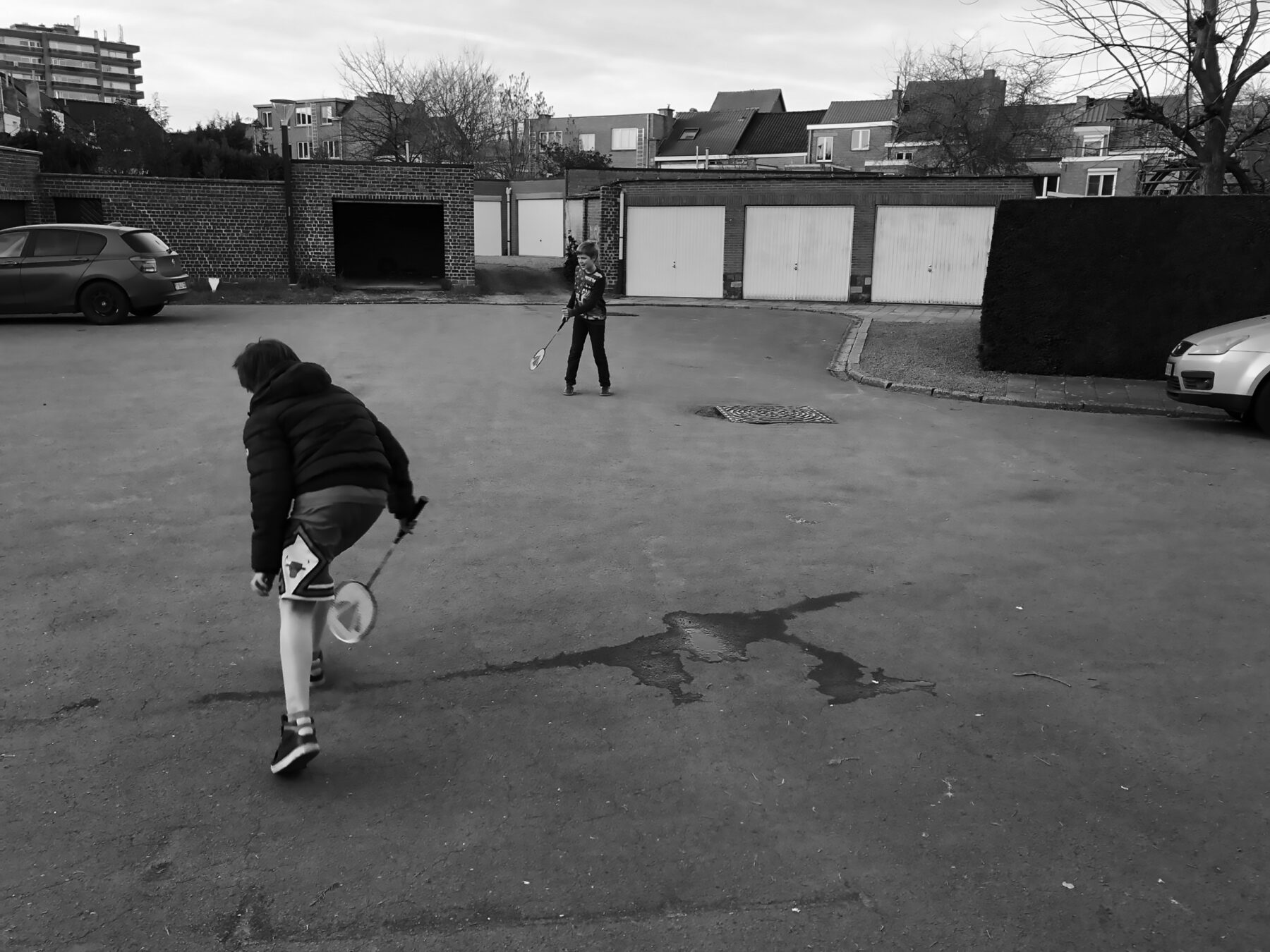
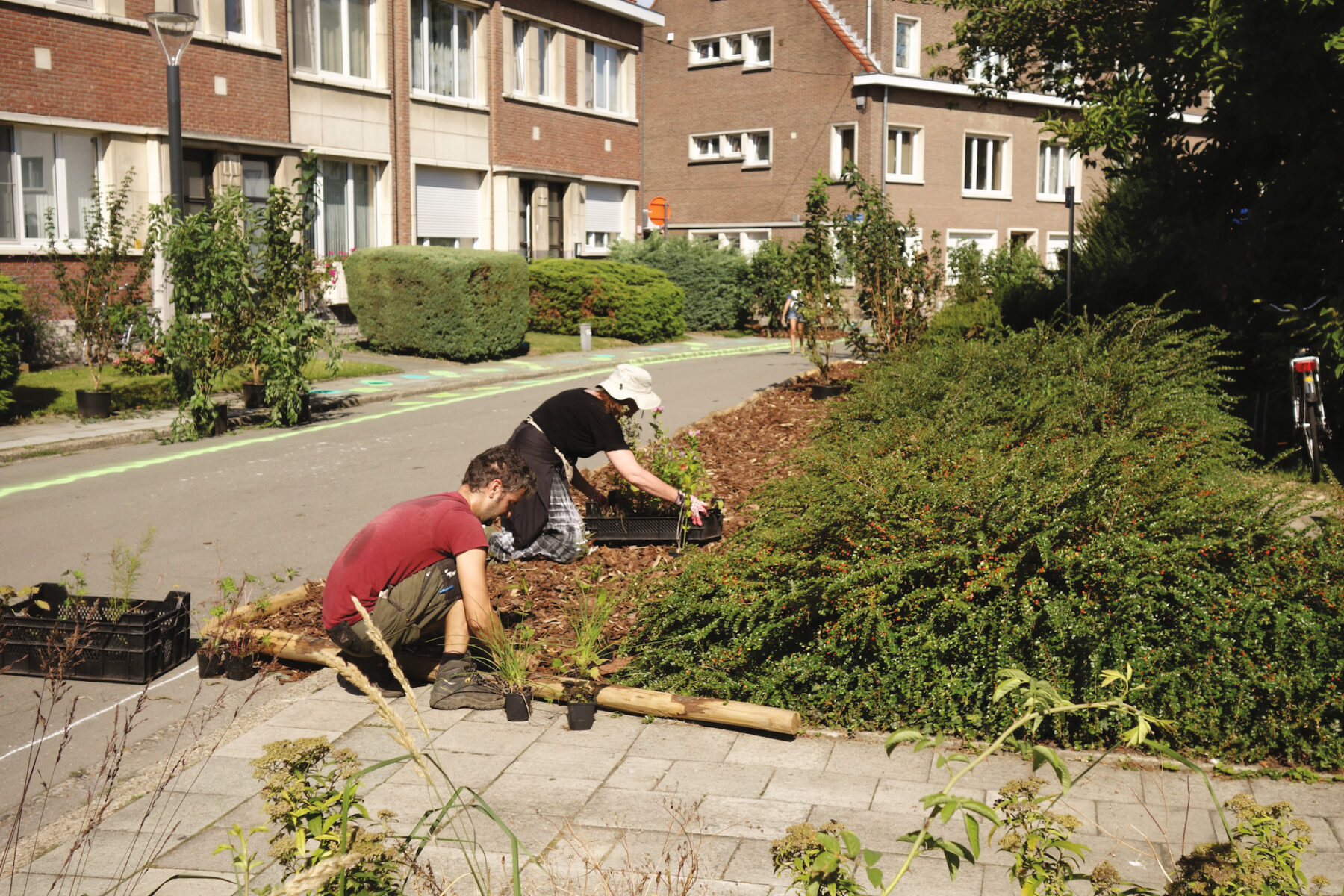
It is eight in the morning, and the first residents of Volmolenstraat are already on site with their tools. The municipality closed off the street as part of the summer’s ‘play streets’ programme. The temperature is already 25°C. The objective today is simple and goes further than the mere reservation of the street for a few hours of play: gathered around the temporary arrangement of the street as a greener zone with more plants, neighbours and passers-by are going to test a layout together for the transformation of the space. One of the key moments for the depaving project of Redingenhof supported by 51n4e and Plant en Houtgoed.
To the south of Leuven, five residents and the school have teamed up to depave the playground and part of the street. They have answered a call for subsidies of the Flemish Region. Volmolenstraat, which serves as the setting for this venture, lends itself well to the exercise. Of asymmetrical design, it includes semi-detached houses with a front yard on one side, and three-storey apartment buildings on the other. On the ground, lots of asphalt. The Redingenhof school campus too is mostly paved. By broadening the frontyards, one can easily create a green swale, at once planted and humid. On an urban scale, the project is connected to the area of the Dijle valley, a system of open and permeable spaces, from Arenberg to the garden of the Grote Begijnhof and the Dijle Park.
The Redingenhof project is part of the Ontharding (Depaving) programme launched by the Environment Department of the Flemish authorities. This experimental programme is developing several test set-ups in parallel, grouped in three typologies: the quick-wins (which can be carried out immediately), the systemic projects (which seek to tie depaving to other issues), and the coalition-based projects (which seek to gather and organize actors around depaving). Open to the whole of civil society and not only to professionals, these test set-ups have been developed over a period of three years and monitored by a quality chamber. The number of initiatives and contexts seeks to generate a field of knowledge whose definitive outlines are not yet known and should eventually lead to a policy that seeks to reproduce and increase the number of these operations. Underlying the depaving slogan are more systemic and cross-cutting themes on the management of our urban environments in an altered future climate context (biodiversity, water management, etc.).
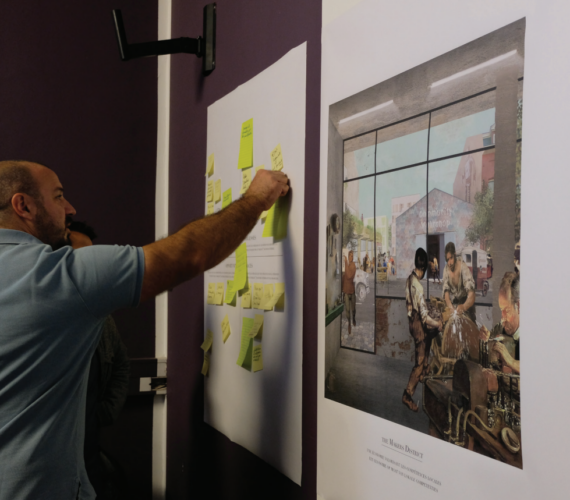
Redigenhof is a coalition-based project. Coalitions, alliances and agendas are words we have heard before, and they sometimes seem to belong to the jargon of certain urban-planning practices. And yet the objective in Redingenhof really is to bring the interested parties together, to understand who is ready to accept and build a depaved public space project, and lastly to organize these alliances. Based on the demand of the residents’ collective, the offices 51N4E and Plant en Houtgoed then outline these operations: a method consisting of on-site collaborative actions intended to stimulate the bonds between the public and private actors and to test transformation hypotheses. The actions are of a varied nature: a core sampling to sound out the nature of the ground, the trial layout of the plants on the occasion of the summer ‘play streets’, the construction of a mock-up of the swale on site, etc. Throughout the process, the school served as a home base for the meetings. In the long term, citizens, city and experts aim to carry out the actual ‘depaving’ of part of the street and the school.
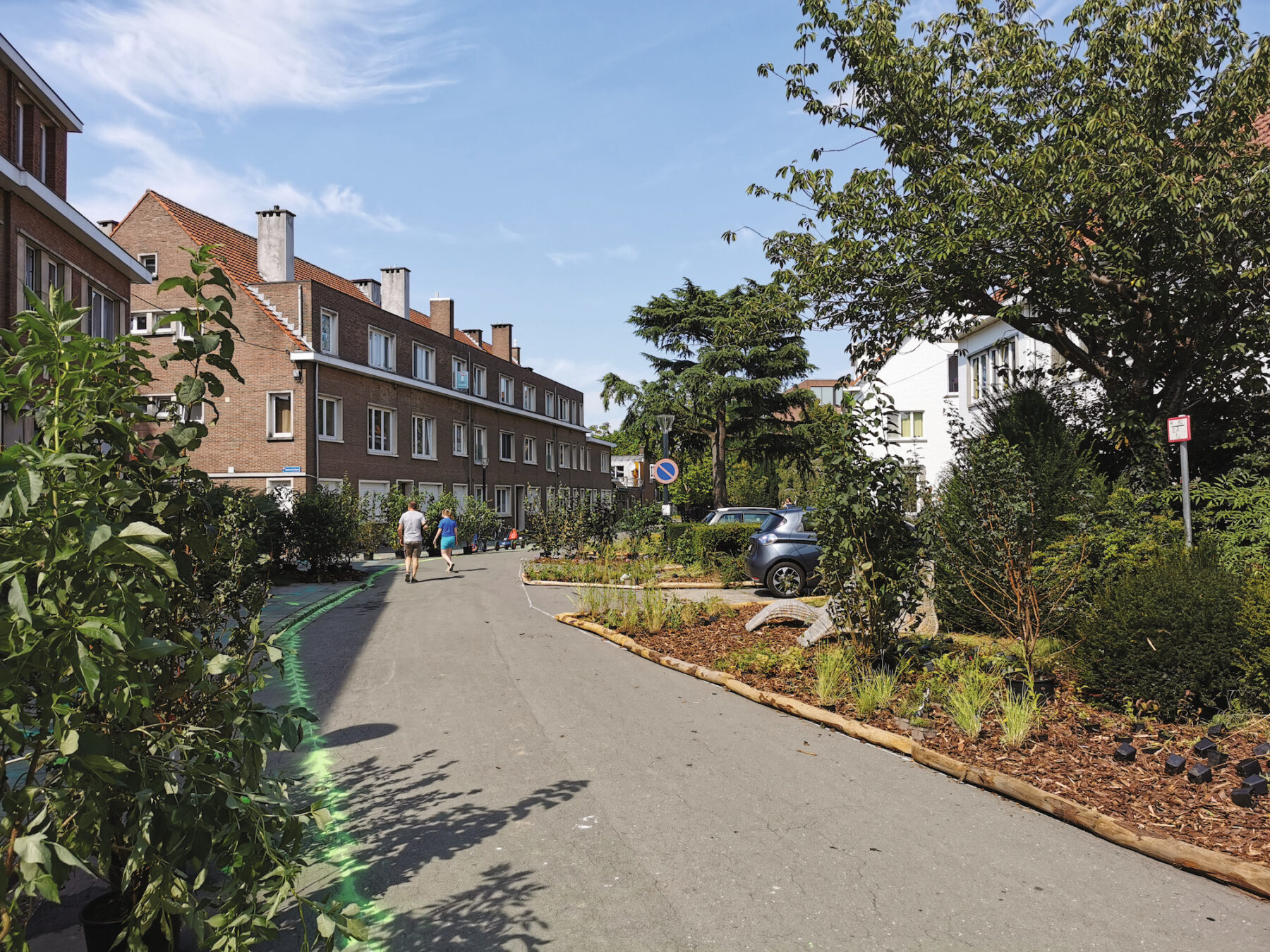
The question that emerges within the coalitions for the town-planning architects is that of their expertise and its transmission. The architect becomes a translator, makes his or her expertise available and understandable to the community. An educational task, rather than a management task, as it is sometimes caricatured. As when, during a botanic workshop when Plant en Houtgoed provided information on the types of plants that make up the high prairie with which the landscape of the future swale would be built. The aim: to discuss whether management can be ensured and who will be in charge. The aim is not to make the expertise vanish, but to ensure it lands in good hands through these actions. The process governing all this is dynamic and results in an ongoing role play, where each party’s responsibilities are interchangeable for a while– the time it takes to understand them and pass them on. One can imagine that in time, this fluctuation in terms of the roles will eventually stabilize. Like a river that erodes the land as it moves, but does not end where it is expected.
This ambiguity is undoubtedly both the strength and weakness of the project. It is above all a major public programme that supports the initiative of a citizen committee assisted by architects and landscapists. Critics sometimes warn of a disengagement of the public authorities in this type of reclaiming process and a lack of collective legitimacy for a group of citizens who decisively take control of the destiny of an ordinary street. Yet, while the city of Leuven seems to have been rather timid at the launch of the initiative, it appears that on the contrary, the experience has enabled it to reposition itself in the vast organization chart for the transformation and management of this space. So, bottom-up or top-down? It’s a fine line, and one may wonder how ‘poaching’ can still fit in this ultimately rather institutional process.
In short, the aim of the game, played here with great panache, is to write a script that leaves enough room to improvise and for novelties to blend in smoothly. Like that resident who initially opposed the project but who, when the layout of the depaved zones was tied to the issue of water infiltration and the measuring of the sheet level of the nearby Dijle, got caught up in the game as the ‘official measurer’ of the piezometer. It is both a strength and weakness of the process to rely too much on chance findings to demonstrate its legitimacy. But this is also the room for manoeuvre necessary to build an open project culture by which to tackle change and transition.
Architect 51N4E in collaboration with Plant en Houtgoed
Website 51n4e.com / plantenhoutgoed.be
Official project name Ontharding Redingenhof
Location Leuven, Belgium
Programme Depaving of public space: two streets and a nearby school campus
Involvement architect Stakeholder and process management, coalition-building
Client Samenwerking Ontharding Redingenhof vzw
Partners City of Leuven; Atheneum Redingenhof; local residents; 51N4E; Plant en Houtgoed
Total floor area 1,200 m²
Completion 2021