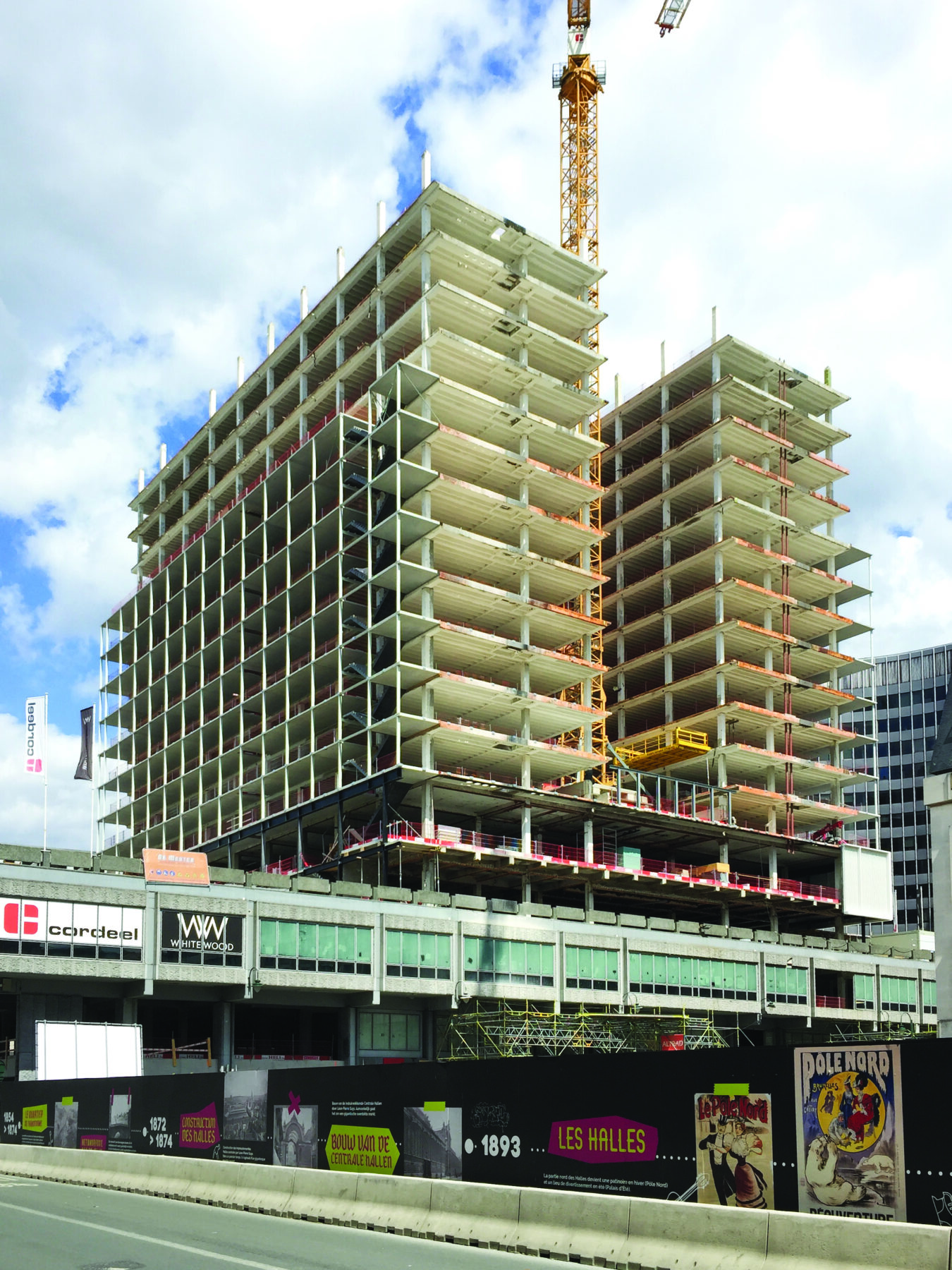
The massive office tower on De Brouckèreplein in Brussels is being renovated. This in itself is quite remarkable already, because the 1960s building had the bad reputation of being a ‘boil’ which one would prefer to cut out from the fine-meshed fabric of the historic city centre. And yet the tower is going to be kept and transformed by CONIXRDBM Architects into a building that is more open to the city. The architects and the project developer have involved Rotor Deconstruction in the renovation. This shows that the reuse of building elements and the idea of a circular economy on a large scale are gradually penetrating the mainstream real-estate market.
The former Philips tower on De Brouckèreplein in the heart of Brussels was a product of another age. The closed, dark, monofunctional office tower dating from 1969 took little account of the surrounding neighbourhood. The modernist planners of the time assumed that more towers would follow along an urban motorway – Boulevard Anspach – running from north to south. But the Philips tower proved to be an isolated remnant of this radical plan and came to symbolize the destructive building policy of the 1960s and 1970s. The black colossus, with a car park on the ground floor and a pedestrian passage on the roof of the base of the tower, contrasted sharply with the surrounding buildings and became a thorn in the side of the city’s residents. People argued forcefully for it to be torn down.1 1 ‘Brouckère Tower niet afbreken maar heruitvinden’, Bruzz, 17 March 2017