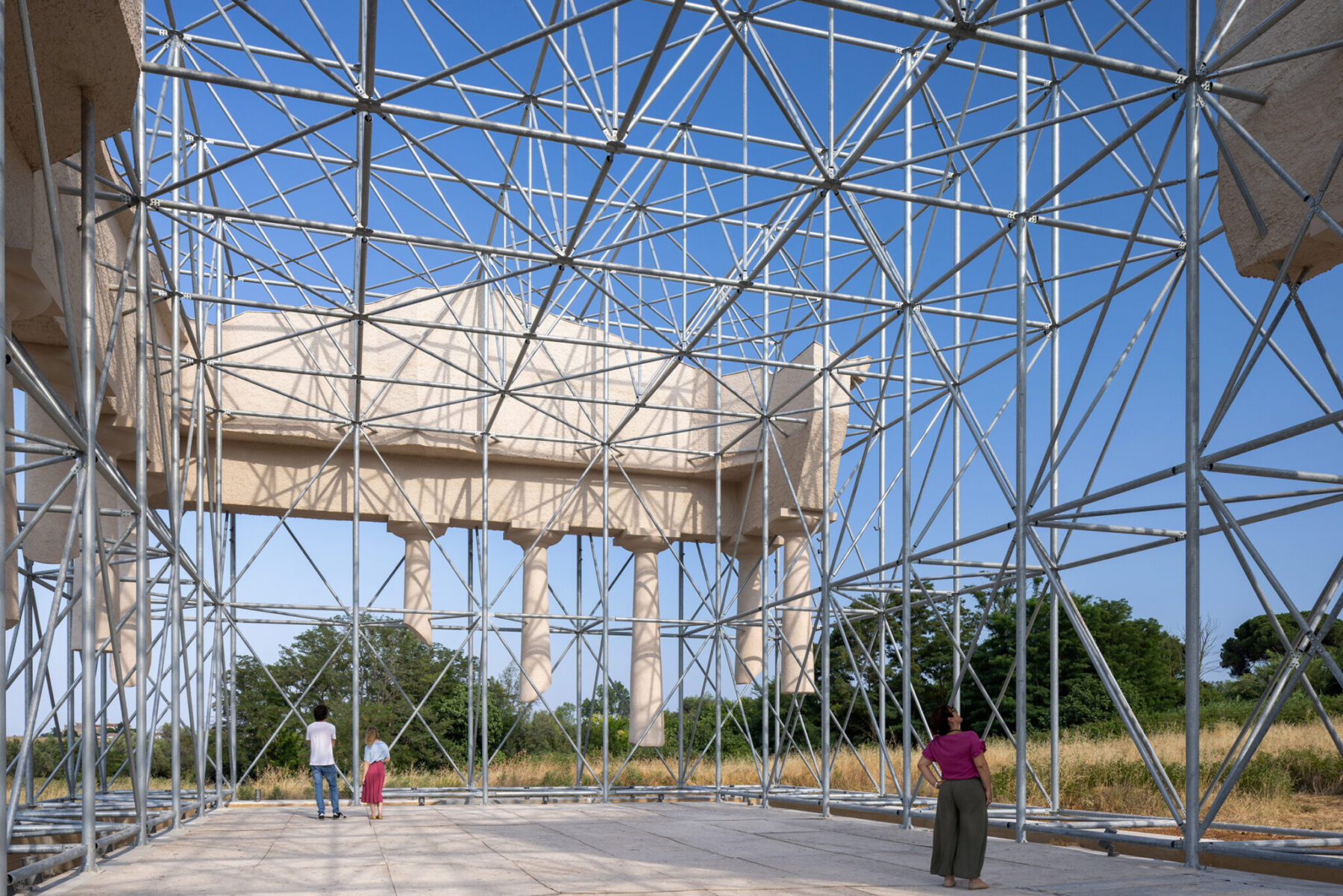
The Inverse Ruin by Gijs Van Vaerenbergh brings the Temple of Dionysus at the archaeological site of Herakleia in Policoro, Italy, back to life. Not in its literal form, but as an artistic interpretation.
There are countless archaeological sites scattered across the Mediterranean region. Faced with this abundance, archaeological museums are each devising their own strategies to keep their sites appealing. The site of Herakleia, an ancient Greek city in southern Italy dating from the fifth century BC, is being redefined through the Siris series of artistic projects, curated by the interdisciplinary laboratory StudioStudioStudio. Along a new route through the park, artistic interventions tell the stories where material remains fall short.
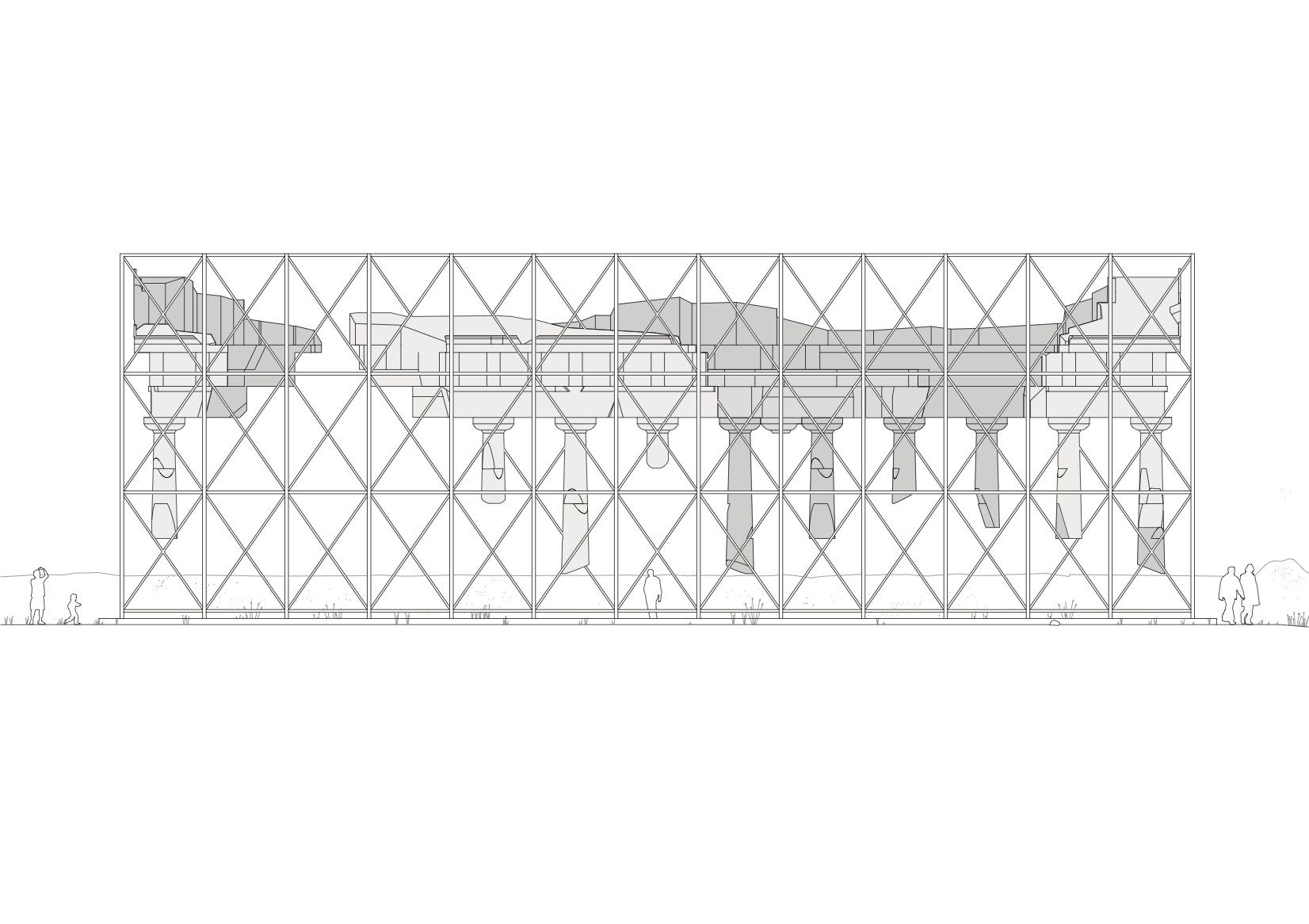
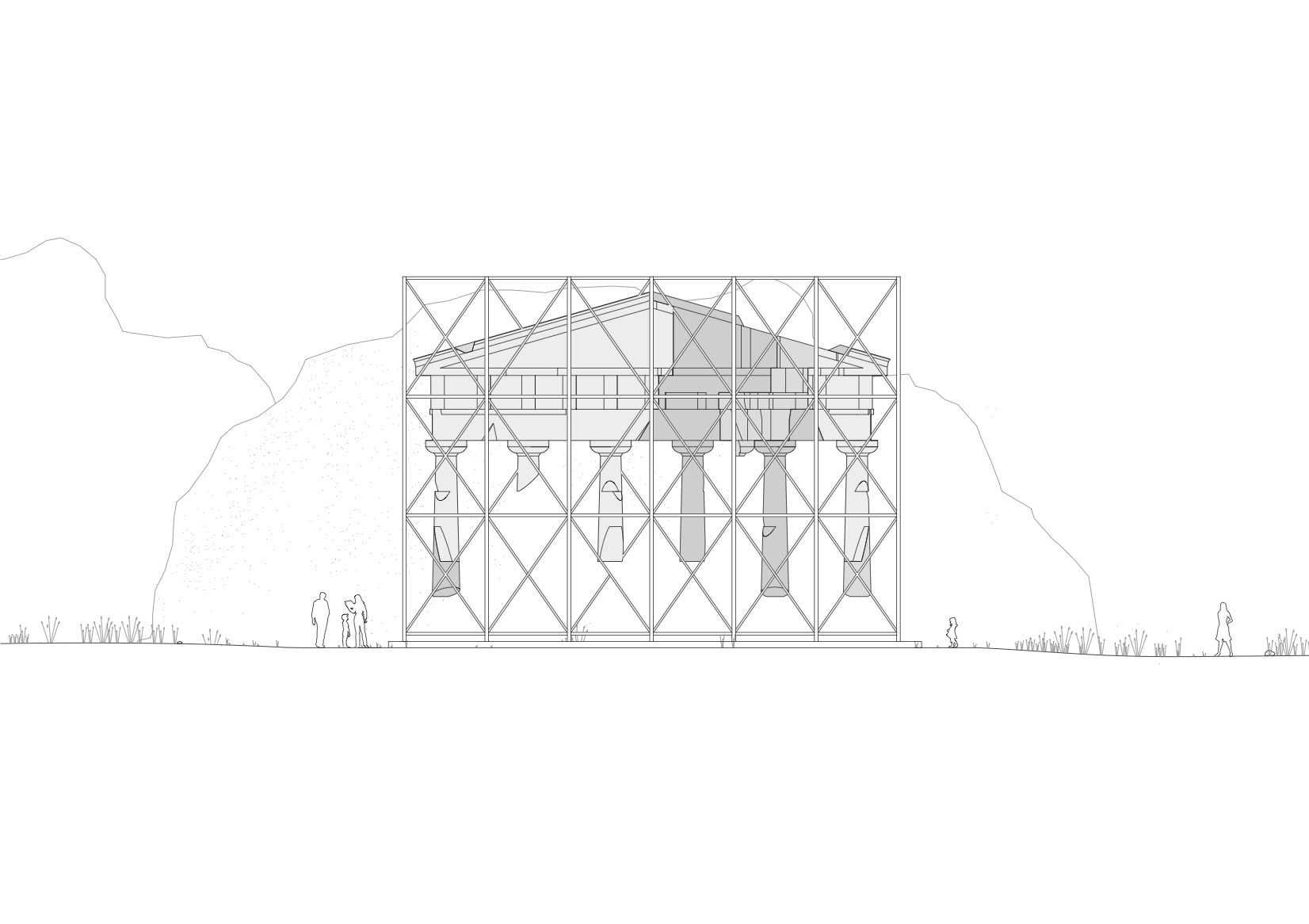
On the horizon looms the silhouette of a Greek temple. As you draw nearer, the image starts to disintegrate. The silhouette turns out to be fragmented and incomplete. It is merely a collection of massive volumes that reveal the contours. The form is trapped within a three-dimensional grid, as if the temple were undergoing restoration. But there is more to it than that. The laws of gravity do not seem to apply here. Unlike a classical ruin, where the structure has been eroded over time from the top down, the temple appears to have crumbled from the bottom up.
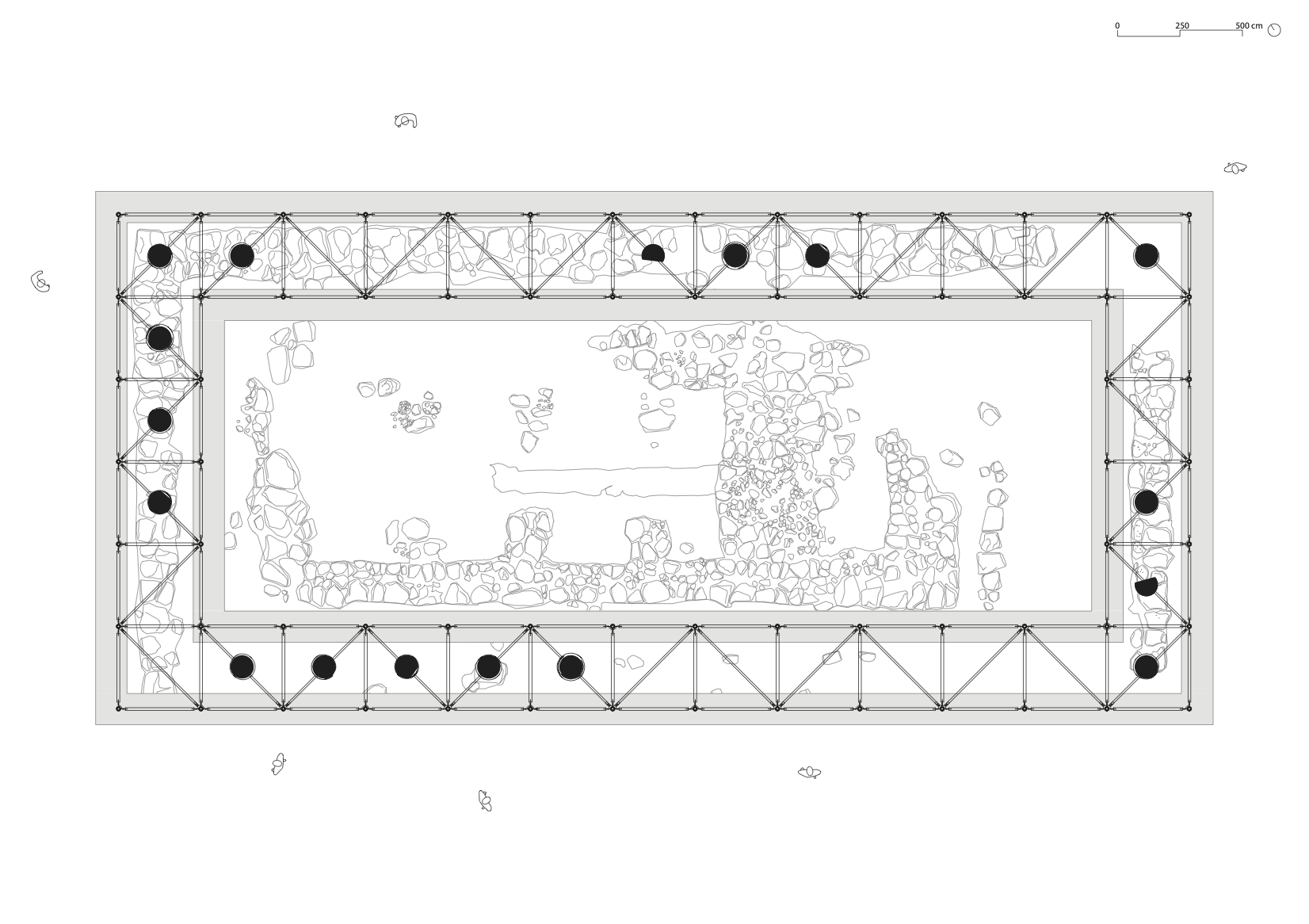
With Rovina Inversa, the Belgian architectural duo Gijs Van Vaerenbergh dramatically reverses the natural process of decay. The original Doric temple, which formed part of the Acropolis of Heraclea, has been reduced to its foundations by the passage of time. Precisely above these remains, its majestic silhouette rises once again. The installation makes the imposing scale of the vanished structure tangible again. Stripped of detail and ornamentation, the temple appears as a contemporary abstraction. The homogeneous volumes appeal to the collective memory and evoke the archetypal Greek temple. Fragments of the pediment, the cornice and the mouldings have been reduced to raw, sculptural forms.
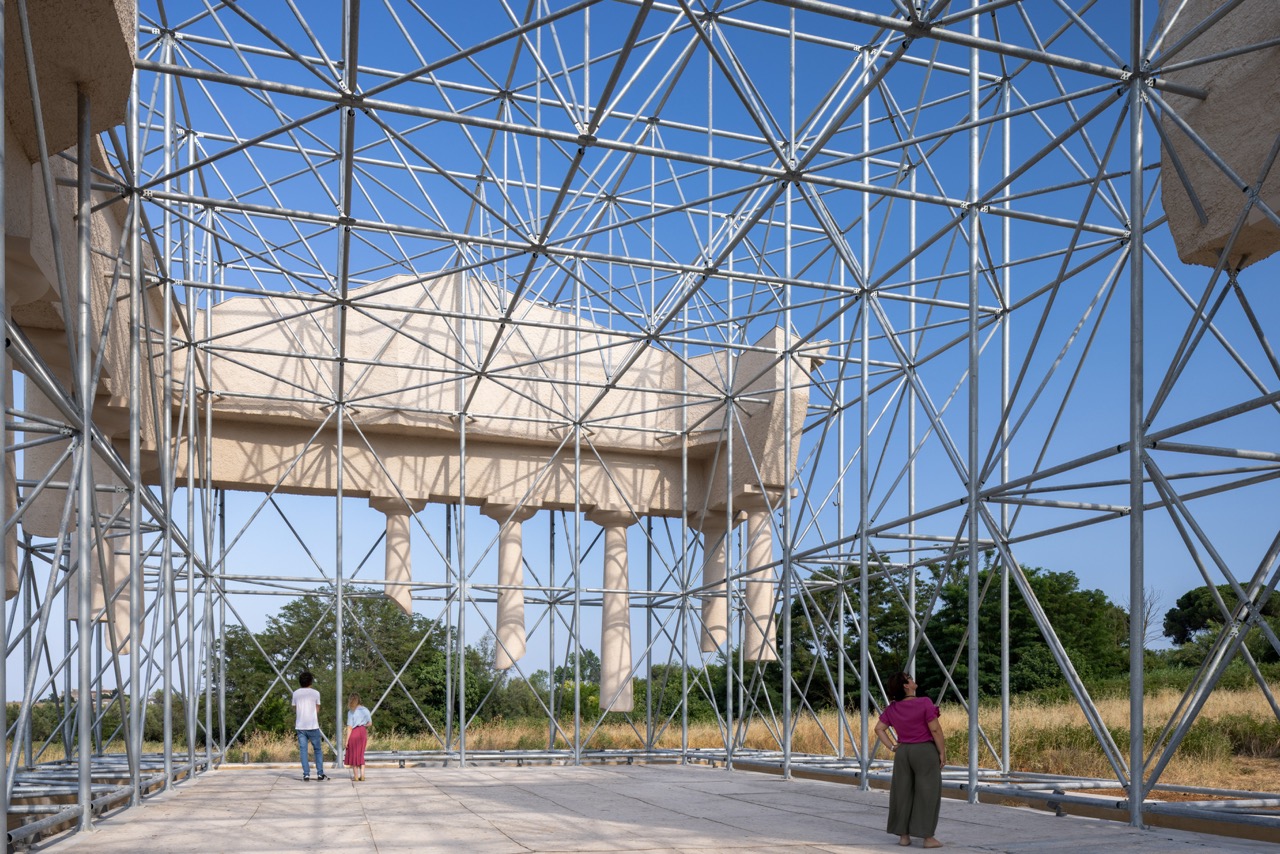
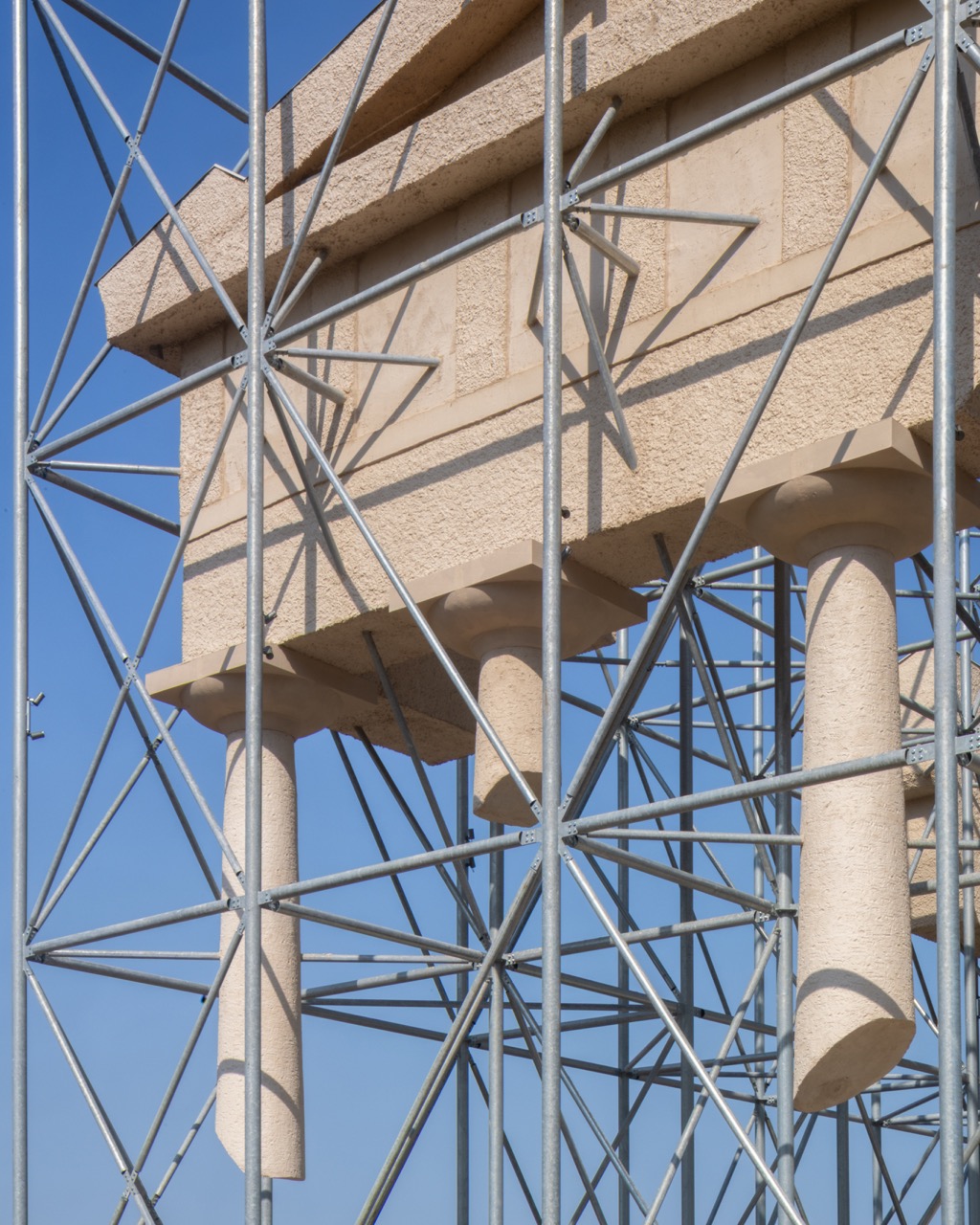
Up close, the true nature of the seemingly solid material becomes apparent. Aluminium honeycomb panels, suspended within the twelve-metre-high frame, are coated with a layer of sprayed lime mortar that matches the colour and texture of the original temple, yet reduces the elements to uniform volumes. The steel truss distributes the weight across a foundation beam running alongside the archaeological remains. The construction method makes the permanent installation reversible, thereby ensuring that the material integrity of the archaeological site is respected.
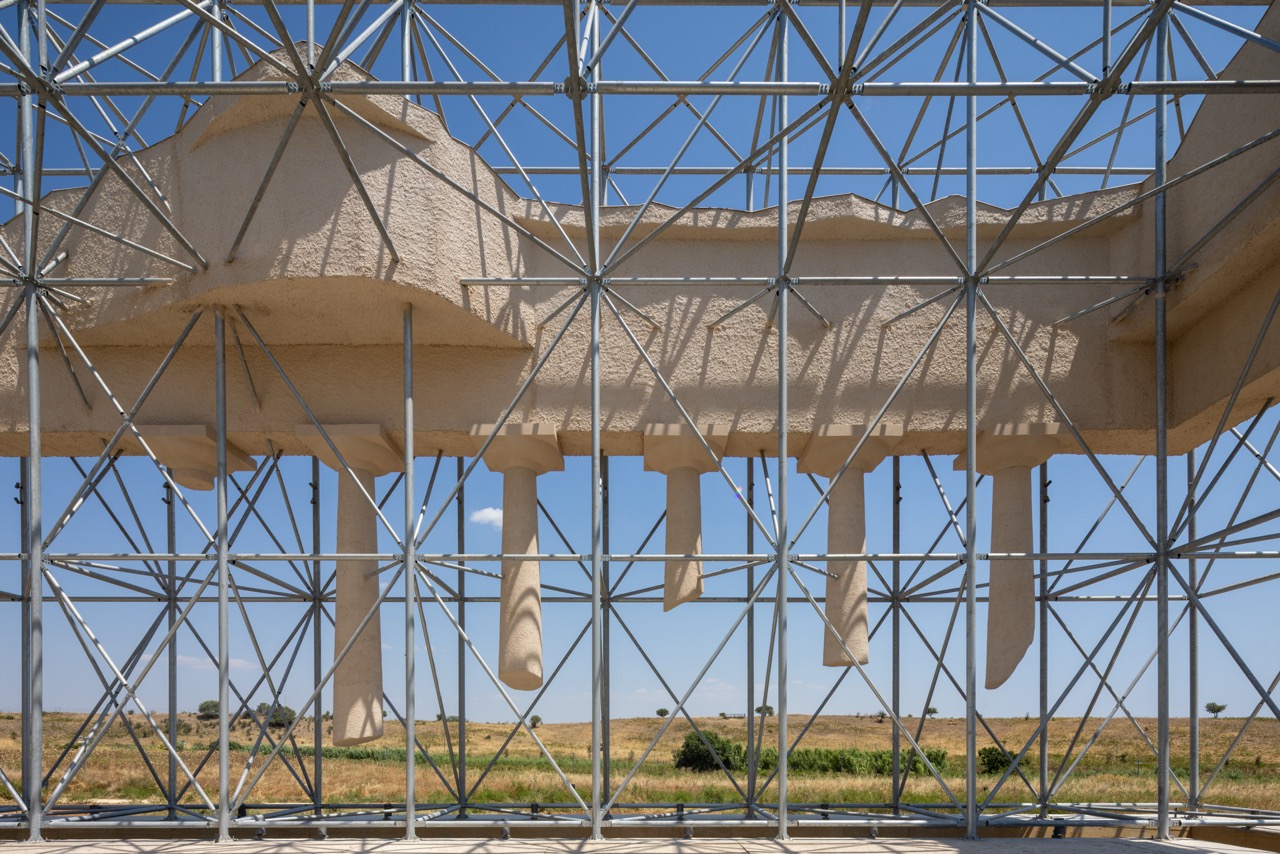
This impressive sculpture is more than just a nostalgic work of art; it is a critical tool that questions the natural decay of ruins. Its potential as a contemporary monument lies in this theatrical inversion. It embodies the monumentality of the past but translates this, through a contemporary awareness, into an installation situated at the intersection of art, architecture and archaeology.
Architect Gijs Van Vaerenbergh
Website gijsvanvaerenbergh.com
Project name Inverse Ruin
Location Policoroa (IT)
Programme Permanent artistic intervention
Procedure Direct commission
Client Museo Archeologico Nazionale della Siritide Herakleia Archaeological Park
Curator StudioStudioStudio
Structural engineering Michele Masciavé
Completion November 2025
Total floor area 612 m2
Budget N/a