The street is not gender-neutral. Urban thinkers, architects and urban planners have shown that the public space is designed by and for men: its uses, its dimensions, its mobility, its opening hours. To consider the street through the prism of gender, we must understand this reality and combat the resulting spatial inequalities by drawing on the lived experiences of the city’s female residents and female users of the street, their daily lives, their needs and their desires
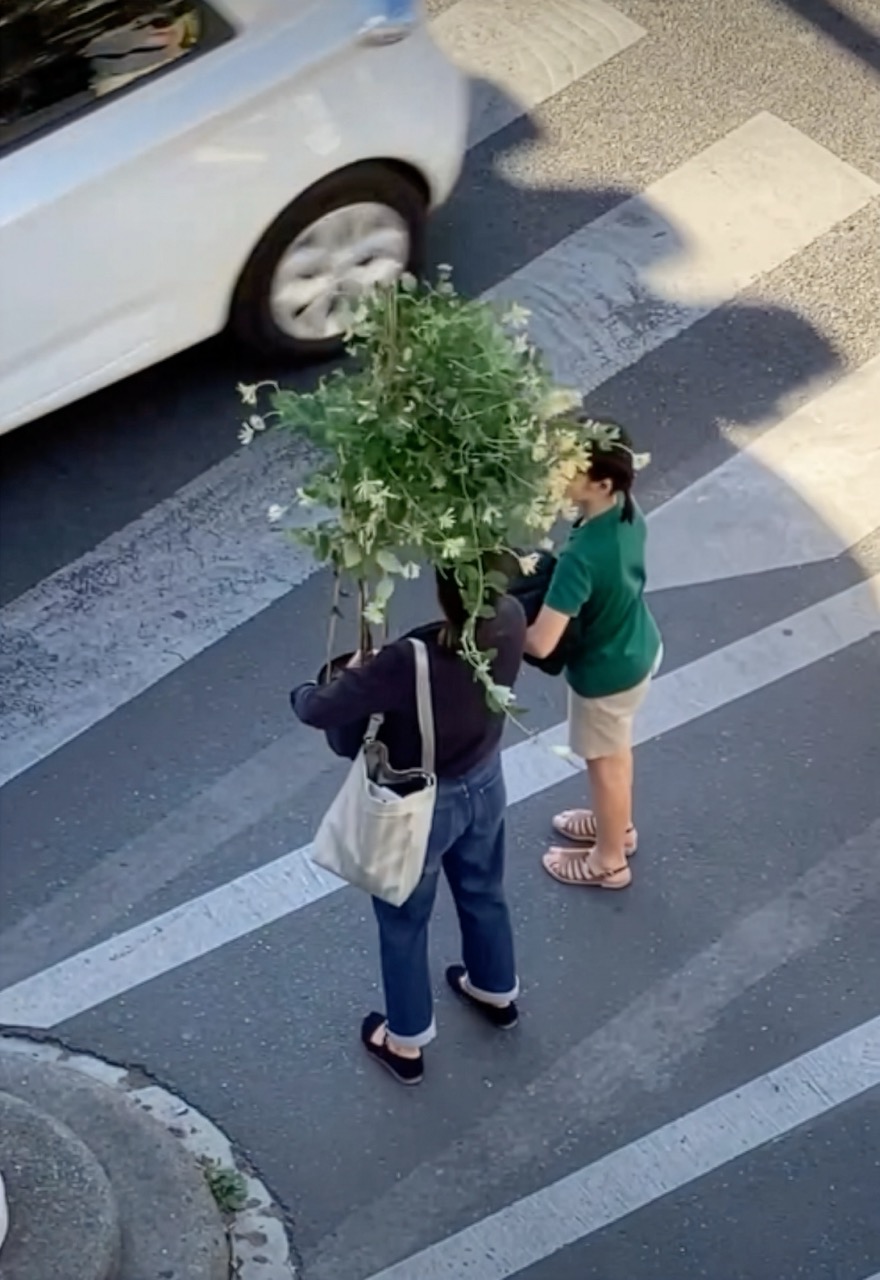
Today, a third of the people using our streets have reduced mobility.(source). You may have already seen the series of Instagram videos entitled ‘Women holding things’1 1 see : Maira Kalman, Women Holding Things, Harper, 2022
in which we see women pushing a pram, pulling a shopping trolley, carrying shopping bags and groceries, cradling a baby, holding a child’s hand, accompanying an elderly person, or someone injured, disabled or in need of help getting around, transporting a bulky object or a piece of furniture, delivering a bouquet or meal, walking a dog, etc. These are all daily services and responsibilities linked to care that women – and particularly racialized women – tirelessly perform to keep the world running. Yet the street follows only the imperatives of productive labour. Reproductive activities remain overlooked in the design of the city and, like women, continue to be relegated to private spaces.
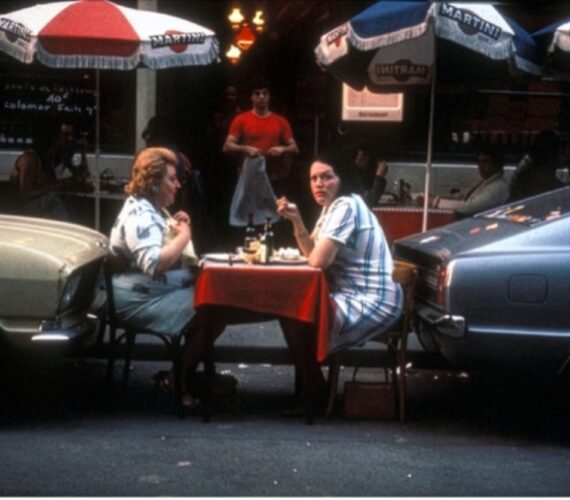
Another striking observation in big cities: women and gendered individuals do not loiter or spend time in the public space. This is known as the ‘corridor city’ phenomenon. This absence can be explained by various factors: a lack of time – the notorious double shift of productive and reproductive work, resulting from an unequal gendered distribution of domestic and household work; the absence of spaces and uses conceived by women and for women – gender is a blind spot in urban planning; or disrespectful, or even violent, behaviour towards them. These conditions generate feelings of illegitimacy and insecurity and lead to strategies for avoiding and going around certain places and streets when crossing the city.
Beyond these feelings, the street is a place of sexist and sexual violence, at once physical, verbal, socio-economic and symbolic. This is not an opinion; these are damning figures 2 : in Belgium, 97 per cent of women under the age of 34 have already been harassed on the street (source). 2 On 5 February 2026, Bart Schols and Soundos El Ahmadi took part in a debate on the programme De afspraak (VRT). The discussion centred on women’s safety. While presenter Bart Schols questioned whether the problem was really that serious, Soundos El Ahmadi was vehement and engaged in the debate with him. ‘We’re not safe anywhere. This is not an opinion. These are damning figures’, she said.
This sad reality continues to shape and limit physical and mental access to the city.
The few measures put in place by the public authorities to combat gender-based violence on the streets have unfortunately produced few effective and systemic changes, and sometimes have even had the opposite effect to that originally intended. In this regard, surveillance measures and their intensification in the public space have proven to be ineffective: the police and CCTV cameras don’t change social reality. They fail to enhance security – CCTV helps to solve around 1 per cent of investigations (source) – and, on the contrary, exacerbate the unpleasant sensation of bodily control already experienced by gendered and minoritized people on the streets.
Surveillance reveals its limitations and organizational logic: the prefix ‘sur-’, from the Latin super, meaning ‘above’, refers to the excess of monitoring and the dominant position of those looking down from above. Going against this vision that focuses more on law and order than on actual security, the notion of ‘lateral surveillance’ or coveillance – ‘co-’, from the Latin cum, meaning ‘with’, ‘together’ – points to a fair balance. More than just a concept, lateral surveillance proves to be a decisive tool for bringing about a project. It involves thinking of architecture and urbanization as supports for connections, bolsters for communities and vectors of the social gaze. Fear is minimized; vigilance is shared, collective and benevolent; and the gaze is horizontal. We want to be free on the street, not brave. Free to come and go, spend time, be alive, be on the street.
On the other hand, certain policy measures, in turn, generate their own share of violence by forming part of barely concealed processes of stigmatization and exclusion targeting specific groups: homeless people, people struggling with addiction, racialized people, those in precarious circumstances, migrants and refugees, etc. This brutality takes direct material shape in brickwork: there is no end to the ‘anti-homeless’ street furniture that prevents people from settling in the public space. We must stand firm against this design of inhospitability and foster optimism: this is where the egalitarian, feminist city finds its raison d’être. What paths, then, are we to take in order to design a gender-sensitive street?
The abolition of gender inequalities – spatially, but not only so – calls for a profound change in the way we live together. This necessary shift in attitudes and in our societies must reconcile strategic imperatives – keeping sight of the desirable horizon we set ourselves: a city built on equality, justice and dignity – and practical needs – taking account of material realities: the outcomes of gender-differentiated socialization. The combination of these two approaches is the cornerstone for radically transforming our planning and development tools, whether in terms of symbols or infrastructure, people or brickwork, our imagination or our everyday strategies.
To achieve this, urban planning through the prism of gender draws on the feelings, habits and subjective experiences of women, as users and residents. This is what exploratory walks – a valuable participatory diagnostic tool – offer. Initiated in Toronto in the late 1980s, these sensory explorations make it possible to assess public space and its design from a gender perspective. The female participants walk and analyse the streets according to various criteria that directly engage the senses: seeing / being seen, hearing / being heard, knowing where one is / knowing where one is going, being able to escape and get help, living in a clean and welcoming environment, acting together.
Yet it is precisely architects and urban planners who compose this sensory and haptic score of the city and who are best placed to respond to these participatory diagnostics by translating them architecturally into visual connections, unobstructed views, acoustic and olfactory well-being, landmarks, signage, symbolic presence, art and public monuments, a sense of community, a sense of ownership, the width of pavements, the variety of routes, lighting, mixed uses, the tactile quality of materials, the comfort and inclusivity of street furniture, public toilets and other public facilities, the freedom for people to move about, etc. The task is at once colossal and undeniably necessary.
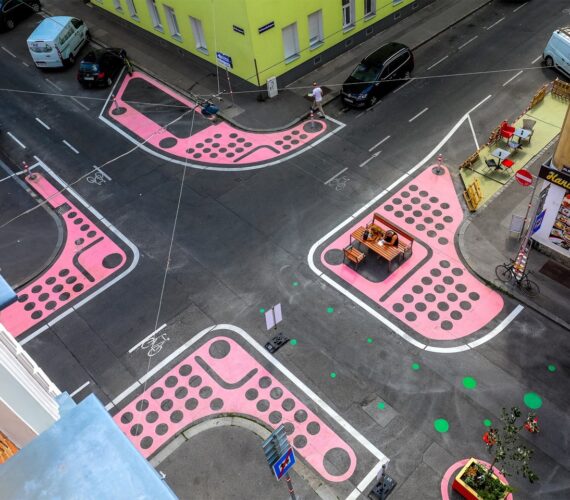
Finally, the consideration of gender in the city goes beyond the scale of the street and opens up new perspectives, underpinned by sound theories and tested by operational practices. It invites us to reconsider our uses, our temporalities, our roles, our structures and our spaces. To move beyond the male-female binary and challenge gender, we must blur and break down the distinction between public and private spaces. The street and its liminal space, the threshold, are the cornerstones of these gendered and spatial reconfigurations, ambiguities and negotiations. Thinking of the street as an extension of the home would undoubtedly help to erase gender boundaries and the inequalities that stem from them. This pressing porosity sits ill with the proliferation of windowless ground floors and the increasing distancing of public space in favour of the interiors of building blocks. In contrast to this withdrawal into oneself and this secession to the detriment of the street, linking public and private spaces within a single continuum could strengthen lateral surveillance, a sense of security and, by extension, a spirit of solidarity.
When feminist activists chant ‘Who owns the street? We own the street!’ as they take to the streets, they remind us of the essential: the street is a right, a common good, a space for social struggles and victories. It was first and foremost through and on the streets that women claimed the right to vote, financial independence, access to education and the right to control their own bodies. The threats currently hanging over these social gains show just how urgent it is to reclaim this eminently political space that is the street.