This year, [2016], the team led by Samyn and Partners is completing the new building for the Council of the EU on Rue de la Loi in Brussels. EUROPA holds up a mirror to today’s divided Europe, whether we like it or not.
EUROPA will host the European summits where heads of state and/or government leaders from the 28 Member States of the European Union come together. It will also be the new seat of the Council of the European Union, the key forum for government representatives from the various Member States. In other words: EUROPA plays in the same league as the Kremlin and the White House.
Symbolism
A structure of this kind cannot escape rhetoric and symbolism. The Kremlin and the White House have burned themselves into everyone’s memory with their iconic imagery. The complexity of the European institutions has not, until now, yielded any striking architecture. Except for the Berlaymont building, seat of the European Commission, which, with its distinctive cross-shape and sweeping wings, forms something of the architectural face of Europe.
With EUROPA, Samyn and Partners now offer the world a few fitting metaphors for the self-inventing European political construct.
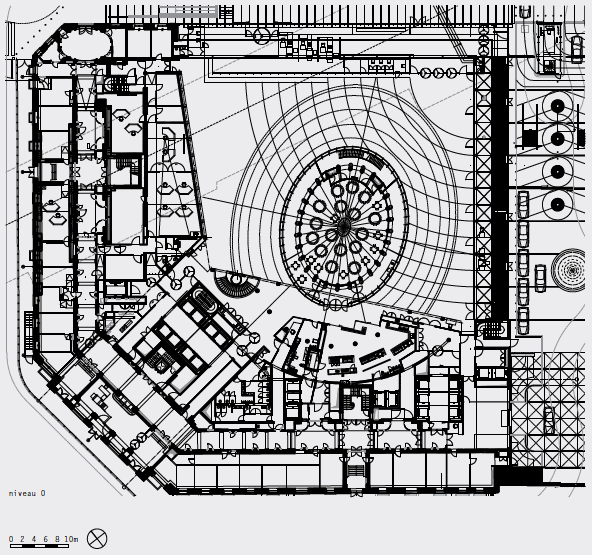
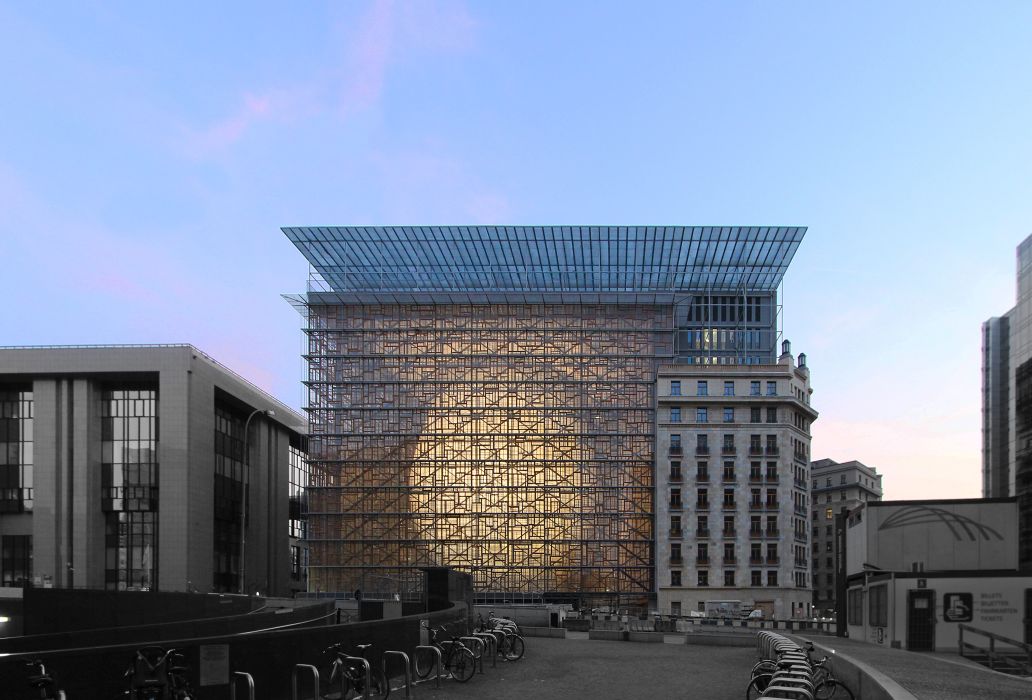
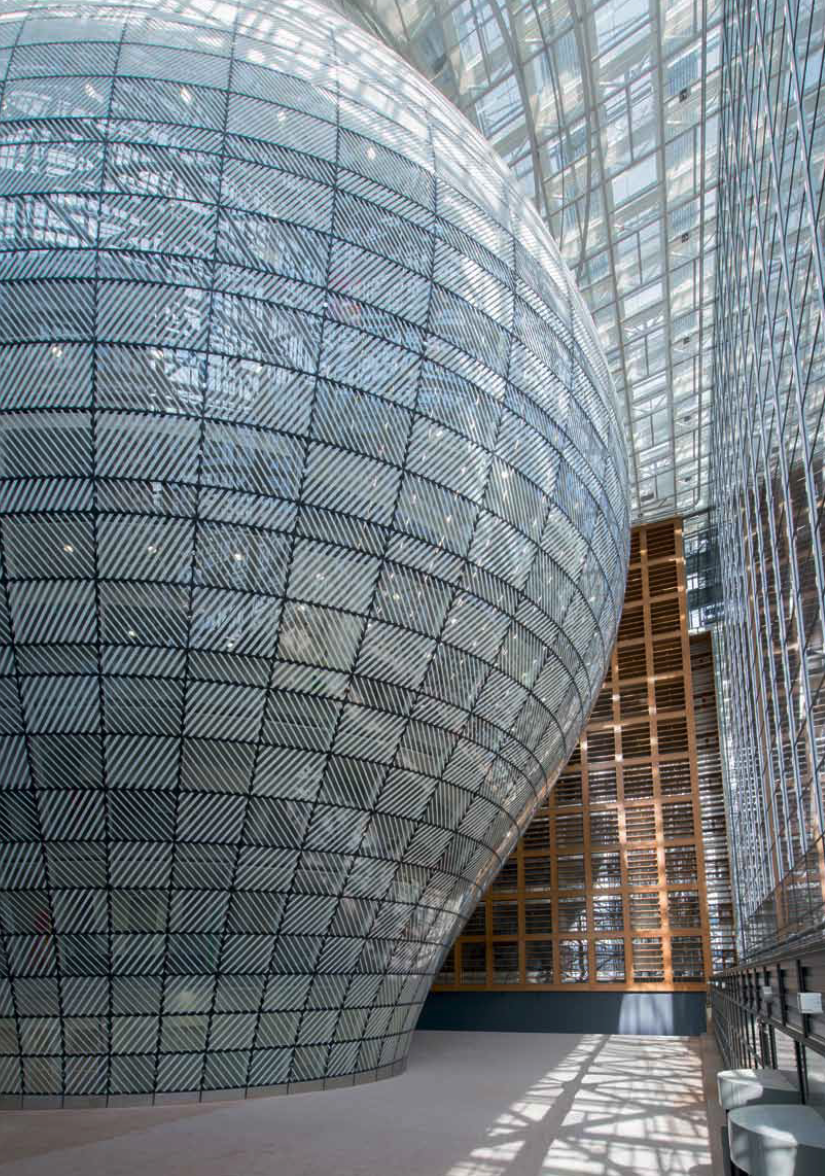
The structure integrates the Résidence Palace, an Art Deco complex whose L-shape borders the construction site. Samyn mirrored this L with a filigree curtain wall; a patchwork of reclaimed windows from all European member states. In this way, he created a 6,000 m² atrium. At its centre stands an elliptical volume that was soon dubbed the ‘lantern’, ‘egg’ and ‘urn’ – the latter being an unmistakable symbolic reference to the ballot box.
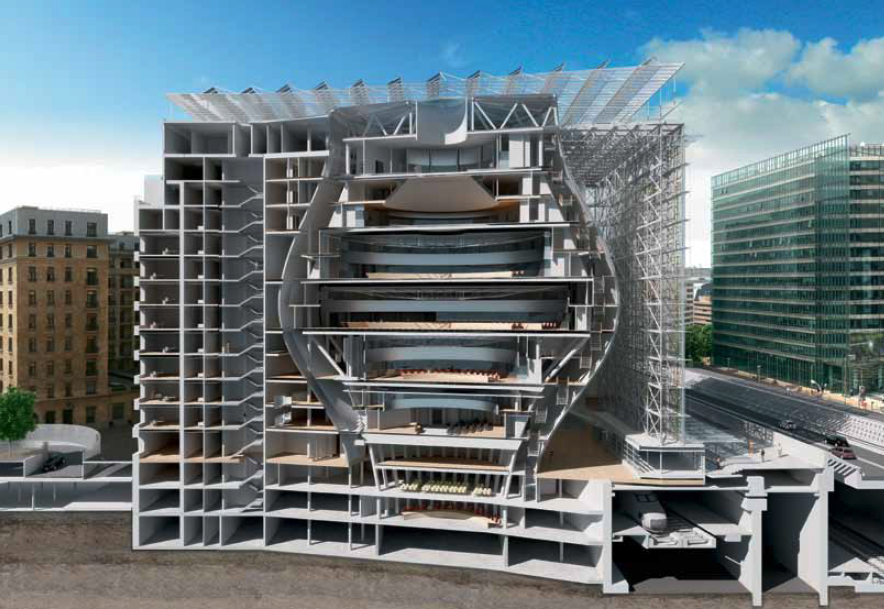
The translucent stacking of the press room and meeting rooms of varying sizes explains the name ‘lantern’. Each plenary hall has an elliptical floor plan. The supporting structure of the ceilings was elegantly realised in a delicate steel framework that creates the illusion of a skylight.
Surrounding each hall is a ring of interpreting booths, accessed via foyer-like spaces on the outside. These service areas benefit from the glass walls that form the actual shell of the lantern. The relatively narrow base is a consequence of the railway tunnel that partially cut beneath the building site and thus compromised it. With the grace of a ballerina, Samyn slenderised the circumference of the urn and, in a single movement, resolved the problem of the limited foundation base.
Lantern
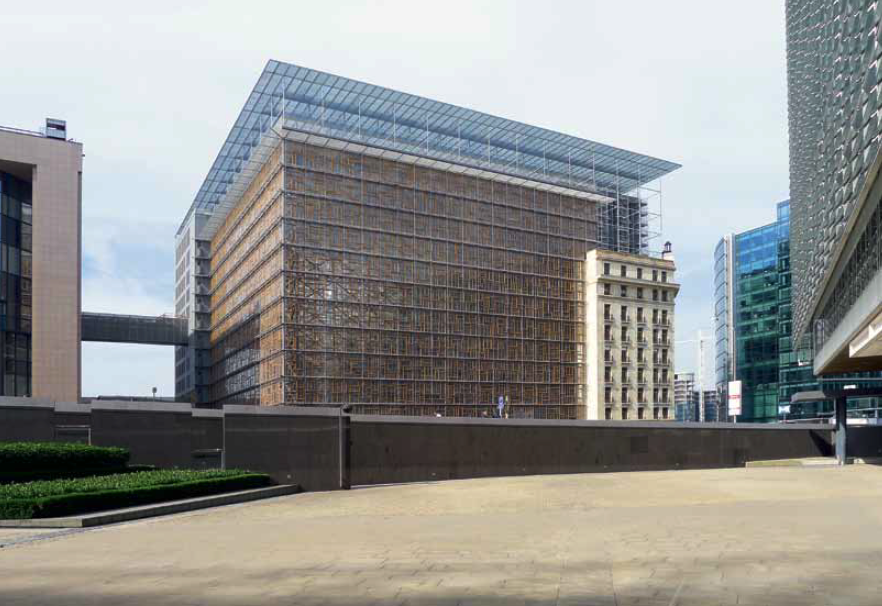
However, the lantern does not stand entirely free but is embedded within the structure of the stripped-back Résidence Palace. It goes without saying that integrating the smooth geometry of the ellipse with the old orthogonal structure is no easy task. Combined with stringent safety requirements, access control points and secure circuits, the ensemble regularly loses its sense of transparency. The restrictive dimensions, in particular the limited ceiling heights of the Résidence Palace, also take their toll: the connecting areas lack a sense of space.
Samyn collaborated with artist Georges Meurant, who introduced fresh colours using post-Mondrian grids alongside Samyn’s familiar palette of pure greys, wood and the intriguing grey-brown hue, a scan of the dust (poussière) from Wetstraat. These colours, applied in chequerboard patterns or elliptical segments, have a soothing effect. Particularly in the lift shafts with their glass cabins, they create a surprising artificial naturalness.
Vodka pavilion
Alongside the ballot box, Europe is thus also marked by a distinctive façade made from reclaimed oak window frames. The dimensions of these windows were entered into the computer and assembled into two monumental curtain walls. Saving windows from demolition has a certain poignancy, almost a sentimental quality. But in reality, it embodies the ambivalence of thinking about sustainability and ecology in architecture. Many windows were removed to make way for supposedly more sustainable, often new, plastic windows. The reclaimed windows are in good condition and required nothing more than a sanding and a coat of varnish. Many sceptics, including the author of this piece, thought the façade was constructed from brand-new windows, but the facts contradict this.
Even if the façade reads like a sentimental tale making room for the human scale and for the citizen within the headquarters of Europe, it nevertheless expresses a certain (un)intended insubordination. Or rather than undermining authority, EUROPA introduces a touch of Magritte and surrealist humour into the architecture of power. Especially when you consider that the famous Russian architect Alexander Brodsky, who during the Soviet era was condemned to being a paper architect, also designed a pavilion using reclaimed windows for the ArtKlyazma art festival in 2003, following perestroika. And not just any pavilion, but the Vodka Pavilion…
Gaps and confusion
It goes without saying that the playfulness in the new EUROPA is not an end in itself, but the result of a complex process. For instance, the client’s request for EUROPA is contested – British Prime Minister Cameron regards this building programme as superfluous – and the construction site is also under discussion, as the Résidence Palace is squeezed between Euro-pudding buildings and railway infrastructure. Added to this is Samyn and Partners’ move to counter the looming invisibility of this European institution with forms and façades laden with symbolism.
As is often the case in the architecture of Samyn and Partners, in Europa the Formwille and the Bauwille clash. This sparks sparks.
And noise and confusion. The engineering logic and clarity that Samyn recently demonstrated at the AGC headquarters in Louvain-La-Neuve sometimes gets bogged down here because ripple zones arise between the orthogonal floor plan of the Résidence Palace and the elliptical geometry of the lantern.
Thus, the mythological figure of EUROPA is joined by the two-headed Janus. Years ago, Robert Venturi argued in his book of the same name for ‘Complexity and Contradiction in Architecture’. It remains, however, a daring exercise to engage with contradiction in architecture. But perhaps it is the right metaphor for a complex, divided Europe.
Architect
Philippe Samyn and Partners
Studio Valle Progettazioni
Website
samynandpartners.be
studiovalle.com
Location
Brussels
Completion
2016
Programme
Renovation and extension of Block A, Résidence Palace, for the new headquarters of the European Council and the Council of the European Union
Procedure
Public contract, client: Buildings Agency
Structural engineering, services, acoustics
Philippe Samyn and Partners
Buro Happold
Structural works phase 1
TV Valen-Dewaele
Structural works phase 2
TV Interbuild-Cegelec
Jan De Nul
Joinery
TV Interbuild-Cegelec
Potteau-Labo
Facade
TV Interbuild-Cegelec
Kyotec Group
Interior finishing
TV Interbuild-Cegelec
Beddeleem
Special materials and equipment for exterior joinery
Facades: Belgo Metal and Tosoni
Walls and suspended ceilings: Beddeleem
Interior finishing: Metal Projects
Lifts: ThyssenKrupp
Photovoltaic panels: Issol
Surface area
70,646 m²
Budget
€240,000,000 (2004 value)