For many Flemings, the allotment remains the ideal environment: the neighbours are kept at a safe distance, the children can play peacefully in the garden, and there is always a place to park at the front door. The question is, however, how long we, as a society, are prepared to continue to pay for the preservation of this truly expensive housing model.1 The Flemish Government has already put forward a series of spatial principles to reduce a number of these social costs. For instance, they propose to increase the spatial yield and to interweave the use of space and make it multifunctional.2 1 Vermeiren et al., 2019. ‘Monetariseren van urban sprawl in Vlaanderen’ (Monetization of urban sprawl in Flanders). Carried out by order of the Environment Department. 2 Environment Department, 2018. ‘Beleidsplan Ruimte Vlaanderen: Strategische Visie’ (Flanders Spatial Policy Plan: Strategic Vision). https://www.ruimtevlaanderen.be/BRV
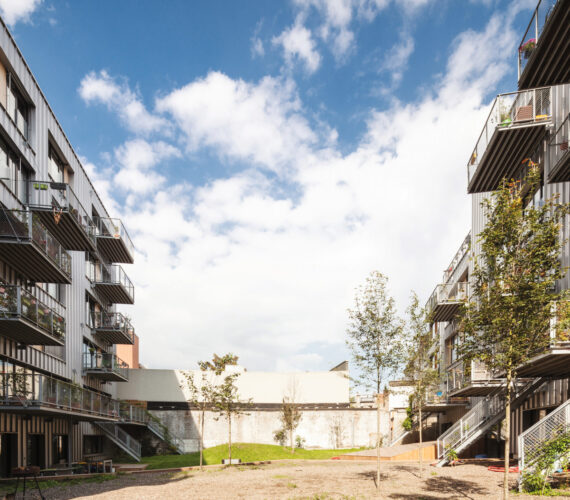
In the case of collective housing projects, too, new, smarter allotments are being proposed, as an alternative to the traditional allotment model. Instead of having each house on its own plot with its own front garden, driveway and garden, dwellings (and apartments) are arranged around a communal garden that includes a trampoline, swimming pond, vegetable garden and slide. In addition, they often share a pavilion with a kitchen, sitting area, work area, fitness room, laundry area, storage, etc. Sharing a bicycle shed and car park goes without saying. Within these projects, the residents’ group is in complete control, and in the first instance they are primarily focused on realizing their communal project. They learn to deal with each other’s differences and strive for consensus on every possible decision or agreement within their project.
This article appeared in A+280, published 07.10.2019.