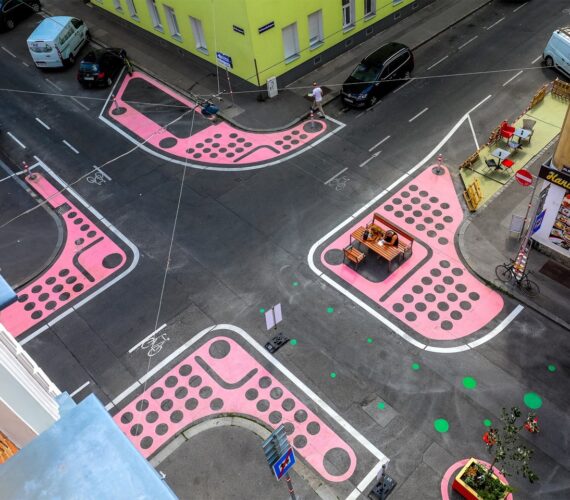
The street is the space in our society that is at once the most widely shared and the least designed. It is older than architecture itself, yet strikingly absent from the architectural discourse. While virtually every aspect of the built environment today is being thoroughly reimagined – living, working, caring, learning, relaxing – the street stubbornly continues to function within an outdated Fordist paradigm. The street is a movement machine; what counts is smooth and efficient circulation. At the same time, however, the street represents the very opposite: stagnation, with a large portion of public space serving as storage for unused cars.
One of today’s main design challenges is not only creating new public space, but reimagining the public space we already have, the ‘ordinary street’. As guest editor of this issue of A+, Gideon Boie, author of Kleine filosofie van de verkeersveiligheid (A brief philosophy of traffic safety), released by Public Space in 2025, argues that the street must once again be approached as a full-fledged architectural space: a public room between buildings, in close dialogue with the façades that border it and open it up. The street should not merely as be seen as a place to move through, but as a space where living, working, raising children, caring and coexisting intersect. This approach raises fundamental questions: what does the right to the street mean, who can lay claim to it, and for what purposes?