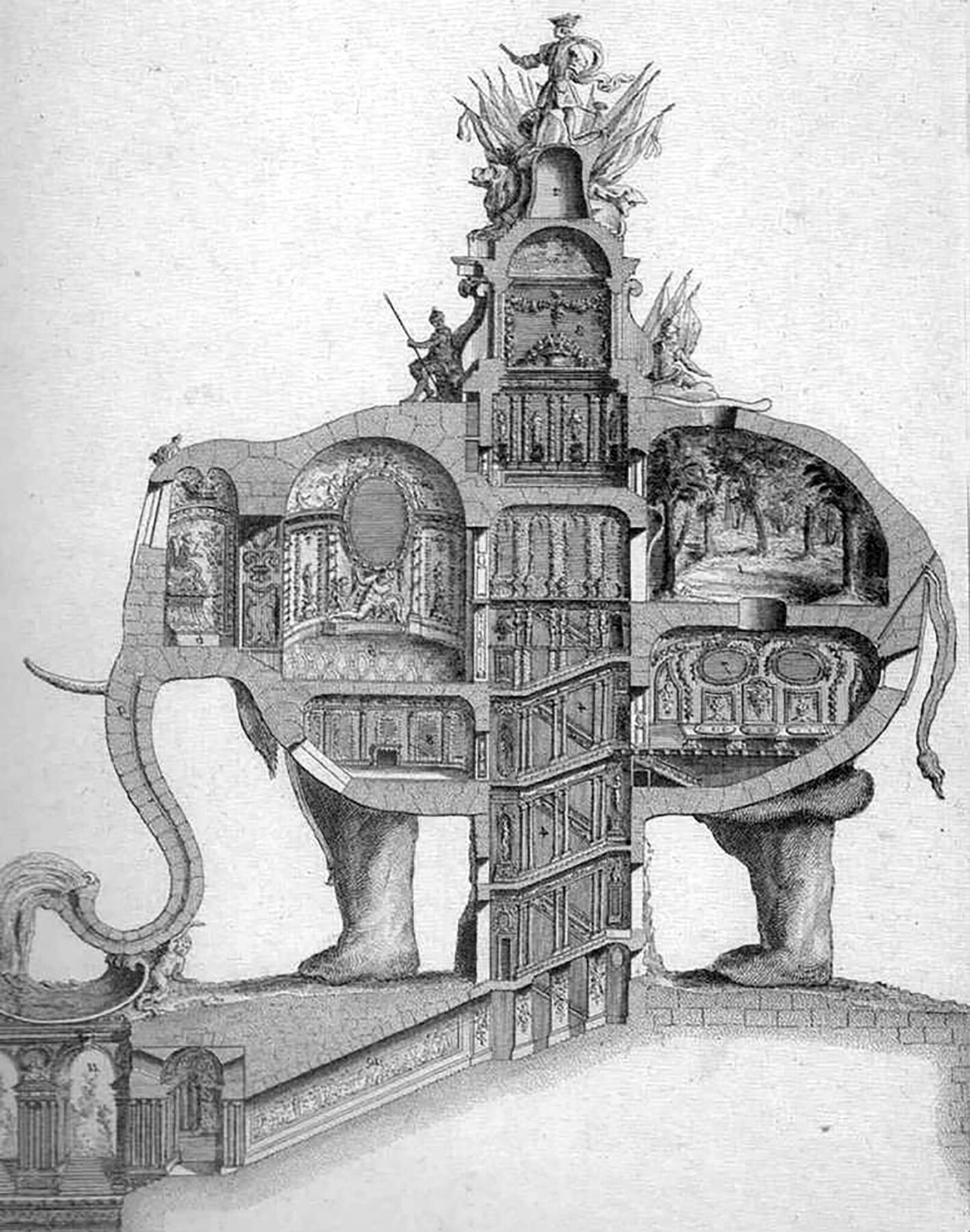
There was once a gigantic bronze elephant in Paris. Or at least, that was the plan. In 1758, architect Charles Ribart designed a monument to honour Napoleon’s victories in the form of this towering elephant, complete with a ballroom, a ventilation system and sanitary facilities, with the trunk serving as a drainage pipe. The structure was intended to be the centrepiece of Paris’s finest avenue, the Champs-Élysées, and to highlight the city’s monumental character. However, the design was not selected, and the French government opted for a classical archetype: the triumphal arch.
The idea, however, continued to linger. Fifty years later, Napoleon commissioned the architect Jean-Antoine Alavoine to build a monument in the shape of a 24-metre-high elephant on the Place de la Bastille, on the site of the infamous prison. This design featured steps in the legs, a lookout post on the back and a fountain spouting from the trunk. Whilst awaiting the final structure, a life-size model made of wood and plaster was erected on the site – a foretaste of the impact and grandeur of the bronze monument. However, it never got that far. Following political setbacks, the project was shelved and, after a few years, the gigantic plaster elephant crumbled into a forgotten ruin.