
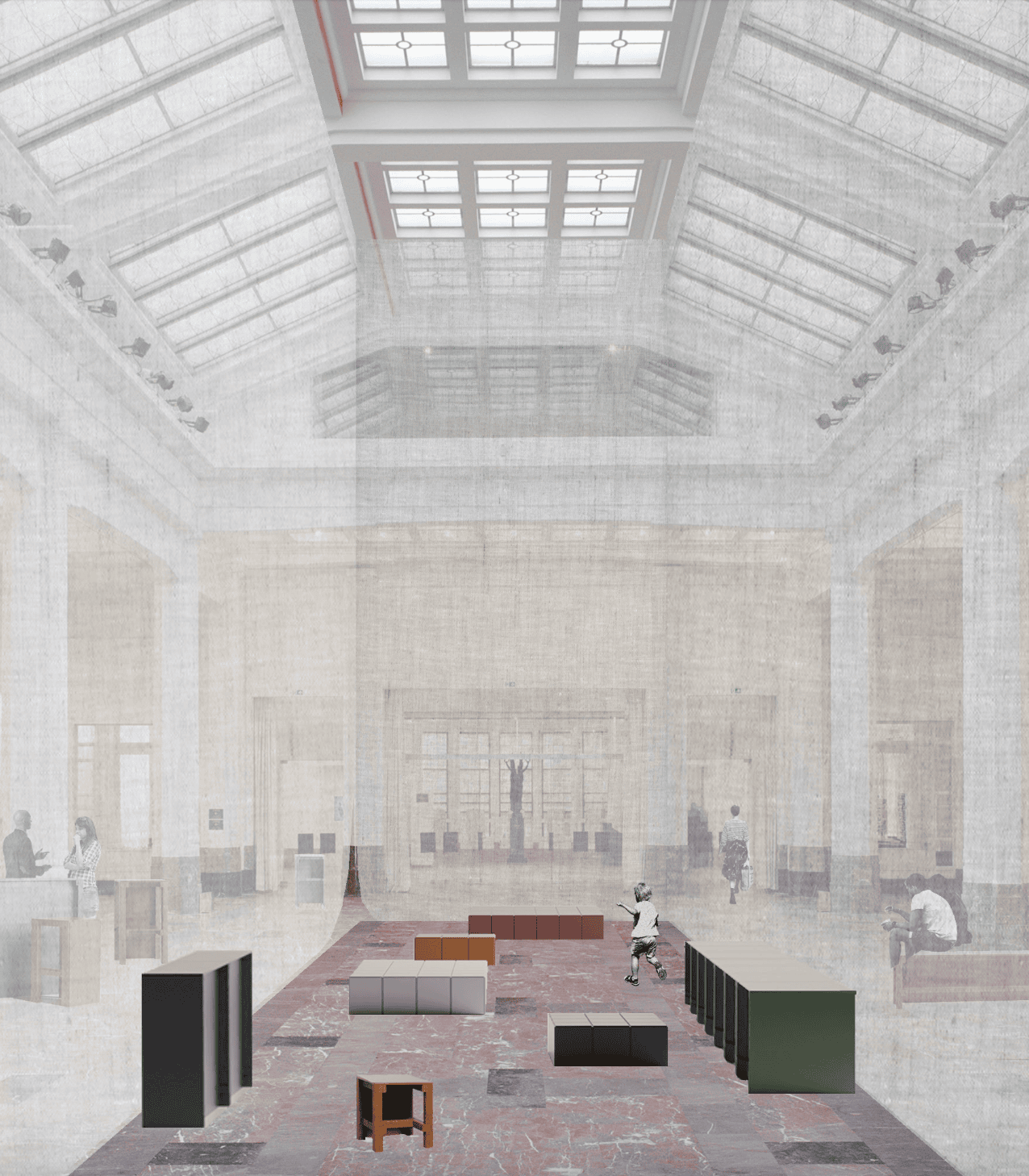
As part of the architectural competition launched by the Bouwmeester Maître Architecte in May 2024 to reimagine the Horta Hall at the Palais des Beaux-Arts in Brussels, one proposal stood out thanks to its sensitive and delicate combination of architectural design and artistic intervention. The firm Giusto Van Campenhout and the artist Michel François are behind it. Through their work, they redefine the function of the Horta Hall as a place for contemplation, engagement, exchange and performance.
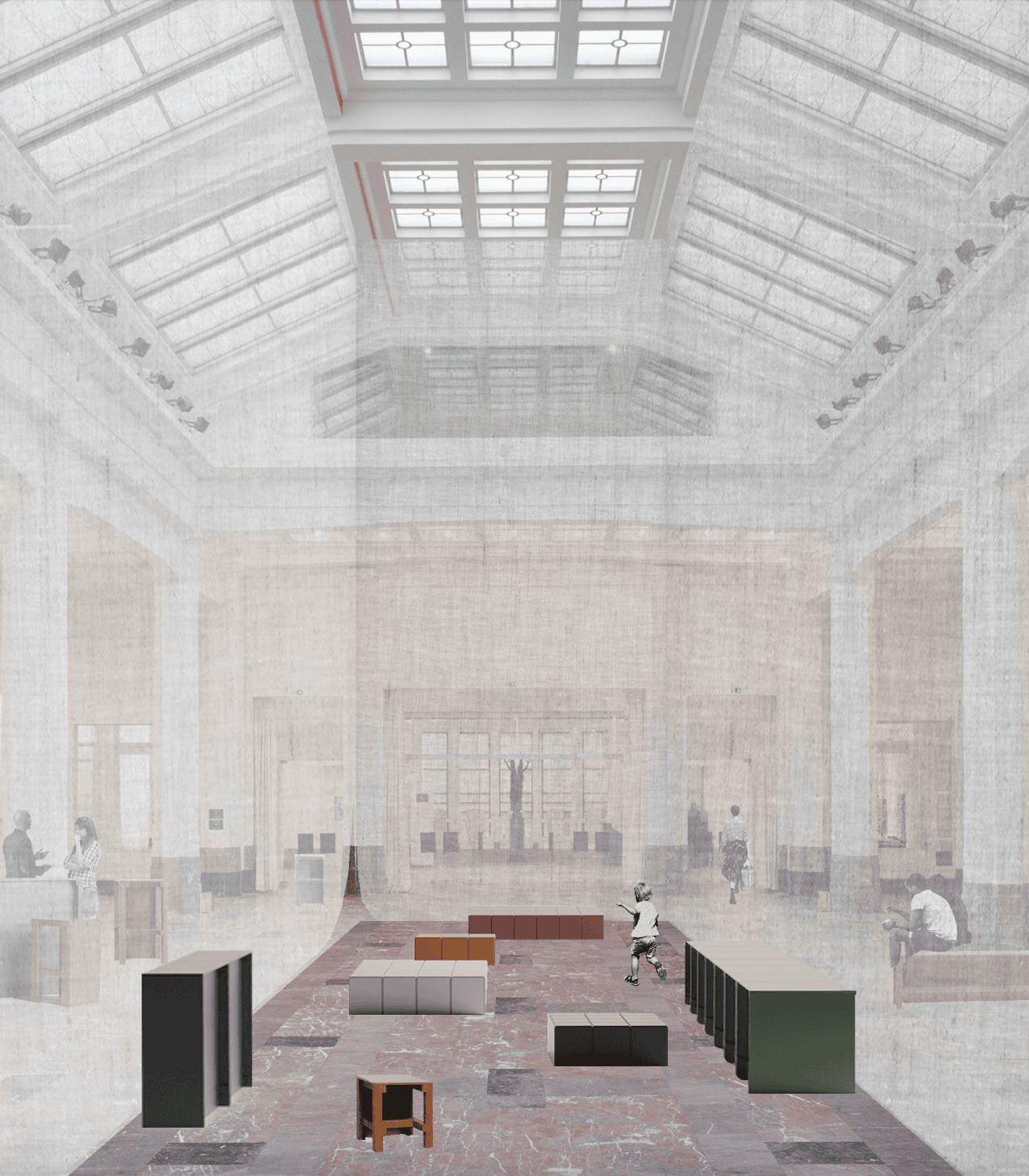
Designed by Victor Horta as an exhibition hall, this majestic space at the heart of the Palais now serves as a gathering place and the main entrance to the exhibition galleries. With the aim of maximising the hall’s potential, it was necessary to reorganise the space to improve its layout through a scenographic and architectural approach. It was essential to deepen its fundamental role: a place in motion, dynamic, which occasionally gives way to a static space.
The scenography is designed so that the space can transform according to its use. Through three elements—the tent, the carpet and the furniture—the hall evolves throughout the day and night. The tent, comprising a translucent acoustic veil, a fixed metal structure and a motorised system, interacts with its environment from another era. The aesthetic and colour schemes of marble – the dominant and significant material in the hall’s architecture – are replicated in the carpet and furniture to contrast soft, warm textures with those of the hard, cold floor that dominates the space. The composition of the tent, linked to that of the carpet, absorbs and reduces reverberations once the veil is lowered. The installation allows for the creation of various atmospheres through acoustic control and works towards an architecture that connects the street to the centre of the building.
This sensitive approach is not limited solely to art and architecture; it also embodies a circular and sustainable approach thanks to the work of Duplex Studio. The furniture is made from reused materials, with a reduced production energy footprint. Under these conditions, users make the space their own and find freedom within a multitude of visual, acoustic and sensory experiences.
