
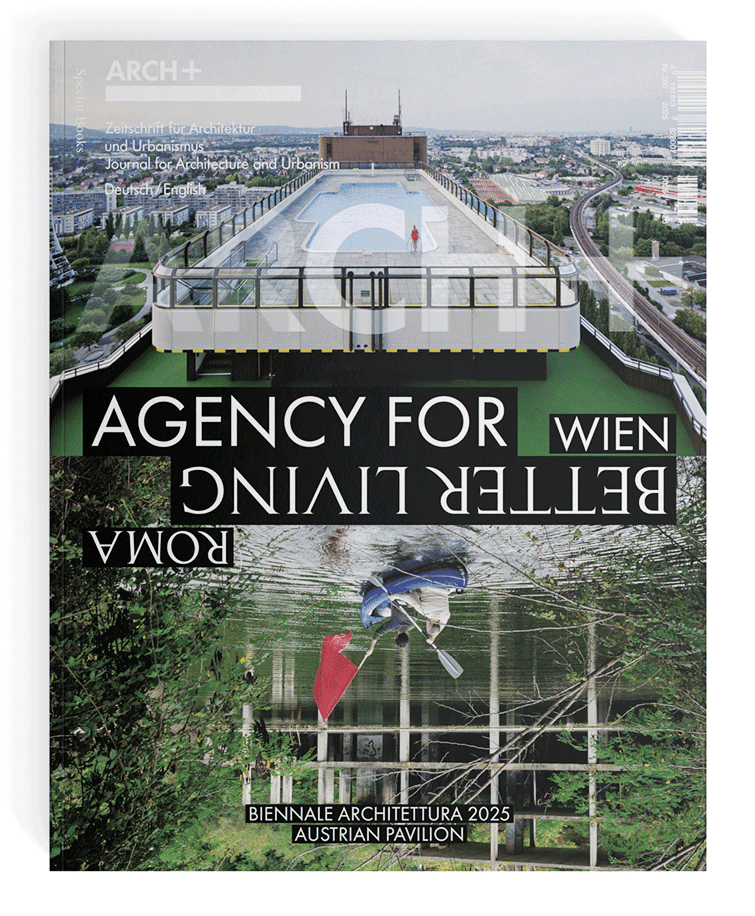
The Austrian pavilion is a welcome breath of fresh air at the 19th Venice Architecture Biennale following the disappointing main exhibition. Vienna/Rome – Agency for better living asks what agency people have to achieve affordable and (socially) sustainable housing. The city of Vienna’s strong housing policy comes close to that ideal, but leaves little room for personal initiative. Rome, on the other hand, has always let the market take its course, resulting in a permanent housing crisis, yet it is precisely in that climate that alternative initiatives are springing up like mushrooms. The question then is what both cities can learn from each other. The German magazine Arch provided the catalogue for that exhibition, but is in itself an indispensable reader on European housing issues today.
Libraries full of books have been written about the housing policy of the city of Vienna since 1919 – the ‘Rotes Wien’. Vienna is one of the few cities in the world where affordable housing has been a reality for a century. The city thus proves that laissez-faire policy, which has led to a ‘housing crisis’ in other countries, including within the EU, is not a TINA (There is no alternative).
However, the approach taken by Sabine Pollak and Michael Obrist, the Austrian curators of the pavilion and co-authors of this book, is unique. They do highlight the forward-thinking building and land policies of the SPÖ, which still form the basis of the Viennese model, but also the unique intellectual climate in Vienna at that time. Physicality and sexuality were no longer taboo there: it was a subject that played a part in housing design. This led to far-reaching experiments such as housing complexes where all dwellings shared a single central kitchen.
That trend has continued to the present day in the current inclusive, feminist approach to housing. This focuses, for example, on facilities for specific groups such as the elderly or LGBTQ residents. Vienna therefore promotes itself today as a ‘caring city’. This is also evident in recent housing projects. One of the strengths of this book is that it documents these. The downside of this ‘care’, however, as various authors note, is that it operates in a top-down manner. Residents have little agency. Another observation is that the city is grappling with new phenomena such as the growing diversity of the population. Its dirigiste and paternalistic model offers no solution to this.
Roman practice offers an alternative. Lorenzo Romito, the third curator of the Austrian Pavilion, argues in his essay that Rome has been in crisis since it became the capital of Italy in 1871. This led to an unprecedented, speculative reconstruction of the city, at the expense of the common people. They were driven to the city’s outskirts. That project stalled time and again, leaving the city littered with abandoned buildings and sites where people and nature have reclaimed their rights in many ways.
It is a passionate account of a city that has died and been reborn countless times thanks to the ingenuity of the many who have washed up there from all corners of the world. It serves as the starting point for a deep dive into an (alternative) history of the city, from antiquity to the present day, featuring numerous marvellous, often little-known projects. This compelling eye-opener immediately makes you want to explore the Eternal City anew. It also demonstrates that bottom-up planning and action can be a vital alternative to top-down organisations, even if that has certainly done Vienna no harm.
ARCH issue 260 Vienna/Rome – Agency for Better Living, Berlin 2025, 208 pages. ISSN 0587-3452 / ISBN 978-3-931435-89-9. RRP €28.00. Bilingual German/English.
