
Stephen Bates of the British architectural firm Sergison Bates is, in a sense, half Belgian: his track record of competitions won and projects completed in Belgium leaves the majority of our architects in the dust. Meanwhile, he has also taught at leading schools across Europe and the USA and has completed numerous projects outside Belgium. It is also noteworthy that, either alone or in collaboration with his partner Jonathan Sergison, he has published a great many texts, including in Papers #1, #2 and #3.
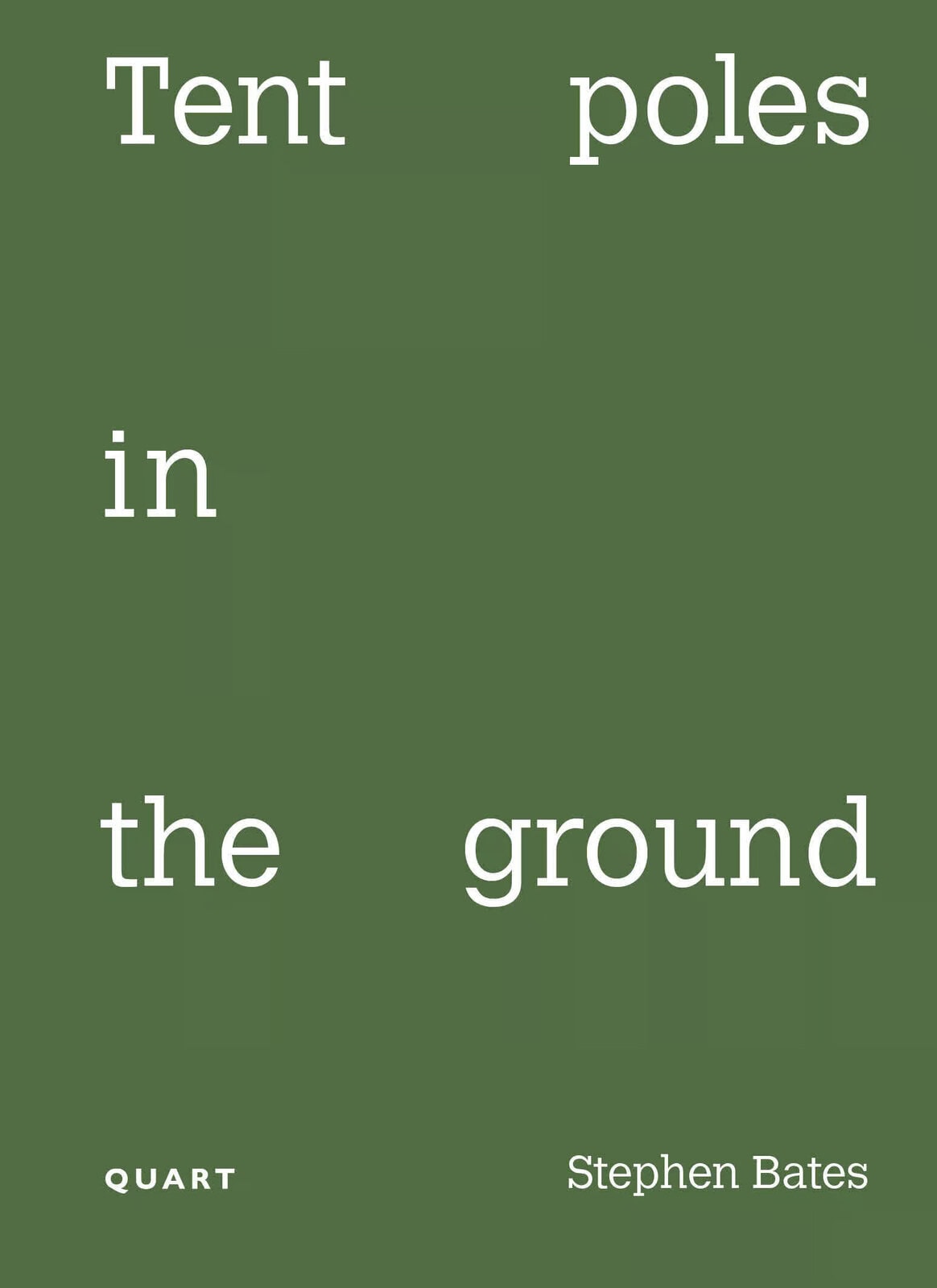
It is therefore no surprise that he presented his most recent book, Tent poles in the ground, published under his own name, in Brussels on 12 June. The book comprises 21 short reflections on architecture. They range from two to eight pages in length, each accompanied by plans or photographs. They are not, therefore, fully developed essays, but rather the musings of an architect who, amidst his busy daily routine, reflects on what he does and is capable of.
However, he almost always does so – and this is what makes it fascinating – by drawing on what other architects, whether well-known or not, have done and attempted before him. Stephen Bates thus presents architecture as a culture or a conversation of a special kind. Language is not its primary or sole vehicle: it is more often a matter of observations, sketches, drawings and the buildings that emerge from them. In those sketches and drawings, the architect imaginatively stakes out the tent poles that determine where and on what he will work. Bates illustrates this idea in the first essay using a sketch by Antonio Coderch for the Ugalde House.
Bates adds a credo to this: ‘The importance of a critical practice intent on finding a synthesis between local and universal culture that is about place and circumstances, about atmosphere and experiences’. That credo is echoed frequently throughout the book. ‘On the table’, for example, offers a brief history of the table as the only piece of furniture that has continued to denote ‘domesticity’ throughout the centuries.
The most interesting text in the book is ‘Collective Domestic – and the house of many rooms’. In it, Bates observes that the growing number of single people requires new types of buildings. To offer a solution, he draws on numerous historical and contemporary examples. It is the only text in the book that – quite rightly – is followed by an extensive series of images with captions that form an essay in their own right. Here, Bates succinctly summarises a problem from a historical, cultural and social perspective, viewed through an architectural lens. He does this time and again. That is, indeed, the great merit of this book
‘Tent Poles in the Ground’ appears to be a small and, above all, slim volume. Yet it runs to no fewer than 316 pages, as it was printed on paper that is paper-thin yet sturdy. The paper is so thin that on every page you can already see a faint outline of the text or images on the reverse. It is also nice that although the book is sewn and glued rather than bound, it still opens beautifully when reading, perhaps thanks to the soft, green linen cover. The care taken with the illustrations is also striking. The beautiful design by JANE Studio makes it a real collector’s item.
Tent poles in the ground, Stephen Bates, Quart Verlag Luzern, CH, 316 pages, 13 × 18 cm. ISBN 978-3-03761-342-9. RRP €54.
