
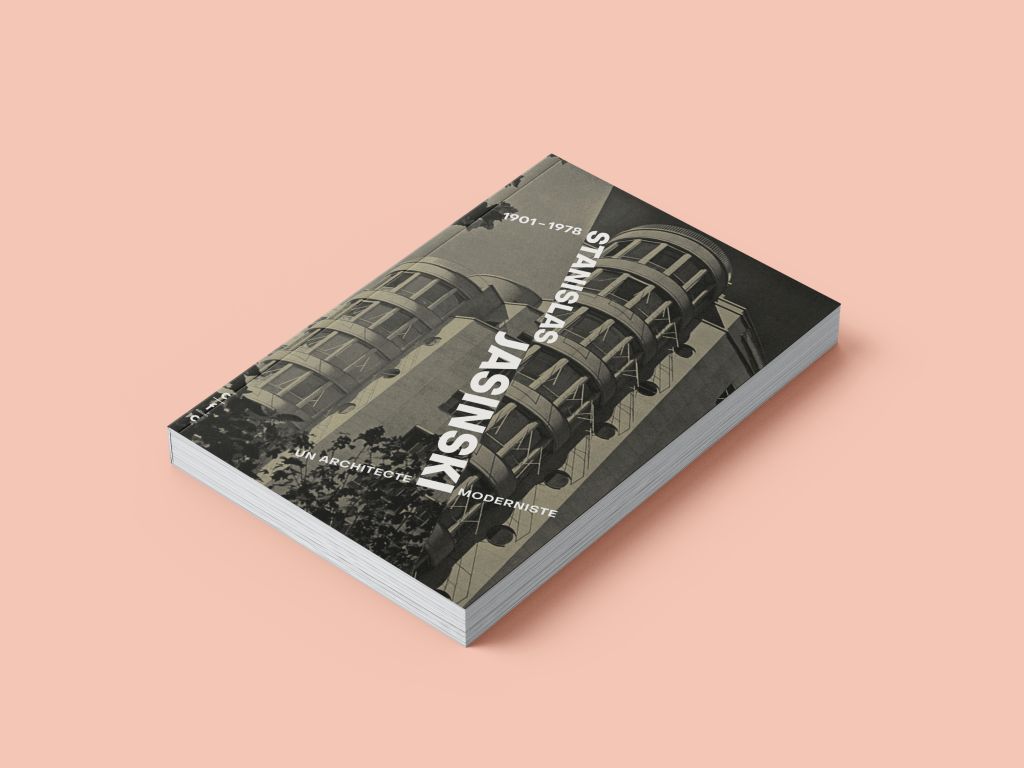
The Archives d’Architecture Moderne continues its mission to promote its collections and, in 2024, published a richly illustrated monograph on Stanislas Jasinski in collaboration with CFC éditions. His name had become famous following the 1930 publication of the manifesto project for the three cruciform towers of an administrative centre he had designed next to the Brussels Stock Exchange. Paradoxically, his work had until now been associated primarily with a series of opulent apartments built in the residential districts of the capital’s eastern suburbs. This paradox stems mainly from one factor: access to commissions, which, in the Belgian context of limited public construction compared to neighbouring countries, often creates a tension between architects’ aspirations and the reality of their projects. The originality of this book lies in its ability to shed light on this from several perspectives, linked to the personalities of the three authors.
Geoffrey Grulois situates Jasinski within the context of public commissions in mid-20th-century Belgium, a period of modernisation driven by architectural competitions. Jasinski designed Deurne Airport and Bordet Hospital (with Gaston Brunfaut), establishing himself within the modernist avant-garde, where he was highly active at the start of his career. However, Jasinski subsequently failed to win any further competitions.
The text traces how a prolific output of architectural sketches and photomontages – including the famous cruciform towers – gradually gave rise to a general vision of the dense, open city, of which Jasinski dreamed of being the grand architect.
In contrast, Amaury De Smet analyses the architect’s actual architectural output, primarily housing, and reveals how Jasinski gradually carved out his own terms for commissions, setting himself up as a property developer and selling apartment blocks off-plan, where he managed to develop a refined and complex architecture. He was not alone in this at the time (see Jean-Florian Colin, Jean Delhaye or Raoul Brunswick), but the text highlights Jasinski’s talent and inventiveness in adapting to the contexts and demands of his clientele whilst patiently laying the groundwork to build a development in Uccle that corresponded to his vision of the city of the future.
This ability to create such conditions is analysed at the start of the book by Yaron Pesztat, the initiator of the publication. He analyses the architect’s notes and looks to his tragic family history for the reasons behind his independent nature, which is matched only by his deep conviction that he could establish himself as a leader. This conviction enabled him, to some extent, to compensate for his lack of political support—a prerequisite, at the time, for securing public commissions—through his determination to build housing for modern high society.
Reading this monograph goes far beyond simply showcasing an architectural body of work; it provides genuine insights into the conditions under which architecture was produced in Belgium.
De Smet, A., Grulois, G. & Peszat, Y. (2024). Stanislas Jasinski: A Modernist Architect (1901–1978). ISBN 978-2-87572-102-0
