
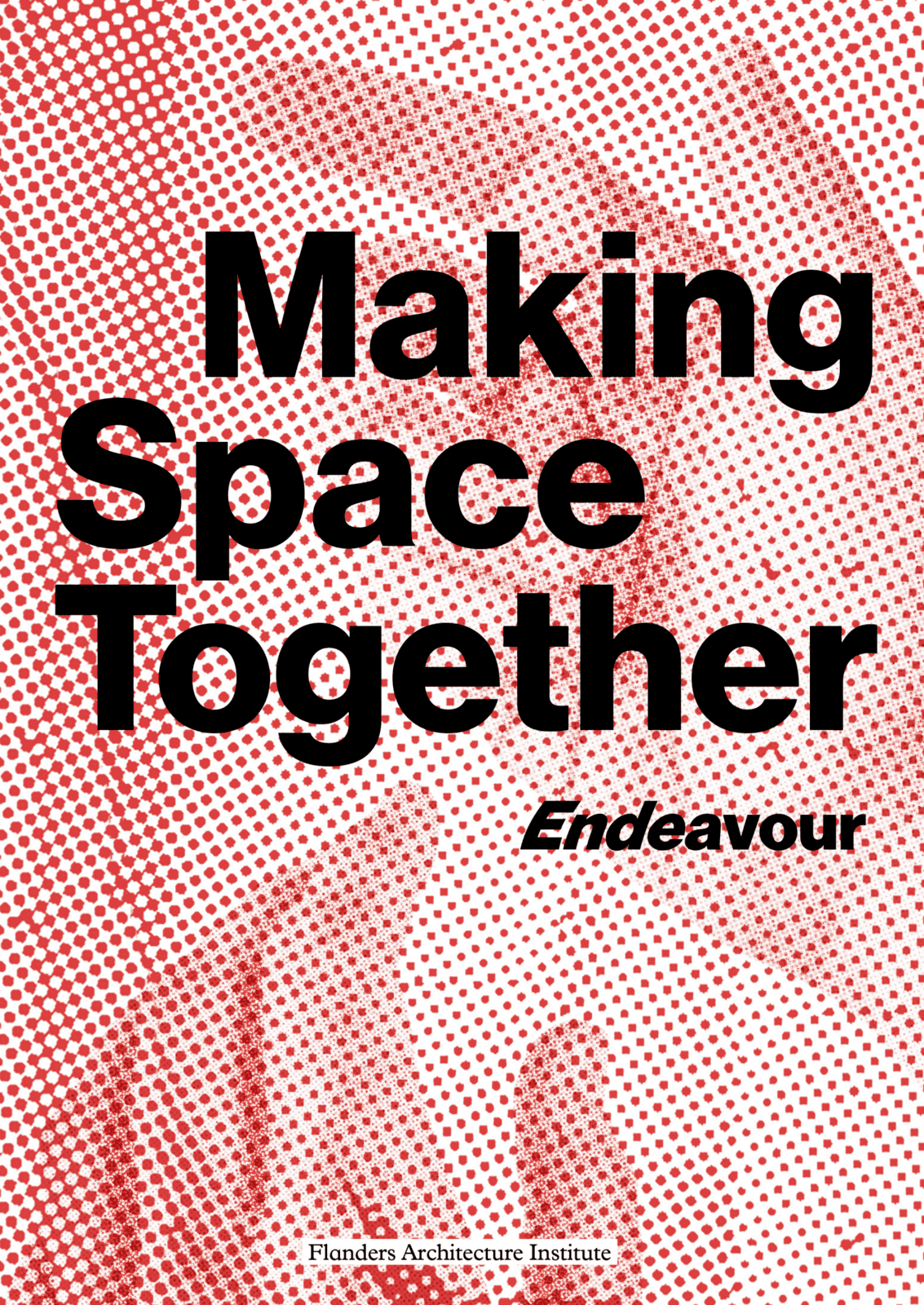
The book Making Space Together, released in January 2025 and published by VAi, celebrates the tenth anniversary of the Endeavour cooperative, a collective of around fifteen people based in Antwerp. Originally emerging from activist activism, the cooperative advocates a participatory approach to space, seeking to foster links between political authorities, users and spatial designers. They champion dialogue as a key method. To this end, Endeavour brings together a wide range of disciplines, from sociology and history to architecture. The same applies to their working methods: the collective is active in the field of project work – primarily urban – and architectural commissions, as well as in voluntary work, education and research.
Like candles on a cake, the book is structured around ten chapters that translate the number of years being celebrated into an exhaustive list of titles which, taken together, encapsulate the cooperative’s commitment. Somewhere between a wish list and a manifesto, one reads through the book to the rhythm of these action verbs. All the chapters are structured according to the same model: an introductory text explaining the chapter’s focus, a transcript of a dialogue between several specialist contributors, and finally, the application of these concepts through projects carried out by Endeavour, explained from a methodological perspective with a clear commitment to sharing knowledge and openness. The systematic nature of this structure benefits the reader’s autonomy, allowing them to move freely and without chronological order through the pages, shifting from “Adopt bold positions” to “Fight for social justice” at the pace dictated by their intuition and curiosity. One cannot fail to recognise here the values of sharing and inclusion that underpin the collective’s approach. The same applies to the form of dialogue, which is central both to the book’s content and to the collective’s practices. We find this familiar format again in the project pages, where methodology and tools are generously shared in a spirit of knowledge-sharing.
Throughout this book, the content seems to strive for accessibility, following considerations that remind us of those of Roland Barthes, who brings about the death of the author by empowering the reader. By structuring and sharing the process, the collective seems indeed to place the reader at the heart of the book.
Visually, the book is no less ambitious; its elegant binding and red edges create a strong identity. Inside, the layout incorporates elements that recall the collective’s processes and tools: post-it notes, handwriting and note-taking aim to make the text interactive and lively. At times, this could also be a double-edged sword, robbing the reader of their autonomy and running the risk of confusing popularisation with naivety. Be that as it may, we wish them a happy anniversary – here’s to twenty years!
ENDEAVOUR, Making Space Together, Flanders Architecture Institute, 2025, Antwerp, 196pp.
