
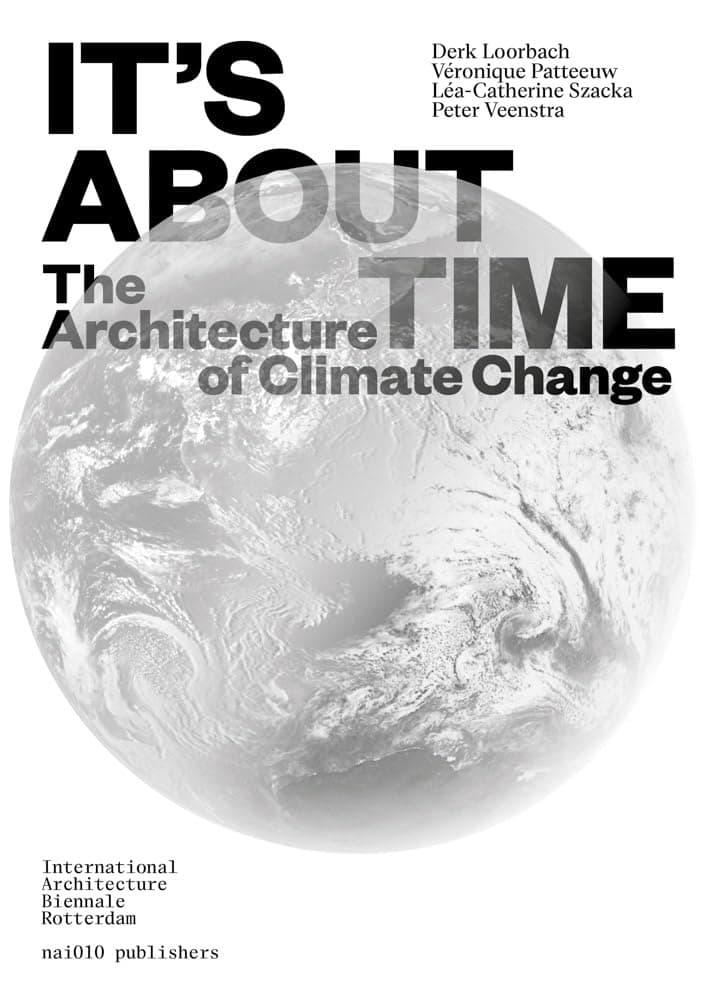
In It’s About Time – The Architecture of Climate Change, Derk Loorbach, Véronique Patteeuw, Léo-Catherine Szacka and Peter Veenstra have published the research they presented in an exhibition as curators of the 10th edition of the International Architecture Biennale in Rotterdam (IABR 2022). The result is a well-argued, excellently documented, but above all hopeful book in hopeless times, where the political courage to reverse global warming is losing out to geopolitical posturing, climate-denying conspiracy theories and the madness of an arms race.
Time is the key word in this publication, far beyond the ‘five to twelve’ metaphor often associated with climate urgency. The dynamics of boundless growth have led in recent decades to a logic of acceleration in which the key players, driven by the market, politics and the economy, are constantly racing towards the next deadline – the upcoming elections, the new stock market listing or the next shareholders’ meeting. This short-term thinking stands in stark contrast both to the very nature of architecture, where the designer is expected to build for the next hundred years, and to the temporal logic of an ecological system that has existed for millennia. At the same time, the climate emergency is so great, and the time pressure to act unprecedented. We must therefore both slow down and speed up. The authors identify three strategies for this within the field of architecture, which they call the ‘Ancestor’, the ‘Activist’ and the ‘Accelerator’. The ‘Ancestor’ aims to be a good forebear, takes a long-term perspective and seeks answers in natural systems, pre-modern practices and low-tech architecture. Examples of this include the metropolitan forest in Madrid or Ringland in Antwerp at the urban level, and projects such as those by BC Architects or the Indian architect Anupama Kundoo. The ‘Activist’, on the other hand, has its feet firmly planted in counterculture and seeks to change, replace or at the very least challenge current power structures through bottom-up initiatives and short, strategic actions. In spatial terms, this translates into projects such as those by Raumlabor or Construct Lab in Berlin, Coloco in Paris or Park Farm in Brussels. Research such as that by Rotor, Forensic Architecture or Lieven De Cauter turns activism into a particularly fertile breeding ground for future action. Finally, the ‘Accelerator’ sees value in time pressure and uses it to develop new standardised, modular systems—whether digital or not—to improve the built environment and our quality of life. This ranges from MVRDV NEXT to Studio Marco Vermeulen’s A37 motorway, demarcated by solar panels, to Ecotron, the climate research laboratory in the Kempen by NoArchitecten.
The projects cited are not ad hoc illustrations but are framed within a broader narrative of climate policy and activism between 1952 and 2022, in which Limits to Growth, the 1972 report by the Club of Rome on the consequences of Western capitalism for the liveability of our planet, plays a central role. The accompanying timeline highlights the pivotal moments, the missed opportunities, but also the decisiveness, political courage and civic spirit of the last 70 years. At a time when one might forget that ecological urgencies were once high on the (political) agenda, this book offers inspiration and hope for the future of the climate cause and shows the architect the role he or she can play in this.
Loorbach, D., Patteeuw, V., Szacka, L., & Veenstra, P. (2025). It’s about Time: The Architecture of Climate Change. Nai010 Publishers.
