This issue of A+ focuses on 19 emerging Belgian offices which together compose a picture of the state of architecture today. What is especially striking is the extent to which the professional environment in Belgium has changed over the past 20 to 30 years. During this time, architectural culture has gone through rapid institutionalization, the result today being a different field for young offices to navigate. Significant developments include a practice that is emphatically collaborative, a readiness to try out different office structures; and a conscious positioning as part of an (inter)national field. These new strategies are now being added to the existing design cultures, in which a strong awareness of origin and education still holds – in terms of geography, of training and of internships.
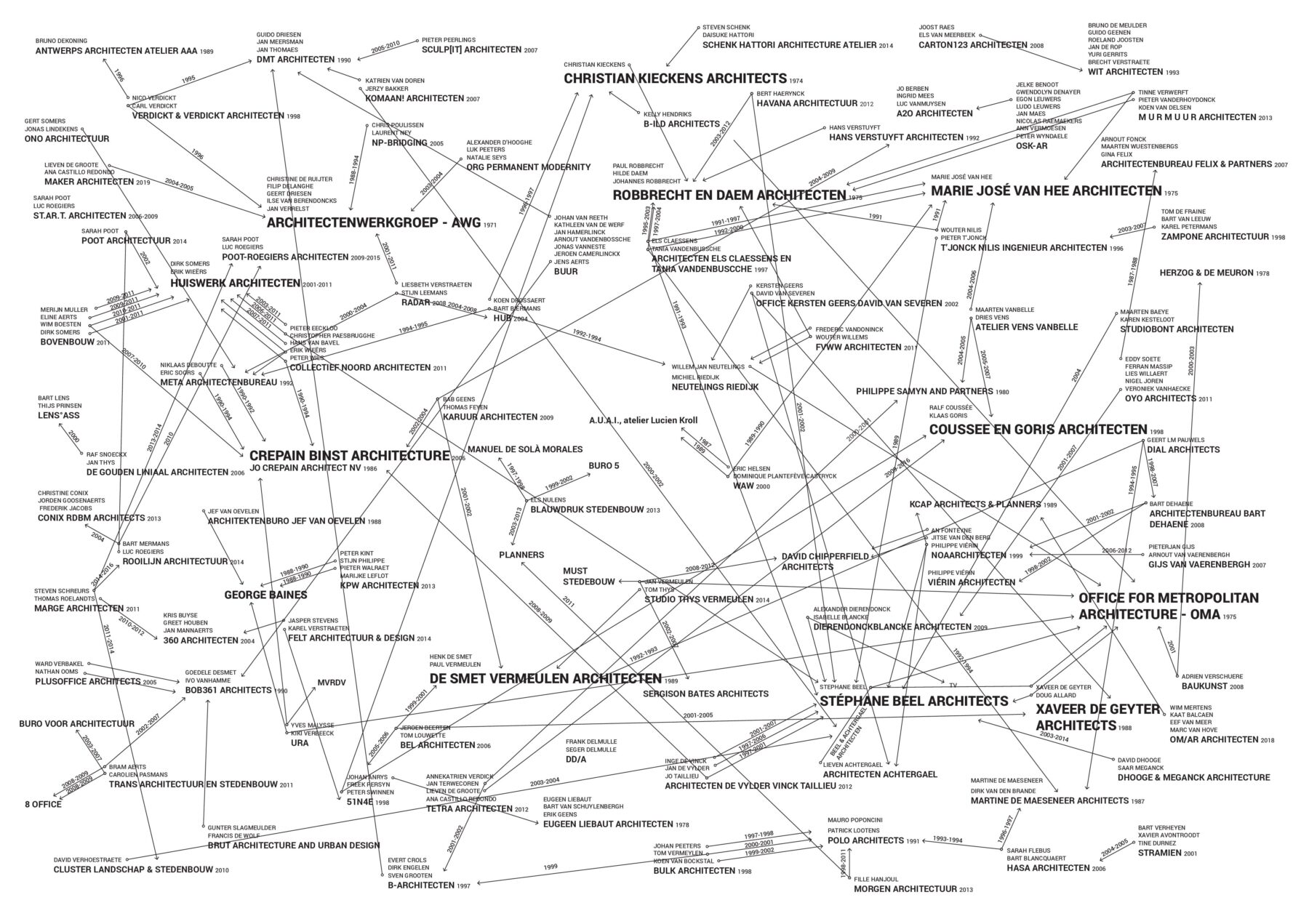
In part, this awareness is the result of the close connection that has long existed between architecture schools and design culture. For this generation, however, these background elements are complemented by connections outside the architect’s home base and alma mater. This makes it more difficult to speak of a genealogy – when Geert Bekaert introduced his ‘young gods’ in 1989, their origins and influences were somewhat easier to trace because it concerned a more limited field. Between the 1970s and the 1990s, a number of important offices were established in the larger cities, such as Robbrecht en Daem, Marie-José Van Hee and De Smet Vermeulen in Ghent, Atelier Pierre Hebbelinck in Liège, and Christian Kieckens, xdga and Philippe Samyn in Brussels. These were often connected to the architecture schools, where the partners also taught.