
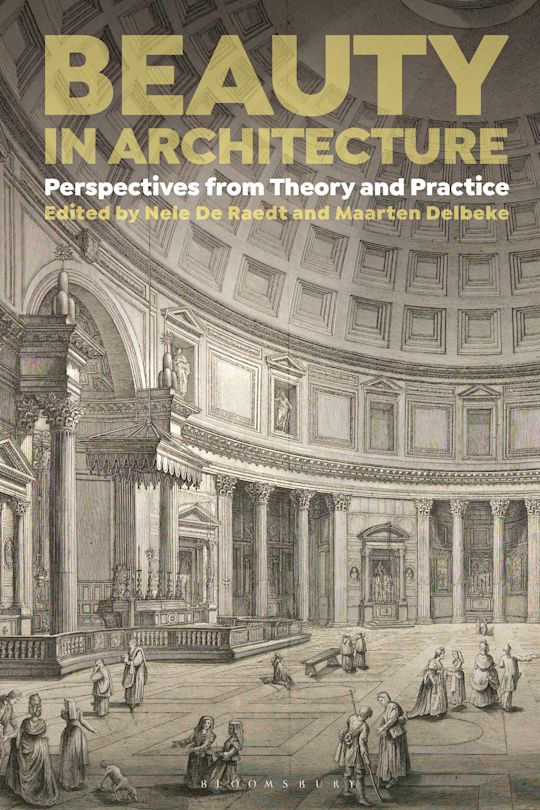
“Let’s make federal buildings beautiful again,” declared Donald Trump during his first term in office, immediately linking beauty to the ‘right’ architectural style. From now on, government buildings in the United States will be constructed solely in the neoclassical style. Fortunately, beauty is not claimed solely by the right-wing conservative camp. But a pre-packaged recipe for architectural beauty remains problematic, especially when debate is shunned. Nele De Raedt (UCL Louvain-la-Neuve) and Maarten Delbeke (ETH Zurich) organised a workshop on this topic and compiled the results in a book. With *Beauty in Architecture, Perspectives from Theory and Practice*, they give a voice to thinkers and designers and make beauty in architecture a topic of discussion once again.
Architects are reluctant to use the word ‘beautiful’. Beauty in architecture seems almost taboo, the reduction of a body of work to a matter of personal taste. For the general public, however, it is perfectly natural to find a building beautiful or ugly. And sometimes emotions run high on this subject. Just think of the debates in the press in recent years about the extension of the Steen in Antwerp or the Gravensteen in Ghent. “The professional architectural scene does not always have an answer to this. Yet beauty is a central concept when discussing architecture. This book arose from that sense of urgency,” says Maarten Delbeke. The book is divided into two parts. First, the designers have their say, with approaches that are very much rooted in their own practice. Through an ever-changing narrative and a surprisingly new perspective, Adam Caruso sketches an alternative framework for so-called classical beauty. Willem Jan Neutelings defends ornament as a vocabulary within the syntax of beauty. Mariam Issoufou demonstrates how deeply beauty is intertwined with the privileges of class and race. And Saar Meganck uses Dom Hans Van der Laan’s Rosenberg Abbey as a canvas for a series of epithets on beauty and architecture.
From a theoretical perspective, the reflections are even more diverse and reveal the endless variations in which the kaleidoscope of beauty can unfold. From the village beauty of rural China by Hong Wan Chan, the ‘terrific beauty’ of OMA’s architecture in a dissection by Christophe Van Gerrewey, or the aesthetic formalism of Branko Mitrovic, to the place beauty occupies in Flemish building legislation, in an analysis by Stéphanie De Somer. From the subversion of beauty as addressed by Vlad Ionescu to architectural beauty in the former colonies by Adam Jasper and Emma Letizia Jones. Each article carries a cultural or social undertone that quickly takes beauty in architecture far beyond the purely aesthetic approach to a built object, its materials, texture or colour.
Talking about beauty therefore inevitably becomes political. “The most important thing is that the conversation remains a polyphonic one,” says Nele De Raedt. “The problems begin when an ideal of beauty is predetermined. As soon as you narrow beauty down to a specific form or canon, it quickly becomes a tool for defending a political position. You need the conversation to test and challenge assumptions and agendas, especially within today’s social complexity.” There is no shortage of diversity of voices, depth and nuance in this book. But you won’t find any real tools in it to defuse a discussion with local residents about beauty versus ugliness. Nor is the problematic appropriation of beauty within a right-wing conservative framework addressed in any depth. Within the academic world, however, this book pushes boundaries and rescues beauty from the corner to which it had been banished since modernism.
Beauty in Architecture, Perspectives from Theory and Practice
Nele De Raedt (Editor), Maarten Delbeke (Editor)
Published: 07 Aug 2025
Format: Ebook (Epub & Mobi)
Edition: 1st
Extent: 240
ISBN: 9781350477292
Imprint: Bloomsbury Visual Arts
Illustrations: 39 colour illustrations
Publisher: Bloomsbury Publishing
