
Before the Leuven university hospitals moved to Gasthuisberg, on the outskirts of the city, they had for a century encroached upon the ‘Duke’s Site’, Leuven’s original city centre. There, the Dijle splits into two branches that form an island. The Aa, a tributary of the eastern branch, winds its way through the middle. The historic 12th-century city wall remained abandoned all this time, sandwiched between the hospital buildings and the covered western arm of the Dijle and the Aa, which had been reduced to hospital sewers.
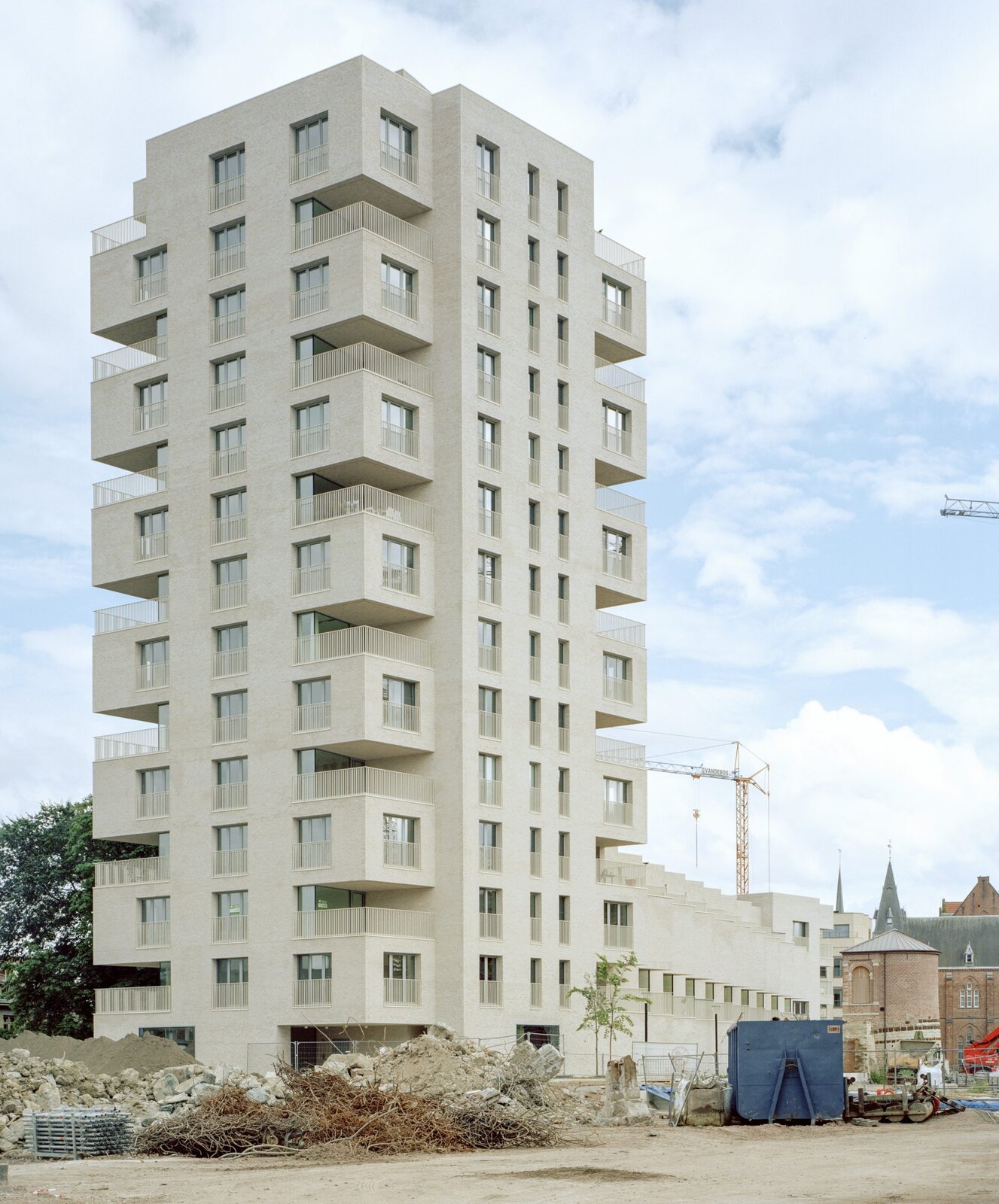
The masterplan by 360 architects and De Gregorio Architects repurposed the area, at the city’s request, into a residential zone surrounded by greenery and situated on the waterfront. Resiterra was appointed as the developer and played a key role in drafting the masterplan. This envisaged, amongst other things, a narrow building block between the Aa and the western Dijle, running parallel to the historic city wall from north to south to connect there with Minderbroederstraat. To the north, this block took the form of a thirteen-storey tower, overlooking a park to the north. Behind it, a long ‘tail’ formed the connection between the tower and the U-shaped Rega building. This tail is the same height as that building: four storeys.
Resiterra asked David Chipperfield to turn this concept into plans. The result is Hertog I, an 8,000 m² residential complex. The tower comprises 24 apartments, two per floor, and one penthouse. The ‘tail’ consists of nine homes with an entrance on the west side and a garden to the east, overlooking the Aa. A small block of flats forms the connection to the Rega building. A narrow road leading off Minderbroederstraat provides access to the underground car park and all the front doors.
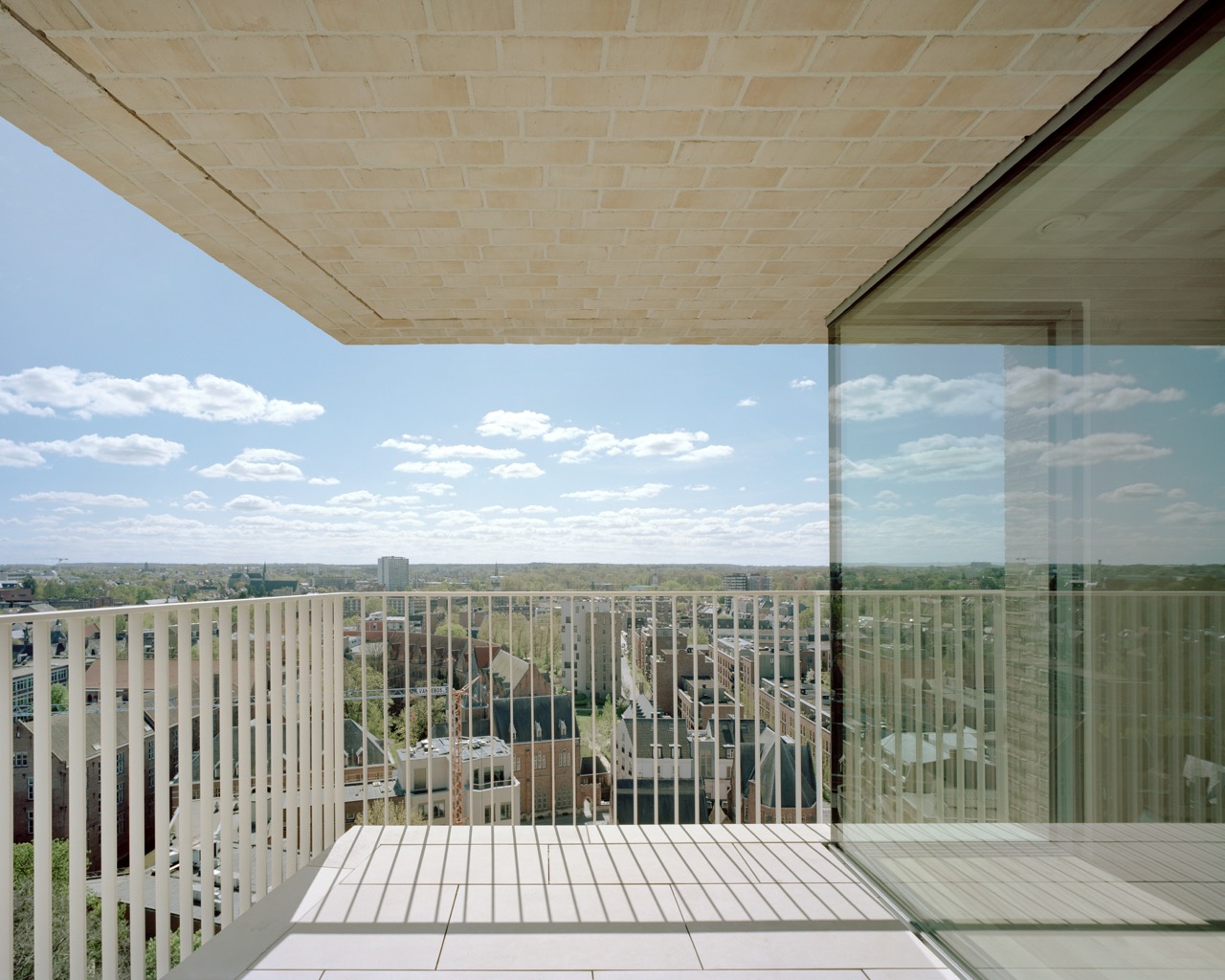
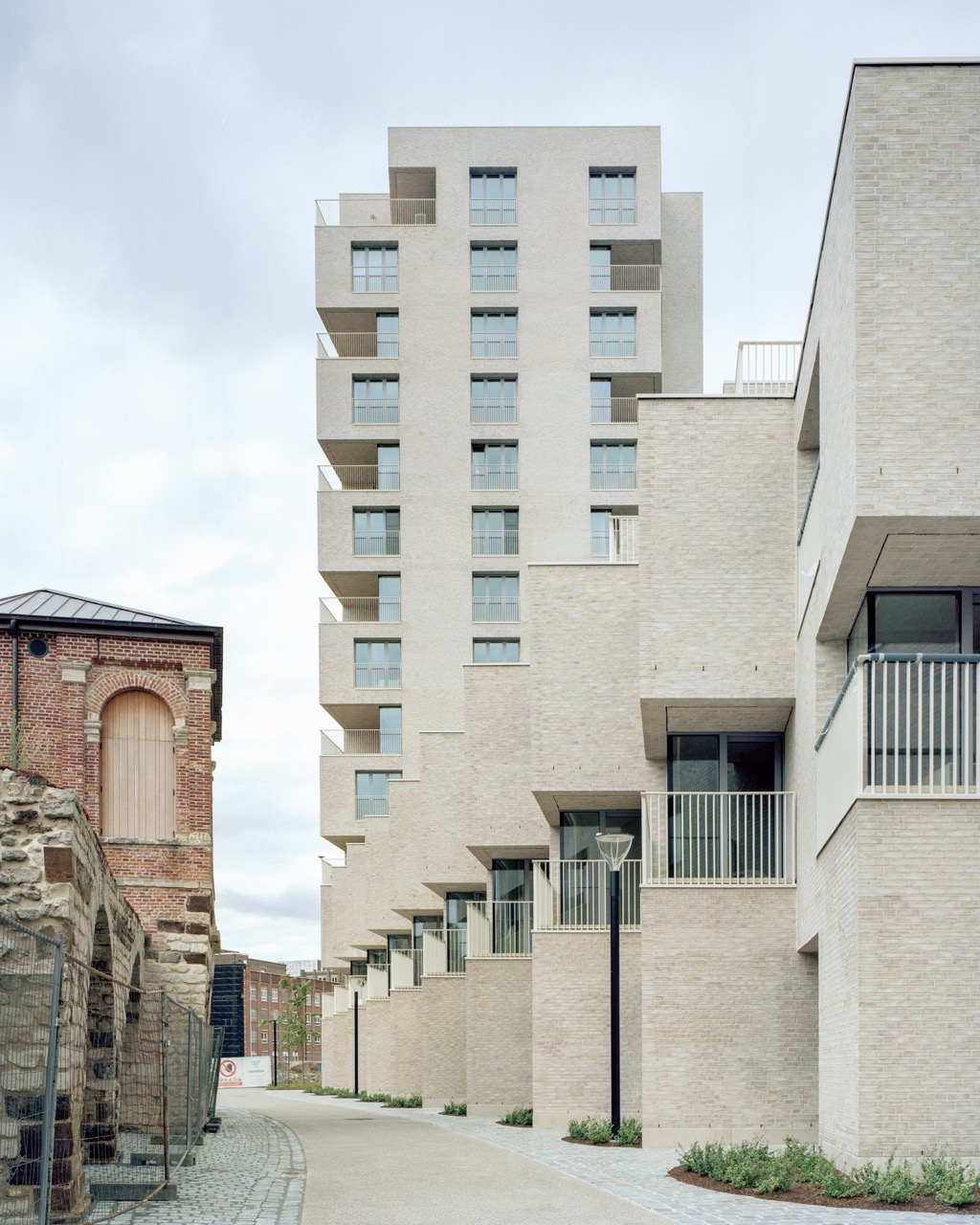
Within these tight constraints, Chipperfield managed to forge the head and tail into a convincing whole, and not only by cladding all the façades and even the terrace ceilings in the same light beige hand-moulded brick. Both the front and rear façades of the dwellings and the end block were given a sawtooth shape.
This is more than just a visual device. The staggered sections in the façades on the ‘street side’ create a sheltered forecourt for each dwelling. On the garden side, they prevent one garden from being overlooked by another. The living space on the first floor connects to that garden via an external staircase. The fourth floor recedes so far on the side facing the Dijle that it offers a spacious terrace, but the first floor also has a sheltered, covered terrace on the street side.
This motif of sheltered, covered terraces recurs in the tower. Two apartments wrap around the central lift shaft in an L-shape. On each floor, the terrace is staggered from front to back, ensuring there is no obstruction between the floors. This interplay of staggered terraces also gives the tower a striking appearance, partly thanks to the strict regularity of the window openings. Refined details in the spacious entrance area, with a huge, covered forecourt, do the rest.
Less inventive, by contrast, are the floor plans of the flats: they offer only the standard layout of dining room-kitchen-living room and bedrooms. The bedrooms in particular are rather cramped. Living here is not cheap either: around €5,000 per square metre. Yet all the units sold out quickly. It is a sign of the times: those who could afford it in the past swapped the city for a spacious suburb. Those who can now afford it are claiming the finest spots in the city as exclusive residential areas. But the park remains for everyone. The city made sure of that.
