
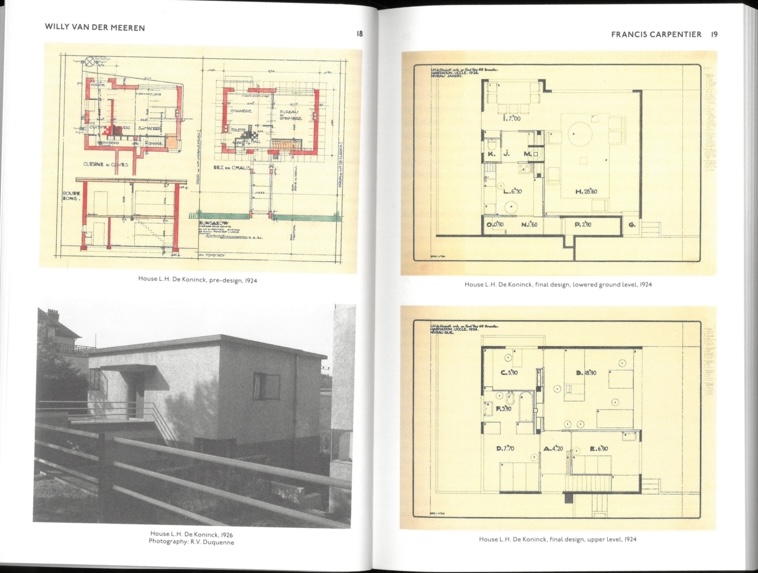
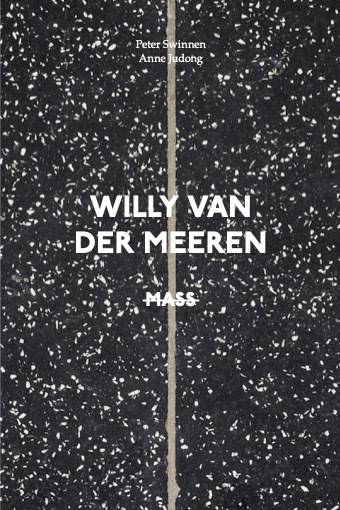
Willy Van Der Meeren. mass , edited by Peter Swinnen and Anne Judong, is—to the best of my knowledge—the first (provocative) English-language publication on the work of architect Willy Van Der Meeren (1923–2002). Earlier on, towards the end of his career, the many publications and the doctoral dissertation by Mil De Kooning (professor of architecture at Ghent University) had already saved him from near oblivion. Coincidentally, a study by De Kooning et al. on Van Der Meeren’s student housing for the campus of the newly founded VUB in Brussels in the early 1970s was published almost simultaneously. Both books complement each other nicely.
In their introduction, Swinnen and Judong argue that, as an architect, Van Der Meeren was full of contradictions—a man of “straightforward complexity” and “perennial impermanence.” He is known for his obsessive pursuit of the industrial mass production of both housing and furniture. His first major achievement was thus to design a complete set of household furnishings for the masses, created in collaboration with the Tubbax company. Together with architect Léon Palm, he also developed the CECA housing units1 early on, which could be assembled like a construction kit in record time at a price that was 40% lower than that of conventional housing. The project foundered, however, due to the mistrust of housing organizations. 1 CECA stands for Communauté Européenne du Charbon et de l’Acier, better known in English as the ECSC (European Coal and Steel Community).
Through a fascinating mosaic of historical research, archival documents, testimonies, interviews, and essays by Francis Carpentier, Rika Devos, Guido Stegen, Francis Strauven, Paul Robbrecht, and Swinnen and Judong themselves, emerges a far more complex picture of the building designer. Van Der Meeren recognized early on that centuries-old building practices were at odds with a rapidly modernizing society, resulting in a practice mired in trivialities, opaque processes, and kitsch. Through his designs, he sought to provide residents with the means to engage more consciously with the “brave new world” that emerged after Expo ’58. His open-ended structures, which combined extreme economy of means with a playful design flair, paved the way toward that goal.
Moreover, Van Der Meeren opposed modernist tenets such as functional zoning. He believed, like Team Ten (think: Aldo Van Eyck, and Peter and Alison Smithson), that cities only come alive through functional mixing. He also realized, long before it became common knowledge, that the complexity of postwar society required computer-driven data analysis. None of this prevented him, however, from conceiving a home imbued with a singular poetry, much like that of the Flemish novelist and poet Maurice Roelants. The many photographs by Filip Dujardin and Aglaia Conrad capture all of this with precision.
Willy Van der Meeren VUB/From Static to Dynamic by Mil De Kooning essentially tells the same story, using the example of Van der Meeren’s prefabricated student housing for the brand-new VUB in the 1970s. The study clearly demonstrates how Van Der Meeren linked prefabrication to seemingly contradictory concepts such as recognizability and “resident empowerment” – making it a must-read on two counts.
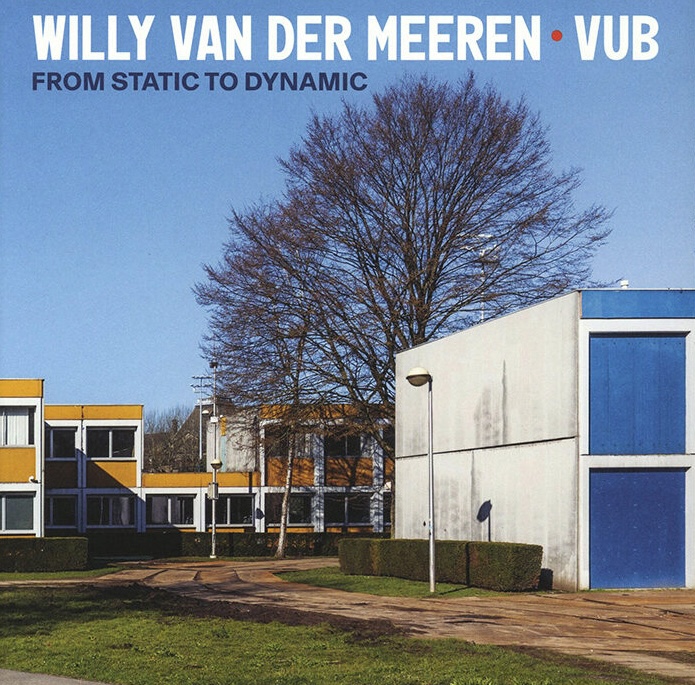
Willy Van Der Meeren VUB/From Static to Dynamic, Mil De Kooning, Stephanie Van de Voorde, Ellen Van Impe. Borgerhoff & Lamberigts, Ghent 2026. ISBN 9789493457645. 200 pp., color and b/w illustrations, softcover. Suggested retail price: 29.99 €
Willy Van Der Meeren mass, Peter Swinnen & Anne Judong (eds.), Spector Books, Leipzig, 2025. 212 pp., color and b/w illustrations. Stapled, softcover, A5. ISBN 9783959059282. Suggested retail price: 27 €.
