
Taking stock of a country’s architectural landscape is no easy task. Even in a small country like Belgium, it is impossible for a single person to keep track of the output of the thousands of architects in Belgium or to draw clear conclusions from the discussions surrounding it. Usually, only éminences grises (such as Geert Bekaert) or collectives (such as the Yearbooks in Flanders) venture to do so. Yet Christophe Van Gerrewey did just that when, at the age of just 32, he published Architecture in Belgium with the Belgian publisher Lannoo in 2014. The book covered the period 1989–2016, roughly the period between the fall of the Wall, which seemed to herald the seemed to herald the ‘end of history’ and the cascade of financial, political and ecological crises (the Balkan War, the banking crisis, the climate crisis, etc.), which proved that history had returned in a gruesome manner, having never truly gone away.
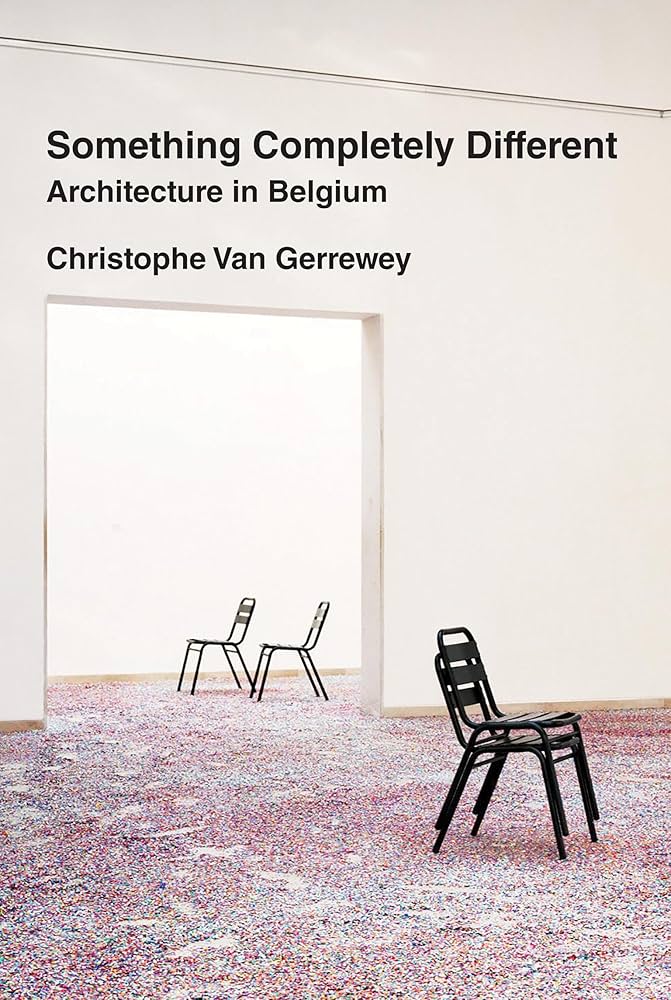
Van Gerrewey certainly did not lack for swagger: the book’s cover openly referenced the quasi-eponymous publication and exhibition *Bouwen in België 1945–1970* (1970) by Geert Bekaert and Francis Strauven, an early attempt to challenge the status quo of architecture. Van Gerrewey was wise enough not to make any definitive pronouncements. Essentially, he presented around 80 projects that made a difference in the confused, and until well into the 1980s, rather uninspiring Belgian architectural scene. The book served as a barometer of the rising quality in the field.
Ten years later, Van Gerrewey repeated the exercise, this time not with a ‘local’ publisher, but with the prestigious MIT Press, in English, and thus for a global audience. Something completely different is, therefore, a completely different study. To begin with, it covers the entire history of Belgium since 1830, with an emphasis on the 20th and 21st centuries. Above all, it presents ‘Belgium’ as a touchstone ‘to tell the story of how architects have, in different and often contradictory ways, mediated humanity’s spatial presence during successive waves of modernisation’.
The afterword to the book spells out the question Van Gerrewey posed in this context. Making a difference, the starting point of his earlier overview, is here contrasted with repetition, the familiar. That tension is a constant theme in every architectural design. By playing on this tension, a building draws attention to itself. But, as Van Gerrewey dryly observes, attracting attention seems to be the only thing that still counts in virtually every sphere of society today. With a bold leap of thought, he thus describes architecture as the canary in the coal mine of the social tension between the individual and society, between the private and the public, which has been growing since the 19th century.
That is what the book is all about. The architect, as an autonomous player in an increasingly complex social field, can serve as a lens through which to question the contradictions within that field, not least because architects – in an endless oscillation between overconfidence and frustration – have often devised outspoken solutions to them. At times megalomaniacal, verging on the comical, at others on the small scale of the house. In that light, the focus on Belgium is highly relevant. The country is historically the result of haggling between European great powers. Having been the plaything of foreign rulers for centuries, Belgians distrust any form of authority that transcends their regional or urban environment. Yet it is also the seat of the EU. It is therefore a country where everything, and its opposite, is (un)true.
Van Gerrewey explores this idea in seven essays, centred on seven questions. The word ‘essay’ should be taken literally here: none of the chapters is an argument that heads straight for a conclusion. Each is a mosaic of texts and images that the author pieces together. In the space between these fragments, intriguing insights emerge, but no definitive ideology. Van Gerrewey is no Siegfried Giedion who maps out the course of history in advance. Rather, he reveals the relativity of history. If you follow him, history is too directionless to fit into a single ideology, however useful ideology may be for sharpening one’s thinking.
This essayistic character means that some architects receive an unusual amount of attention within a particular line of thought, whilst others of equal renown go unmentioned. It also means that burning issues such as climate change are touched upon here, but rarely in their own right; rather, in the way they (and discussions about them) shape designs. He barely even comments on the ‘heritage’ of the country. The book’s central theme remains the complex, evolving relationship between public and private, or rather, the shifting dynamics in which architects sometimes retreat to the individual house and at other times redraw the entire national territory.
Within that premise, the book is a delight to read. Van Gerrewey draws on a wide variety of sources. He draws on writers such as Charles Baudelaire or Hugo Claus, philosophers such as Hannah Arendt, Theodor Adorno or Walter Benjamin, and artists such as Roger Raveel or Frans Masereel to illustrate a specific perspective, accompanied by well-chosen images. In addition, he also quotes and discusses many designs, but his selection is rather idiosyncratic. When it comes to urban planning, Le Corbusier makes a few brief appearances – not in his most favourable light – as does his follower Renaat Braem, but he attaches equal importance to the work of Bovenbouw, Luc Deleu, Dogma, Henk Desmedt and Paul Vermeulen (HDSPV), Office Kersten Geers David Van Severen or Xaveer De Geyter.
The sixth chapter of the book, ‘Pull out a chair’, illustrates well the wealth of ideas that Van Gerrewey connects in such an inimitable way. It deals with the question of what architecture still means today in a culturally oversaturated society. The author opens with the question of how confetti scraps became an architectural motif. After all, confetti is chaotic, random, fleeting – everything that architecture is not. Yet it emerged at OMA as an organising principle for Parc de la Villette in Paris. The floor of the installation ‘1907…After the party’ by Office KGDVS at the 2008 Venice Biennale was even strewn with it. Van Gerrewey links that image directly to the banking crisis that had just broken out: the neoliberal party was indeed over, with all the consequences that entailed for architects. What, then, can architecture still mean, Van Gerrewey wonders, echoing Manfredo Tafuri and Victor Hugo. This leads him to the Belgian urban planning context: that too is a scattering of objects carelessly strewn across the landscape, despite the existence of an Order of Architects. As if nobody except those architects gave a damn about architecture or urban planning. However, as he notes with Geert Bekaert, those architects – and especially that Order – have only themselves to blame. They wanted to monopolise the discussion on architecture, but architecture cannot exist in isolation: without a dialogue about it, fuelled by a serious culture of competition, it means nothing. He demonstrates this with an overview of high-profile competitions. He concludes: ‘Architecture is not about building. It’s about using the possibility of building to envision a desirable future. Architectural culture should enable us to consider what our options are, even when most of the parties are over’.
In other words: it is about differences, but not as an end in itself. In this, architecture distinguishes itself from the bulk of contemporary cultural expressions. It is a delight to read a text that takes you through every corner of the landscape to arrive at this proposition.
Something completely different – Architecture in Belgium, Christophe Van Gerrewey, The MIT Press, Cambridge, Mass. 2024. ISBN 978-0-262-54751-2
