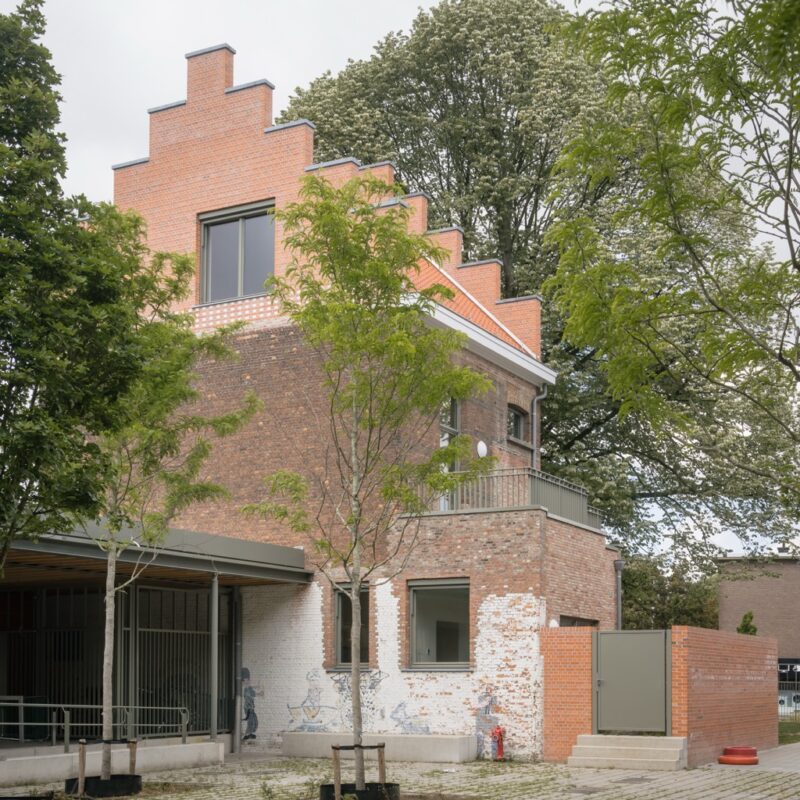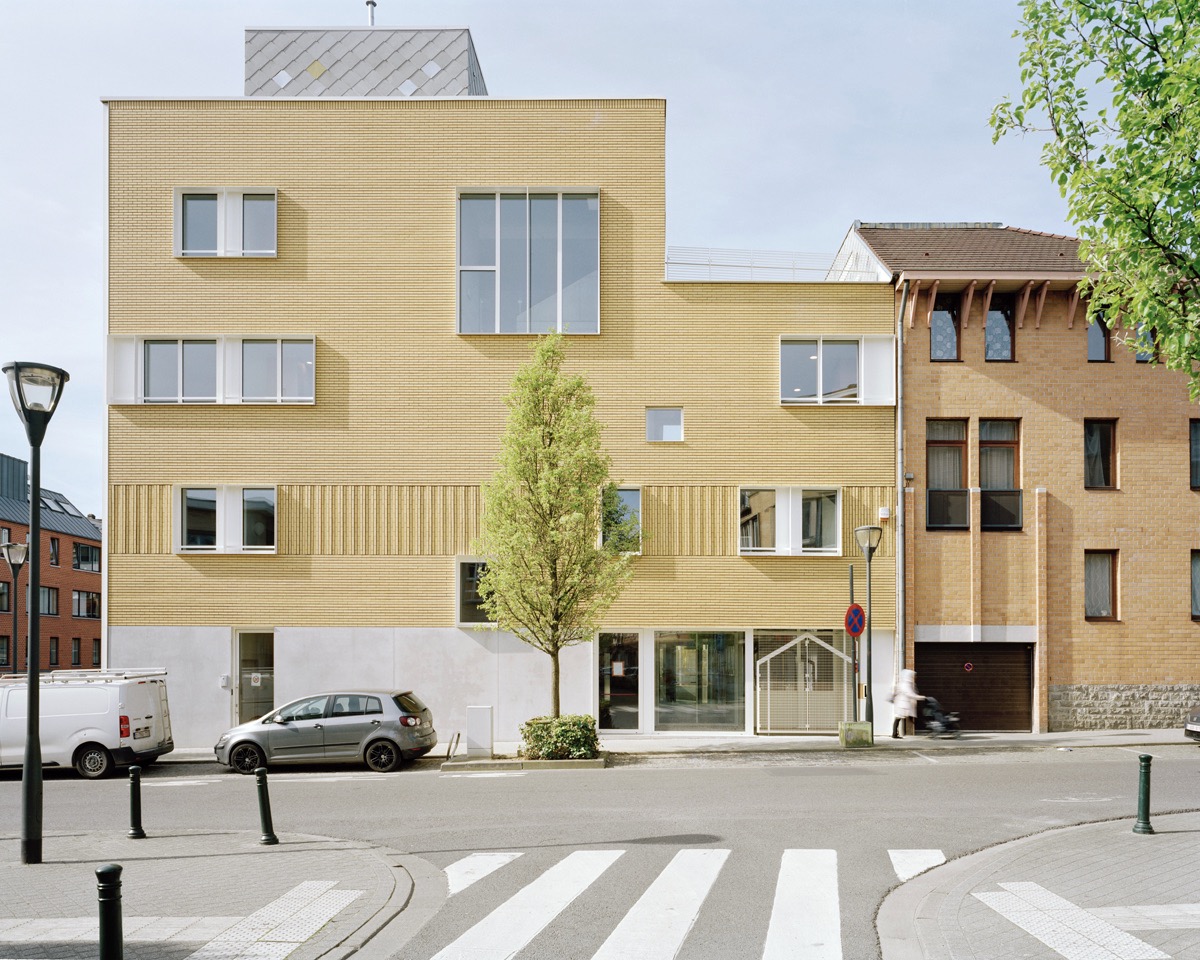
In the municipality of Koekelberg, the architectural practice Baumans-Deffet and the Yves Delincé studio have completed a nursery with two distinct faces: on the street side, it blends in perfectly with a yellow brick façade that discreetly echoes the neighbourhood’s urban character, whilst at the heart of the block, it embraces the whimsy required by the project, with monumental objects suspended from the façade, surrounded by shimmering metallic scales.
The practices of Bernard Deffet and Yves Delincé have long shared offices on Rue Bois-l’Évêque in Liège. Their temporary partnership to create a municipal crèche provides an opportunity to combine their specialisms: urban planning for the former and early childhood programmes for the latter. The project, initiated by the Koekelberg Historique sustainable neighbourhood contract, goes beyond the scale of a single building by producing an urban response that forms part of a medium- and long-term process, aiming to close off the block situated between Rue Émile Sergijsels and Rue de la Sécurité. Together, they worked on the various phases (nursery, shops, housing) as successive stages that could be carried out independently of one another. However, in the end, the local council abandoned the ambition of a mixed-use development on the site, and only the nursery was built.
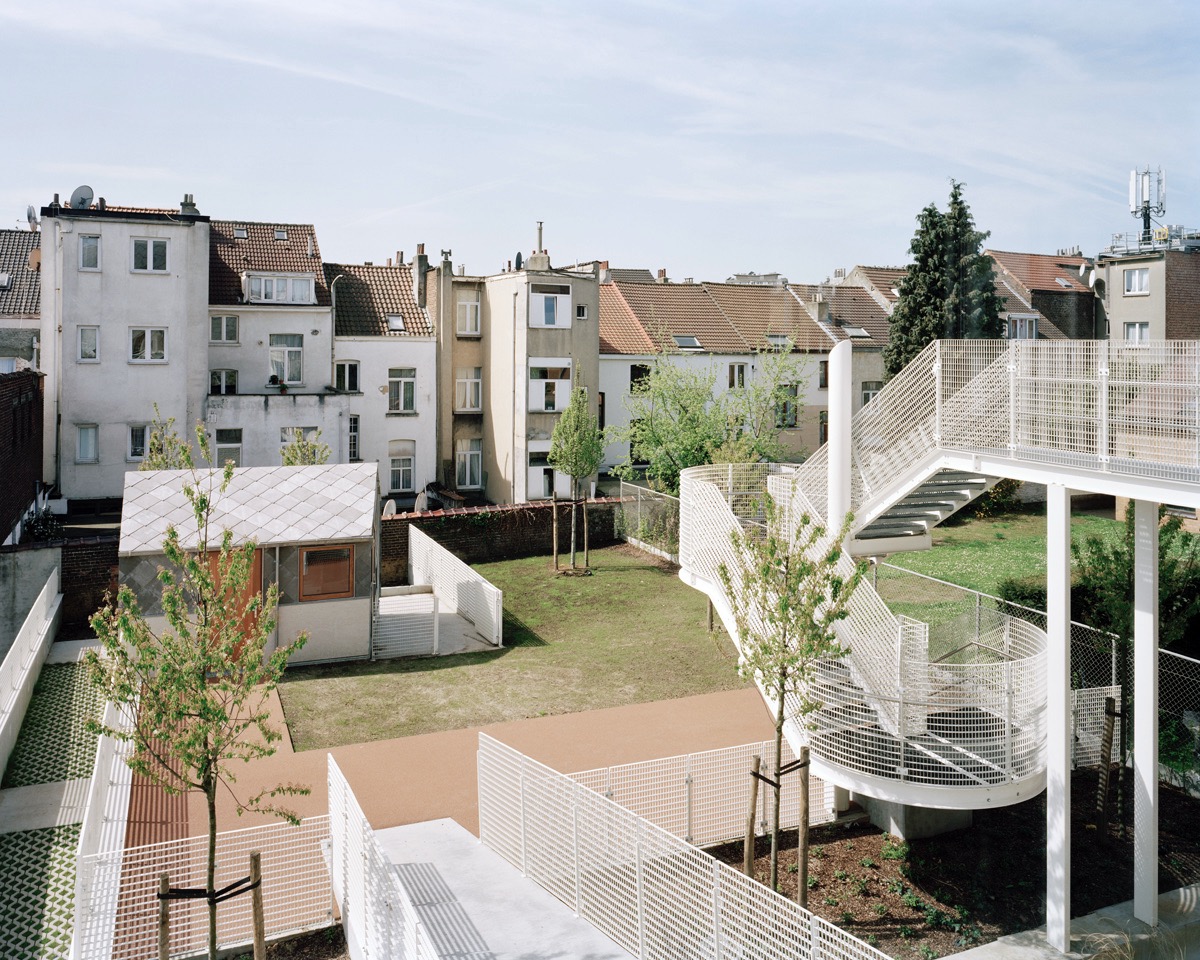
Its location was specified in the tender documents; it must be situated adjacent to a building belonging to the clergy. The architects therefore decided to respect the continuity of the existing structure and opted for a compact volume, spread over four floors. This verticality of the project was intended to allow for the creation of a genuine central courtyard within the block, to be enjoyed by the children and staff of the nursery. Two distinct facades characterise the building; they ensure both its integration into the neighbourhood and the development of an architectural vocabulary that stimulates young children. Thus, on the street side, there is a concrete plinth topped by three storeys of light yellow brick (1950s style). Mechanical in nature, this façade features fine lines forming a uniform surface, interrupted only by a band at the level of the first-floor openings, whose vertical arrangement creates a play of light and shadow. It echoes the materiality of many public buildings in the neighbourhood, helping to anchor the building within its context. At the rear, at the heart of the block, the façade features a lighter cladding, consisting of matt grey scales punctuated by metallic slates. Across the entire volume, the windows appear as chiselled white boxes, embedded in the façade.