
Toolbox Dorpenbouw (Toolbox for Village Development) is the follow-up to Toolbox Dorpse Architectuur (Toolbox for Village Architecture) and features some of the same authors, too. Like its predecessor, this toolbox does not provide any definitive answers to the questions of what constituted a Flemish village in the past, why we should preserve it, or how it might evolve into a ‘village idyll 2.0’, but it does provide interesting insights into the history of villages, which it supplements with a few inspiring examples.
A village is a cluster of houses in a rural landscape with a communal space such as a church or commons. From this description, the authors derive three definitions of a village: it is a spatial entity, a specific social space, and a nostalgic ideal of a place where life is good. They realise, of course, that this ideal rarely holds true historically, and is often fictitious these days. Nevertheless, they believe that this fiction can positively influence decisions regarding the layout of a village.
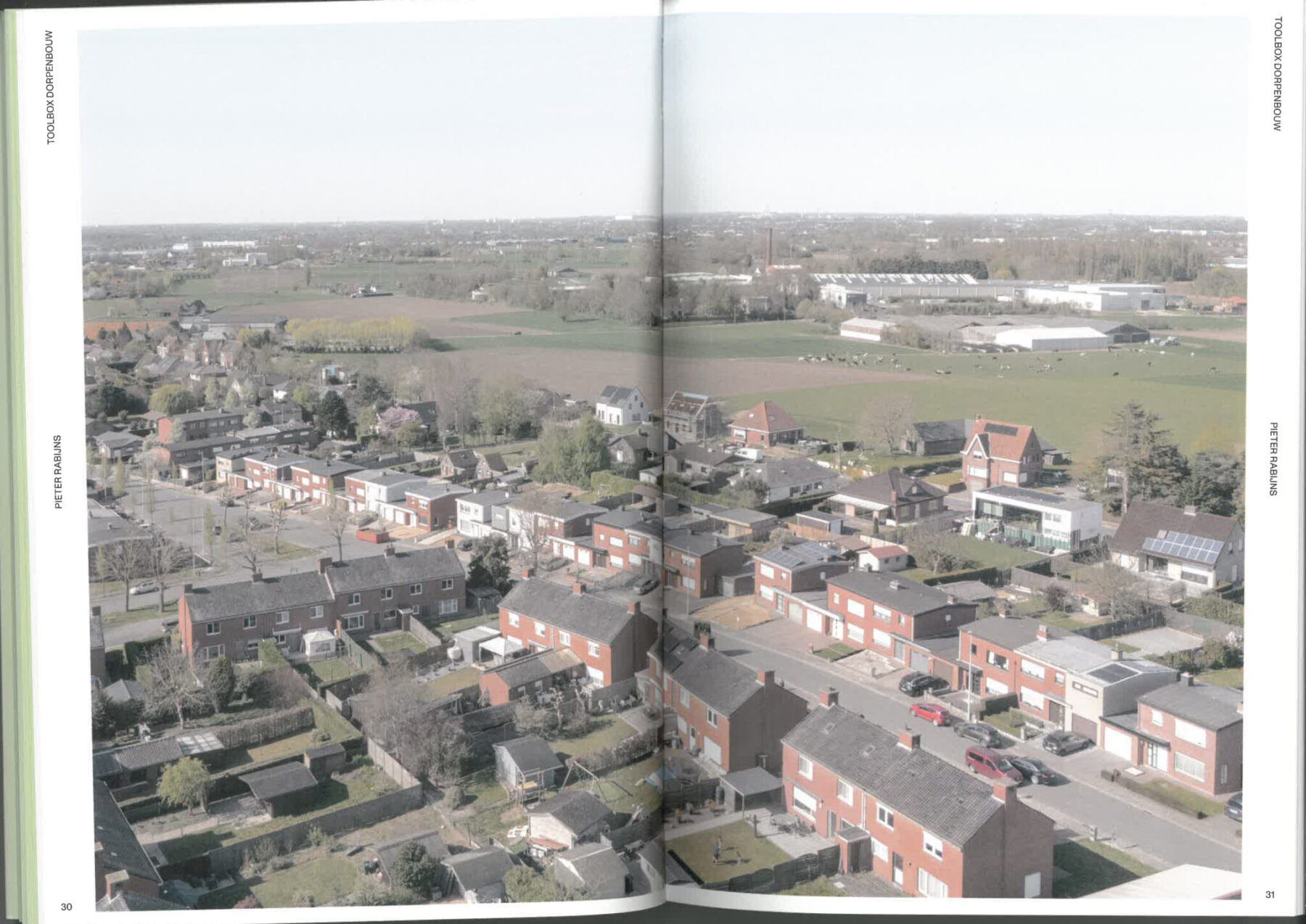
As the +/- 1,200 villages in Flanders are quickly becoming denser with urban housing forms such as flats, the authors believe this trend can serve as a catalyst for improvement. After all, this densification also provides the capital for improvements to public spaces, water management, or the relationship with the surrounding agricultural and nature areas. The book aims to contribute to this evolution by offering a conceptual framework and a range of good practice examples. The urgency of the situation is demonstrated – in my opinion – by Pieter Rabijns’s depressing drone images in which the Flemish village appears as an endless sprawl of villas and infrastructure.
The book’s ‘Kleine Atlas van het Dorp’ (Compact Village Atlas) clearly illustrates the diversity of village types in Flanders. First, the atlas illustrates the connection with the landscape, which is quite different in the polder region than on the Kempen plateau. It also shows the impact of a village’s history of origin. The authors distinguish eight types, ranging from the typical medieval village centred around a church to the 19th-century colony village or the more recent village consisting of parcelled plots. Using a single example, this section also illustrates how villages ‘exploded’ after the Second World War, yet without mentioning the specific political choices that motivated it, which, as we know, did not turn out well.
The crux of this book is the question of how one can still realise the ideal vision of a ‘village 2.0’ and reconcile it with current concerns such as the preservation of natural diversity, water management, and soil decompaction. The authors also discuss the issue of social cohesion by presenting several inspiring examples that focus on five themes. These cover the connection with the landscape, solutions for (car) mobility, community life and (political) participation.
The book concludes with quotes from researchers on the same themes. Reading between the lines, one senses that architecture and urban planning have much to offer, but “not all problems can be solved!” The book also remains conspicuously silent on the stubborn reality of overly legalistic urban planning legislation. As such, it sometimes reads more like a wish list than a practical toolkit.
Toolbox Dorpenbouw, Ward Verbakel, Karl Catteeuw, Edith Wouters, Els Demeestere, Joeri De Bruyn; Public Space Mechelen 2026. ISBN 9789491789458. Recommended retail price: €35.
