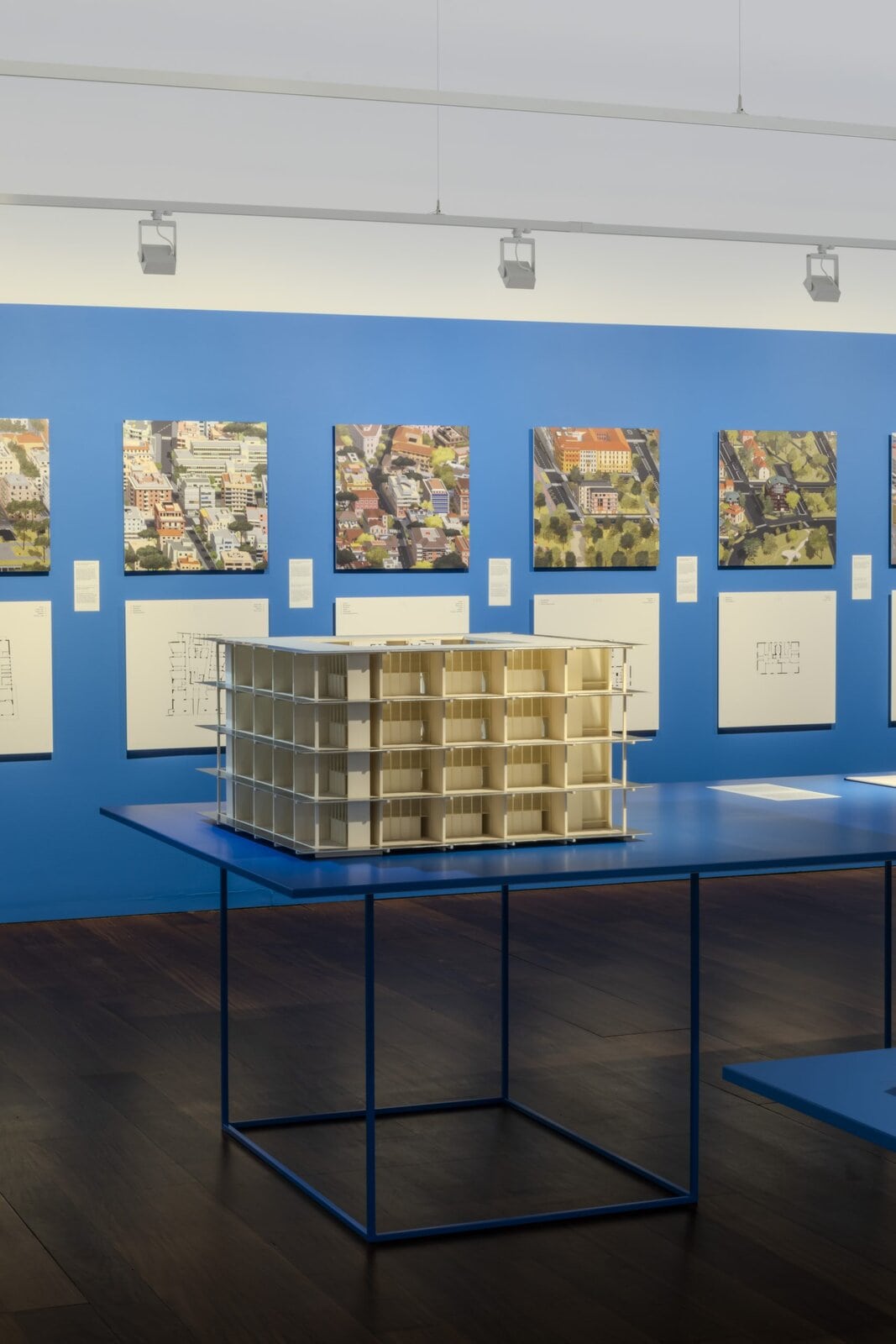
From October 2024 to February 2025, the exhibition ‘The urban villa / From speculation to cooperation’ by DOGMA (Pier Vittorio Aureli and Martino Tattara) and VAi ran at DeSingel, Antwerp. It put forward the argument that the urban villa, originally a speculative building type, lends itself perfectly to radical collective forms of housing due to its layout and construction method. The publication that followed the exhibition defends the same argument with a wealth of plans and texts.
From the 19th century onwards, urban villas enjoyed growing popularity in European cities as a type that reconciled the illusion of a detached suburban home in green surroundings with a small footprint. In this way, rising land prices in cities were countered. Such villas are a compact version of a type that originated as far back as Roman times but really came into its own from the 15th century onwards. Typically, such a villa has a block-like form, with a central staircase, so that the flats on the upper floors enjoy plenty of light and air, often with spacious balconies.
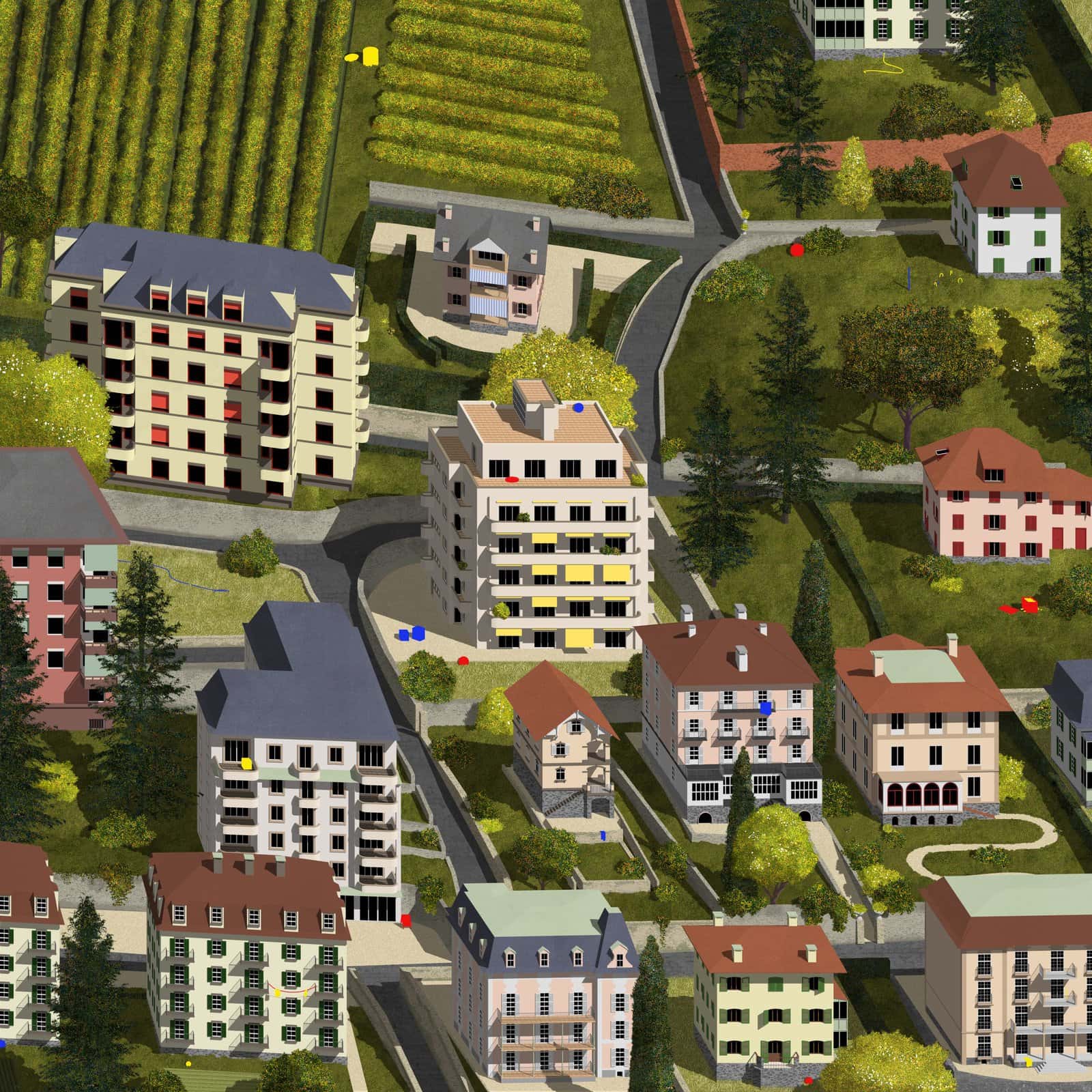
In the first part of the book, DOGMA outlines this evolution using historical examples. The oldest is the Villa Medici in Fiesole (IT) by Michelozzi and Alberti. The most recent examples, by EM2N or Atelier Kempe-Thill, date from the years after 2000. This overview demonstrates just how versatile this type of building is. It was also frequently used in social housing. Each project is presented through a detailed axonometric view of the building in its context and a typical floor plan.
However, ‘The urban villa / From speculation to cooperation’ aims to be more than a historical sketch. After all, a housing type, argues DOGMA, is the expression of economic and political forces. Today, these forces elevate private ownership and the nuclear family to the norm, at the expense of multi-generational and multi-family cohabitation. Yet in pre-capitalist times, this was the rule rather than the exception. Such a collective form of housing offers vulnerable people in particular a stronger support network and thus better life prospects. According to DOGMA, the urban villa is ideally suited to this purpose. After all, its essence lies in the fact that the load-bearing walls are concentrated around the central circulation core and the external facades. This allows for flexible floor plans at limited cost.
DOGMA illustrates this through concrete designs. The most radical proposal is the Communal Villa (2015, Berlin). The outer edge of the four double-height storeys consists of identical, double-height cells for one or two people, each with a bathroom, bedroom and private workspace. All other facilities, from kitchens to studios, crèches and even a swimming pool, are located in the central, top-lit space.
DOGMA also explored the possibility of providing this type of collective housing in Antwerp, for example in Europark on Linkeroever. These projects are preceded in the book by five interviews with housing experts such as Nicolas Bernard, Marta Maliverni, Geert De Pauw and Gert Eyckermans, as well as an expert by experience such as Anita Palumbo. They shed a sharp light on the many obstacles, both ideological and regulatory, that hinder the emergence of collective housing forms in Belgium. The urban villa is therefore more than a beautifully illustrated historical overview. It challenges architects to recognise the unspoken ideological assumptions underlying classical planning forms. It also challenges policymakers to face up to the detrimental impact of much of the regulation on collective living.
The urban villa / From speculation to cooperation, DOGMA (Pier Vittorio Aureli, Martino Tattara and associates). Vai and Black Square, Antwerp, 2025. Soft cover, 245 p. ISBN 9788894030655. Recommended retail price €34.