
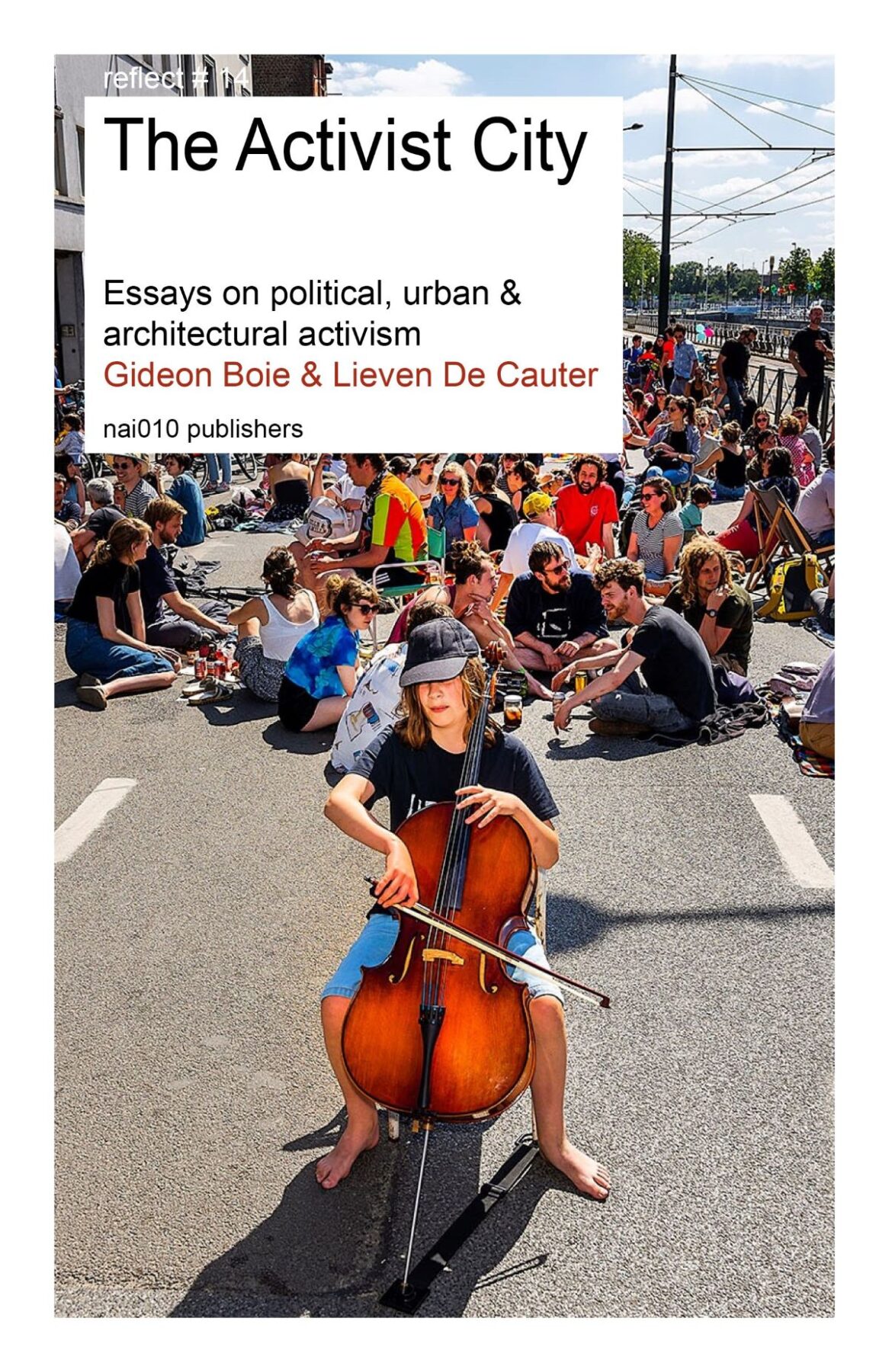
On 7 May, Gideon Boie and Lieven Decauter presented the collection of essays THE ACTIVIST CITY / Essays on Political, Urban and Architectural Activism at the Beursschouwburg in Brussels. Two weeks later, Boie passed away. This plea for a city for all has now become a spiritual testament. Moreover, it proves that architectural activism isn’t only possible and desirable, but is gradually becoming the norm.
In the first part of the book, the authors describe activism as a positive act, aimed at improving living conditions for all. They draw on Jacques Rancière’s idea that politics revolves around the exceptional moment when marginalised groups raise their voices. A recent example is the school strikes organised by Greta Thunberg, to demand a voice in the climate debate. The fact that children took action here changed both the debate and society. In those first essays, the authors set out their thoughts as clearly and comprehensibly as possible, without resorting to oversimplifications. It’s a book for everyone. This is also true of the other essays, which shed light on related themes such as the meaning of the ‘Commons’.
The city, the polis as the cradle of politics, is the natural point of reference for all these essays. Part II, Forms and Constellations of Activism, sets out how activism manifests itself in the city. The authors identify three basic forms. The first is political action: demonstrations, occupations or acts of civil disobedience. These don’t necessarily relate to the day-to-day of urban society itself. Urban activism, by contrast, seeks to transform the urban fabric through specific actions, in such a way that marginalised groups are given a place within it. It therefore also concerns the struggle for more togetherness in public space.
Surprisingly, the authors present architectural activism as a third form of activism. One would assume that architects, as service providers, generally do what their clients ask of them. Yet, many architects contribute to alternative visions of (urban) society, either outside or during their working hours. Some of these architects produce ‘paper architecture’, but an increasing numbers is also creating ‘hands-on’ work. The book charts this history, particularly in Brussels. However, the authors also point to some unintended consequences, such as gentrification. Even more surprising is the category of activist architecture: the building itself as a driver of change. The work of Lacaton-Vasalle appears to be a forerunner in this regard, but Brussels also has many examples, such as Parckfarm.
The book concludes with a plea for a city – in this case, Brussels – that invests in road safety for its residents. It’s Boie who speaks out most strongly on this issue: a previous essay of his, Kleine filosofie van de verkeersveilgheid (A Brief Philosophy of Road Safety), was dedicated to this topic in the Zuidzee series. He mercilessly dissects the double standards and cowardice of politicians when it comes to the rights of active road users, making the book a must-read for anyone interested in activism in an urban context such as Brussels.
THE ACTIVIST CITY / Essays on Political, Urban and Architectural Activism, Lieven Decauter and Gideon Boie, nai 010 Rotterdam, 2026. English, 266 p. ISBN 978-94-6208-985-3. Recommended price: 39,95 €.
Kleine filosofie van de verkeersveiligheid, Gideon Boie, published in the Zuidzee series, Public Space, Mechelen 2025. ISBN 978-94-9178-410.
