In the Marolles district, on Rue Terre-Neuve, the emergency shelter for homeless people run by the non-profit organisation Pierre d’Angle is launching a call for proposals supported by the Joint Community Commission (CoCoM). The centre wishes to expand with a second building within the same block. The aim is to renovate both buildings and connect them through a structural integration, so that the centre’s activities can operate with spatial continuity.
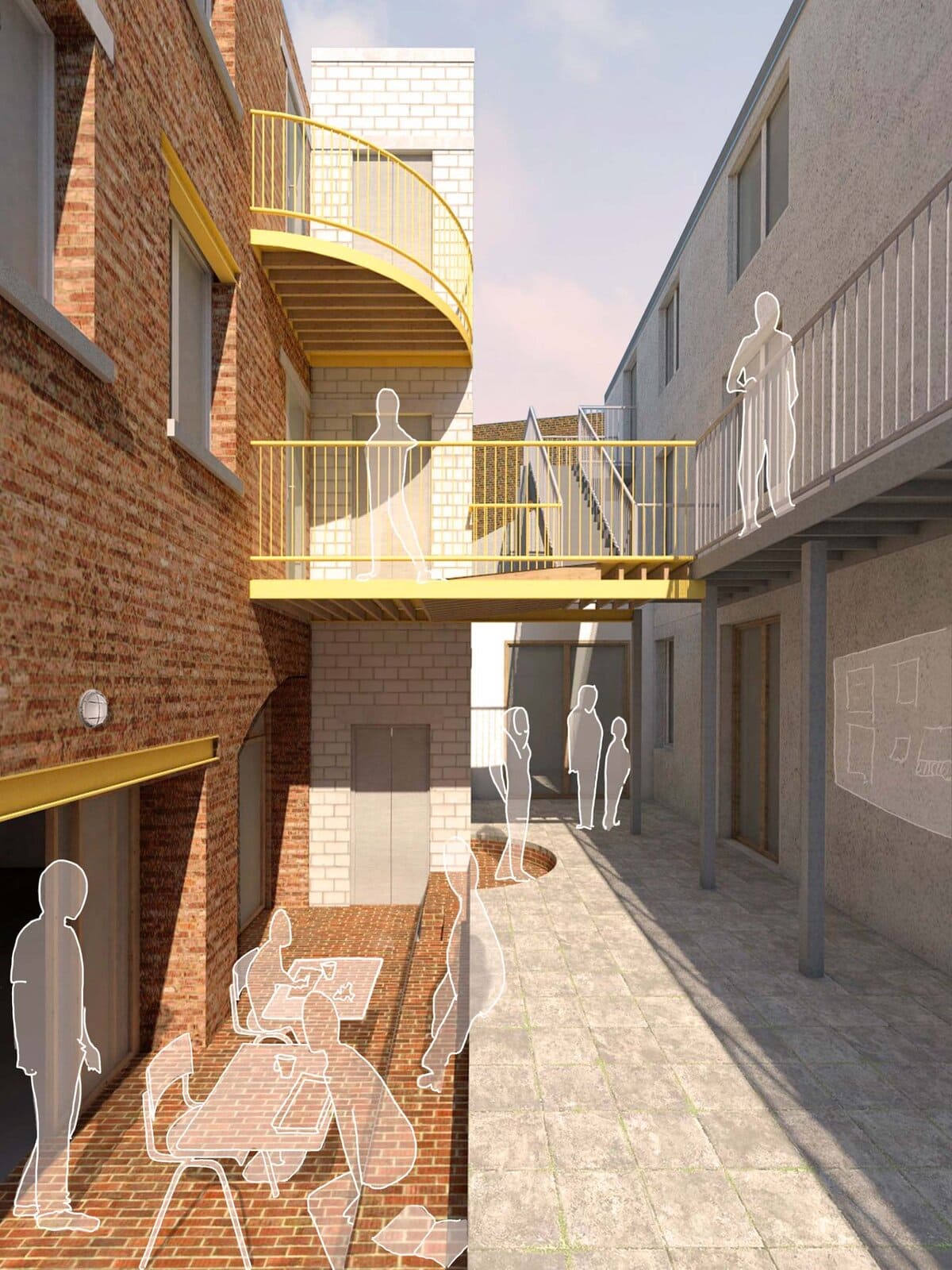
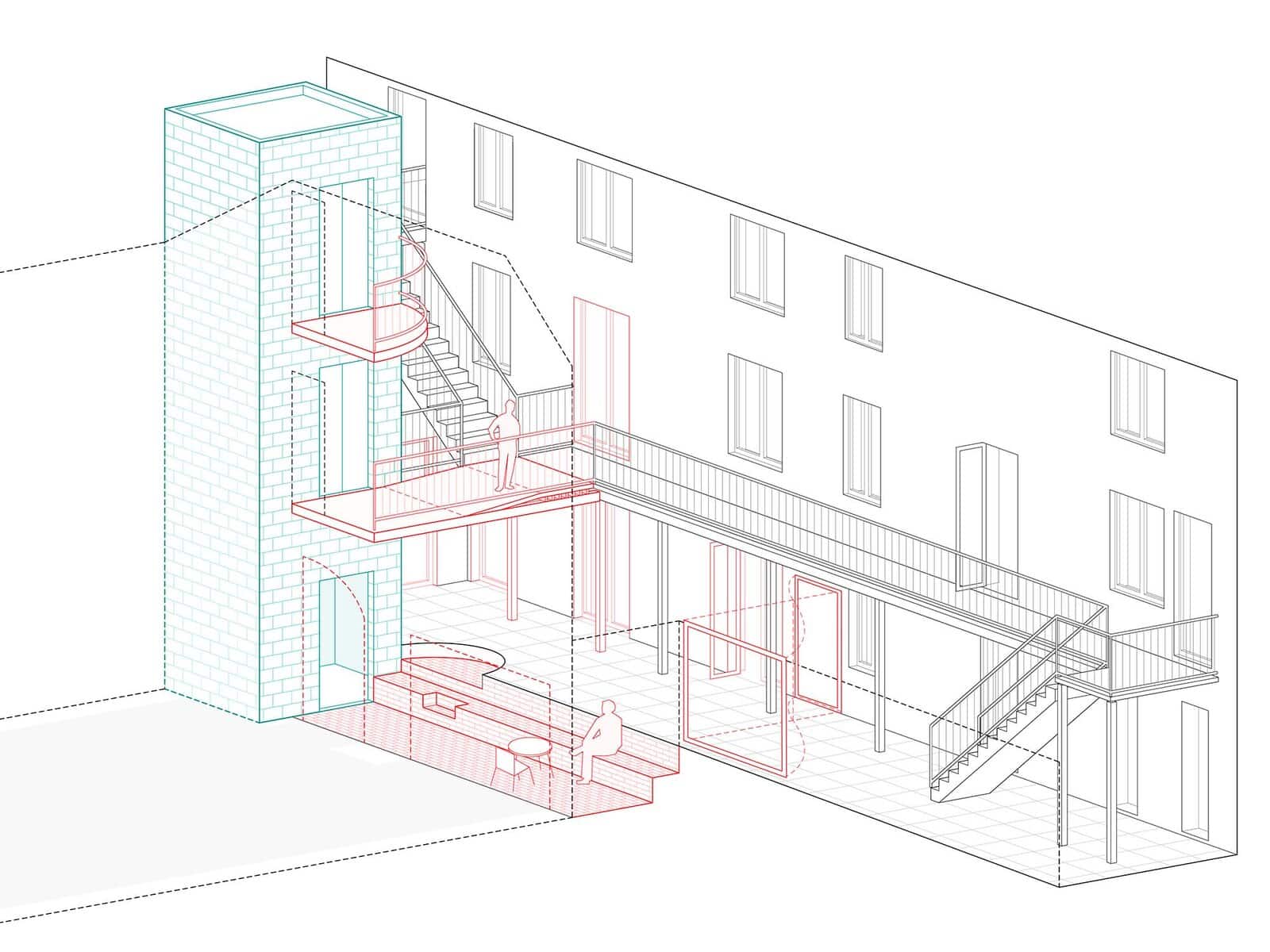
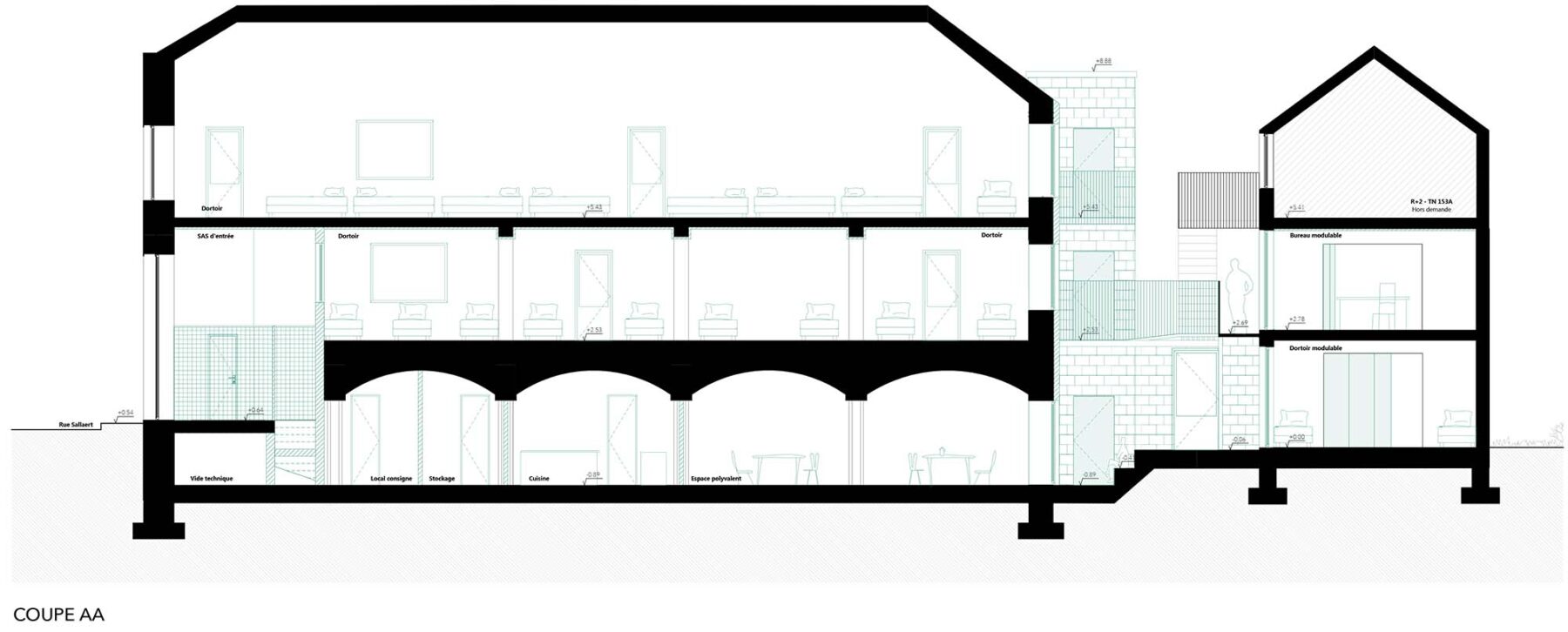
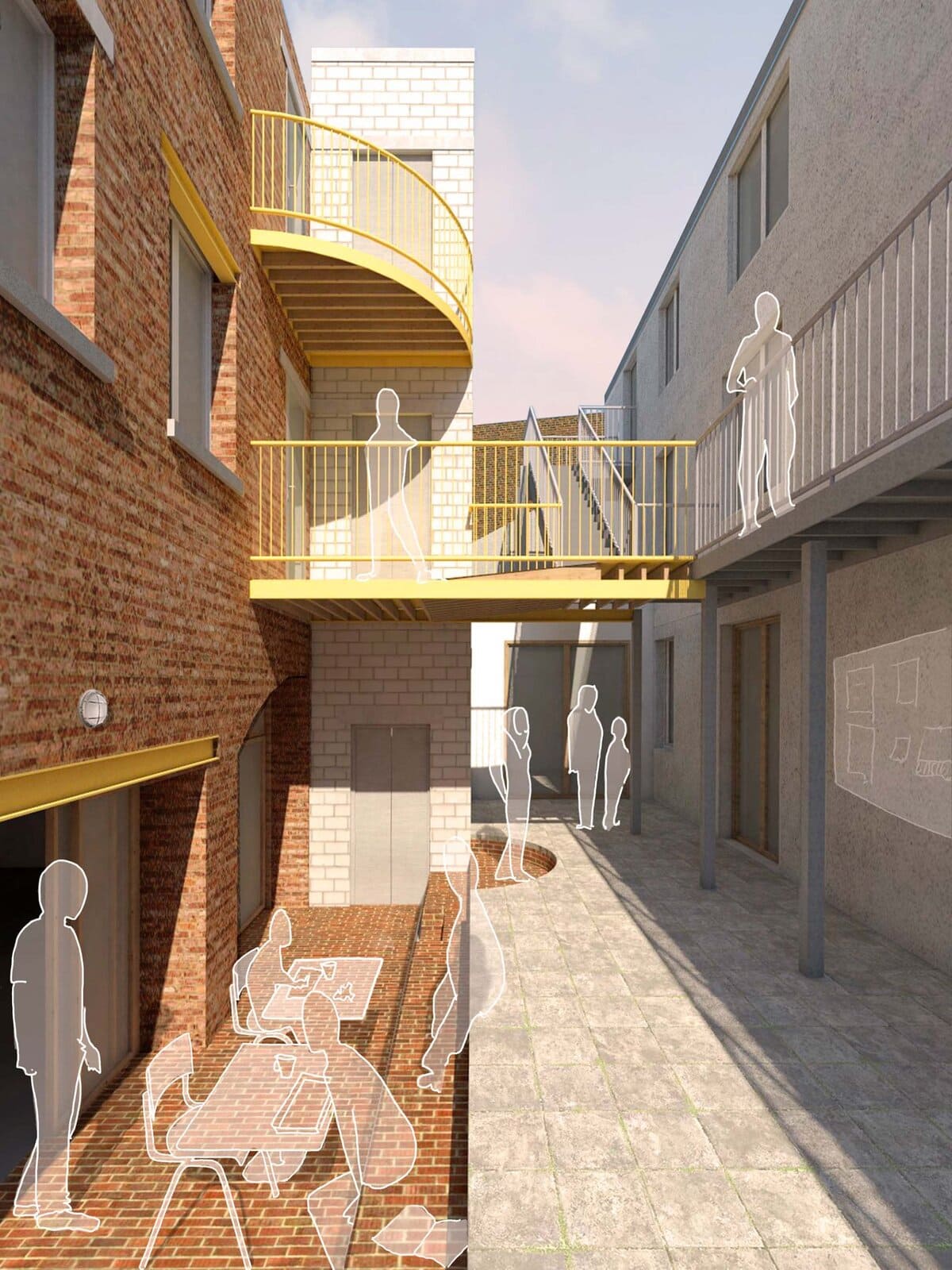
The winning project is that of Bauclub, thanks to in-depth research into the significance of the connecting space. The void that emerges amidst the dense interweaving of the buildings is perceived as a space to be enhanced. Bauclub focuses on articulating this void, a breathing space within the continuity of the surrounding buildings. Indeed, the alleyway within the block leads to a courtyard which becomes the central element of the project. By choosing to concentrate on improving circulation flows, a connection emerges, according to Bauclub, that is both spatial and social. A spatial connection, by utilising the previously unused Impasse de la Bouquetière, and a social one, by creating new communal spaces that can be adopted by the centre’s users.
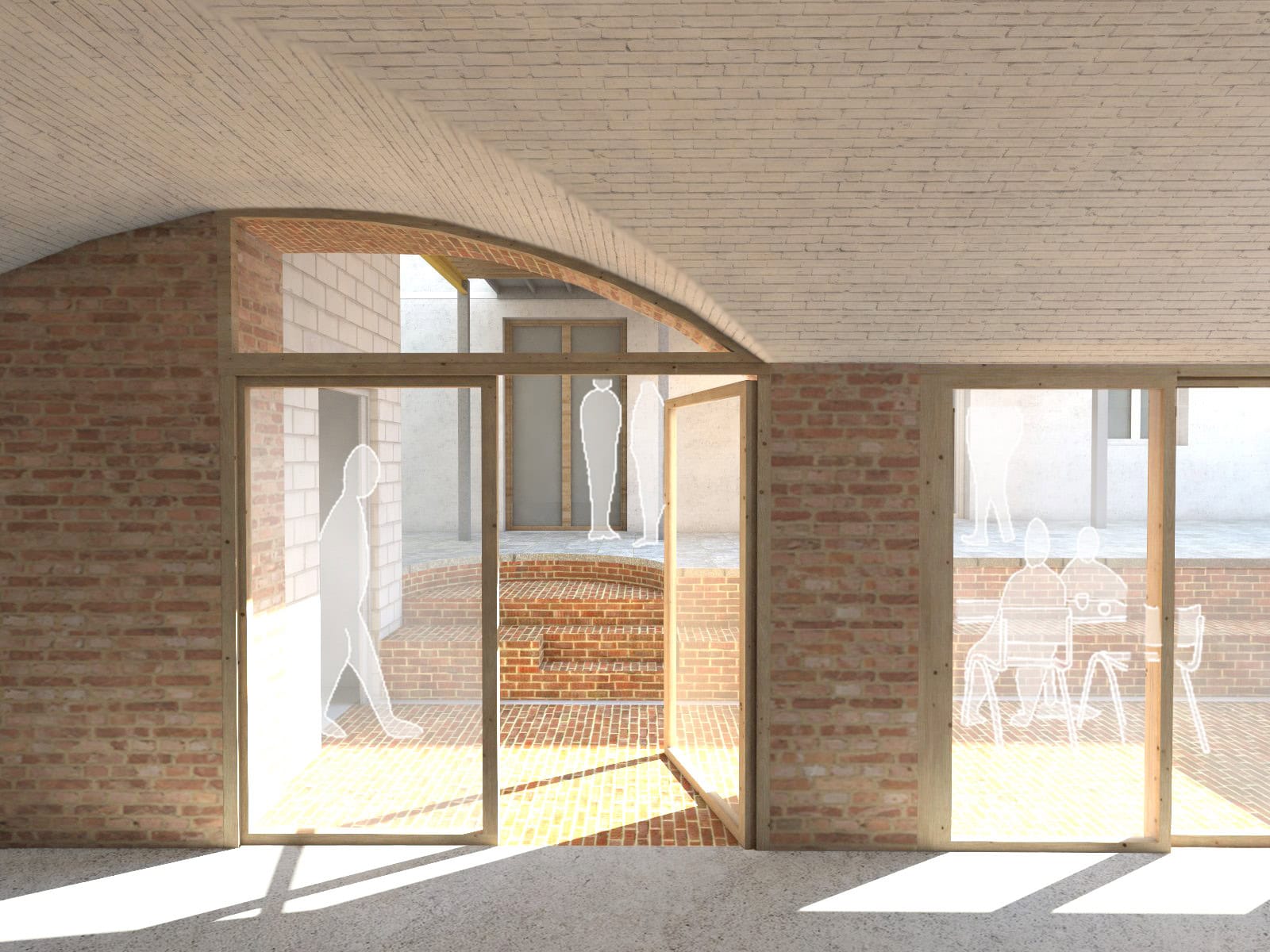
The external lift is crucial; it acts as a landmark by standing out visually and serves as the physical link connecting the different levels. Aware of spatial and budgetary constraints, the project focuses on resource efficiency. The intervention aims to be economical by reusing what is already there. The existing wall is partially demolished to free up space in the courtyard. It is reinterpreted to form the transition between the cul-de-sac leading to the inner courtyard and the passageway. This slight difference in levels softens the transition and allows it to become a place where people can sit, like a step, thus encouraging interaction between the two areas. The old wall becomes an element that fosters connection rather than separation. Strategic functions are situated on the ground floor, thereby facilitating visual control. The courtyard is therefore not merely a breathing space but also becomes a living space for nearby activities.
The other shortlisted candidates are the architects from Karbon’ and Nele Stragier Melanie Tamm. Karbon’s project also takes an approach of articulating the void with the aim of connecting the two buildings. There is a lift whose blue-tinted metalwork asserts its status as an added element. More distinctive, the project by Nele Stragier and Melanie Tamm is a footbridge combined with a goods lift, inspired by the language of a specific architectural element: the flying buttress. Serving both as a structural element and a connector, with its exposed brickwork, it aims to create the warm atmosphere of a communal courtyard.