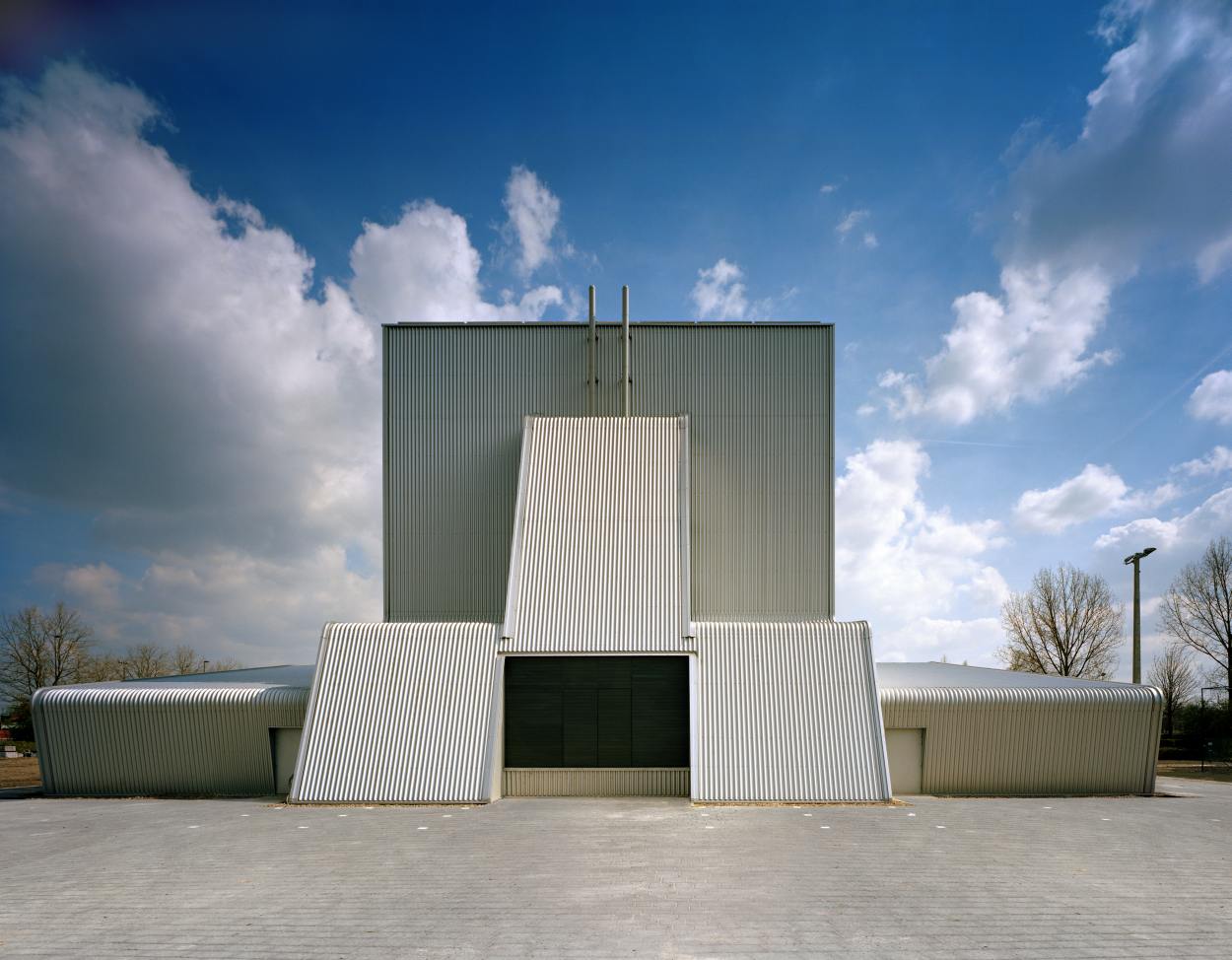
Thanks to the perseverance of the West Flemish mayor of Izegem, the town has recently acquired a theatre. It has become a striking silhouette with a magnificent metal façade, a real eye-catcher in the local area. It certainly serves as a landmark; better still, it is a true spectacle-maker, with a monumental design language. A creation by Samyn and Partners. Now the venue simply needs to make a name for itself.
At the client’s enthusiastic request, Philippe Samyn realised ‘a mission impossible’ given the limited budget and the context – an old landfill site. The architect of the Belgian research base in Antarctica promises that he will be able to realise half, or at best three-quarters, of the client’s dream. Ultimately, Samyn does manage to meet the town’s expectations. “It is the client who creates the architecture, not the architect,” says Samyn. Izegem confirms this rule, for it is thanks to the mayor’s perseverance that the project succeeded. But did the architect really merely obey the client? This would mean that the architect’s input remained very limited. Perhaps that idea does reflect the actual ins and outs of various political architectural projects, particularly public commissions.
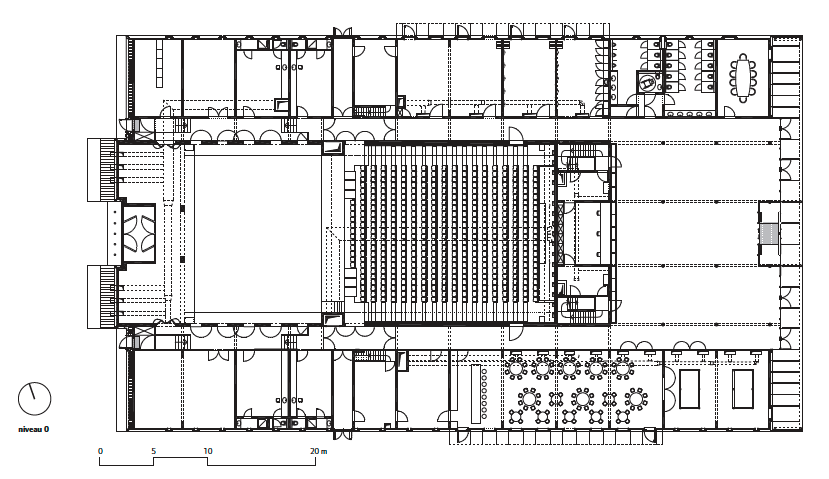
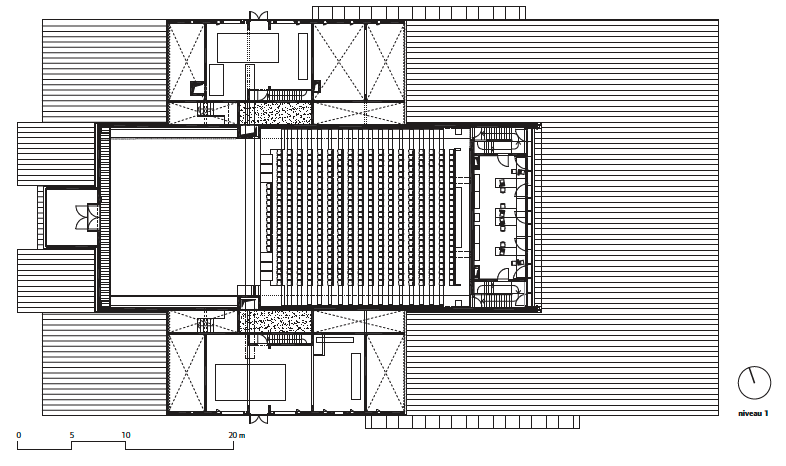
For Izegem, a municipality of 26,000 inhabitants, the programme is ambitious: a modular theatre, integrated into the surroundings and connected to an existing care home. The irregular fabric, a patchwork of sports fields and plots with a layout dating back to the Middle Ages, offers no anchor point from which to develop a new volume. Samyn therefore takes the programme as his starting point and generates a perfectly symmetrical building with a solid base, firmly anchored in the ground. The theatre auditorium is planned at the heart of this imposing structure. The axiality is surprising, but it is unyielding.
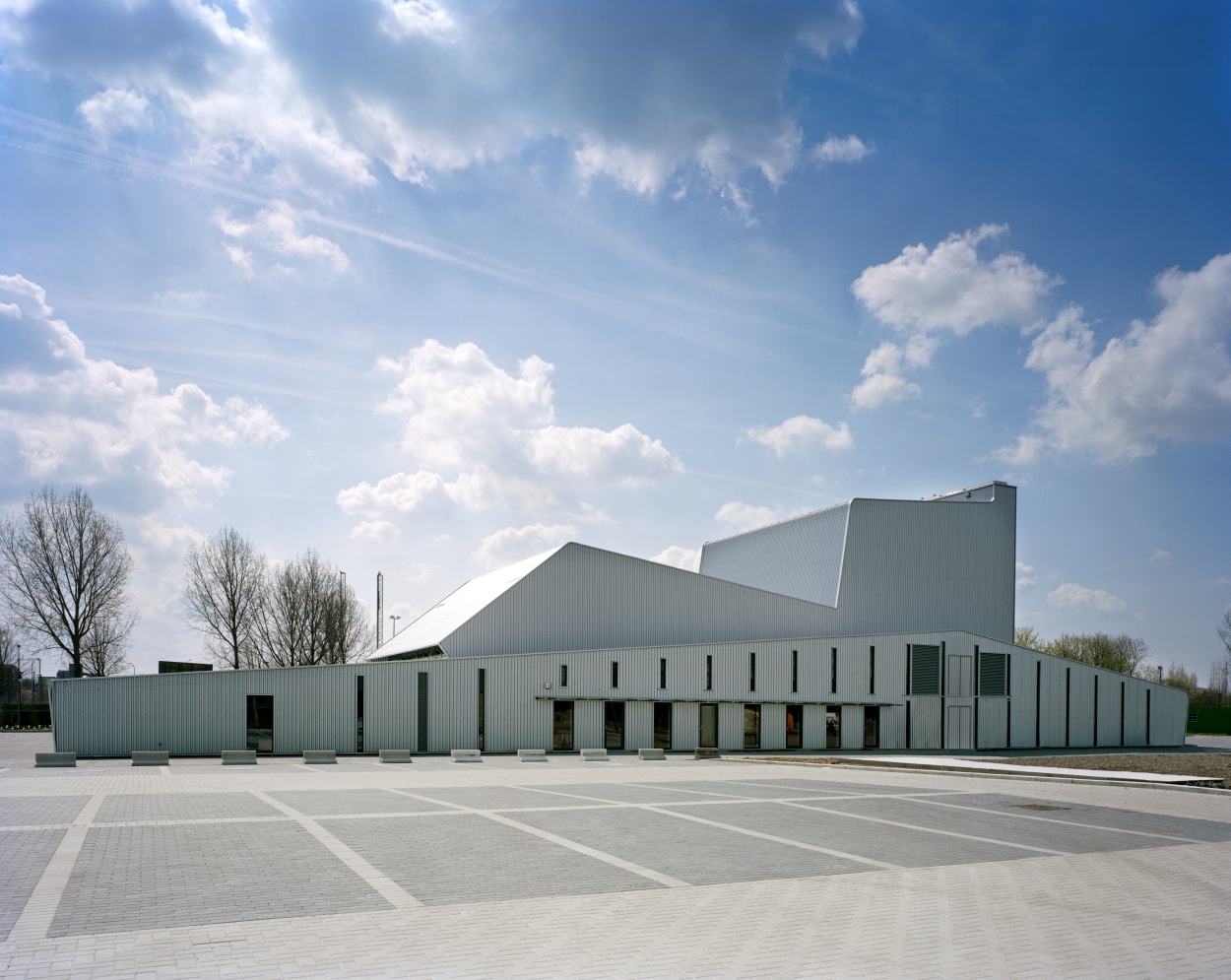
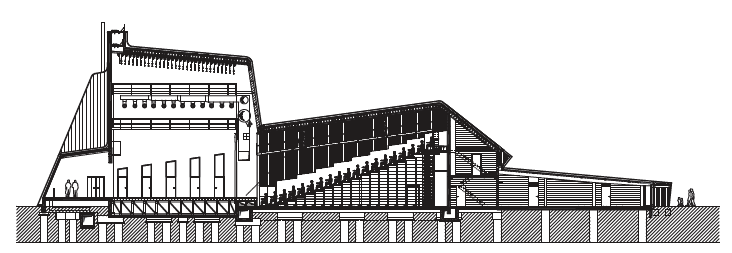
Due to the limited budget, Samyn opts for an industrial design language. The cladding is made of steel, not aluminium “because that is energy-intensive and difficult to recycle,” says the architect, a champion of ecological values. In the design phase, the lines of the building’s galvanised cladding resembled a samurai suit. Later, taking the context into account, the design was simplified. The result: the roofline fits precisely within the outline of the auditorium and the stage, each with its own distinctive shell. Various sketches bear witness to the rigorous work carried out and tell the story of the creation of this silhouette, which is unusual for Samyn: a undulating, aerodynamic form, whose bodywork is reminiscent of Claude Vasconi’s ‘Filature de Mulhouse’. A theatre was housed within the blind black box, folded from a single type of material. The machinery typology references Fritz Lang’s mechanical Sphinx in Metropolis, an image further emphasised at the rear by the enormous stage tower. At the front, the entrance hall draws visitors in between the tightly clenched lips of the floor and the metal cladding. Due to the contaminated soil, the theatre’s layout at the rear of the plot had to be separated from Sint-Jorisstraat and thus also from the existing care home. Samyn, however, continues to seek a connection: in the sketching phase, he creates undulating canopies that frame a water feature and extend as far as the care home. The grassed area depicted in the drawings was eventually raised to form a forecourt. As the car park is situated to the side, this 150-metre-long green space can serve as an outdoor stage for festivities and events.
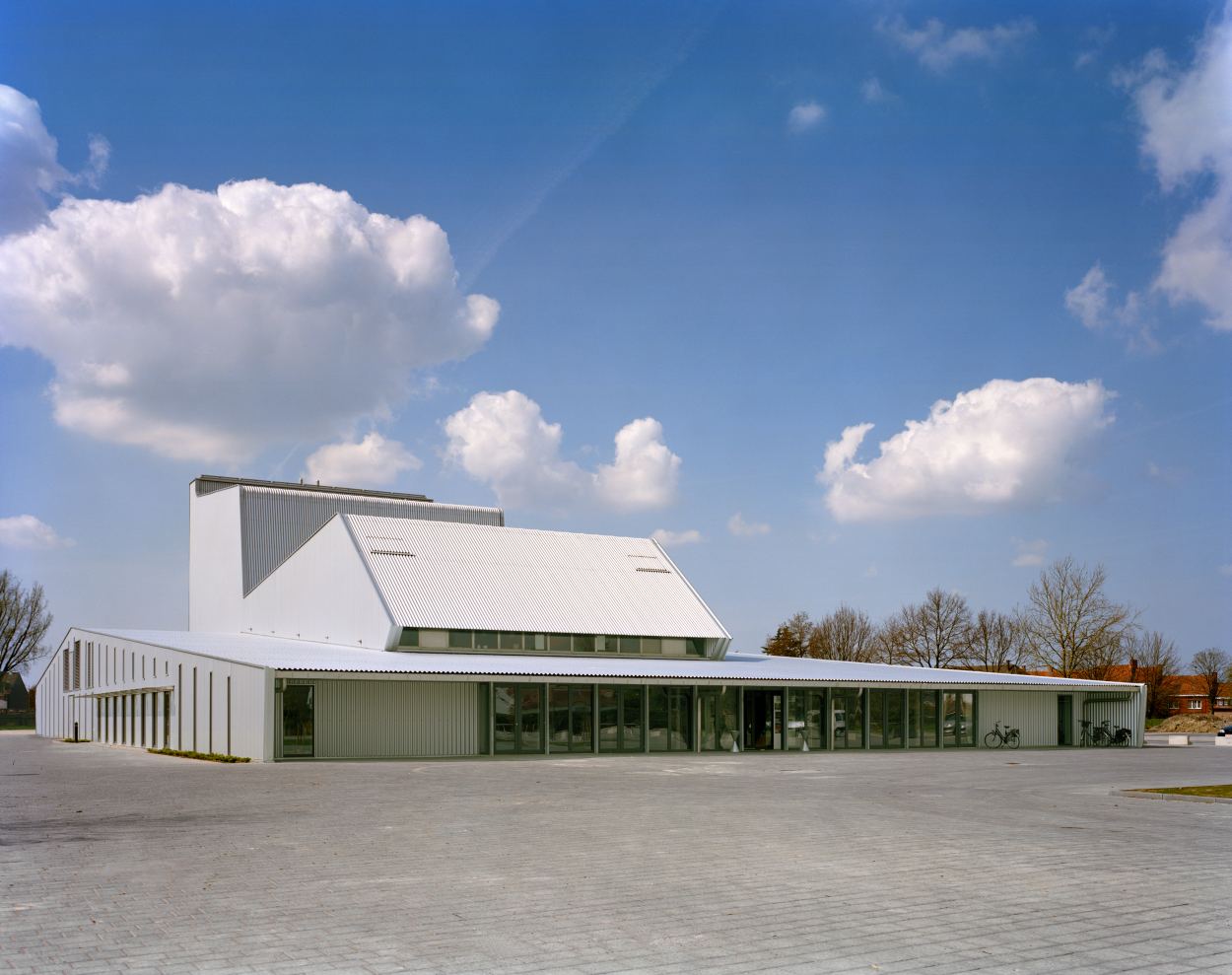
The theatre building has a regular layout with low side aisles. On the south side are a billiards room and a dance hall; on the north side, a multi-purpose hall and rooms associated with the stage, such as dressing rooms and storage areas. The central thick concrete box of the main auditorium absorbs sound vibrations, thereby isolating the theatre hall from the side aisles. Between the 11-metre-wide transverse span of this void, there is space for a retractable grandstand. This flexibility was required in the competition brief but is ultimately little used. The interior cladding of Douglas fir creates a warm atmosphere and contributes to good acoustics. This complies with the decree imposing restrictions on airborne vibrations. These are also absorbed by 15 centimetres of rock wool insulation applied to the outer shell.
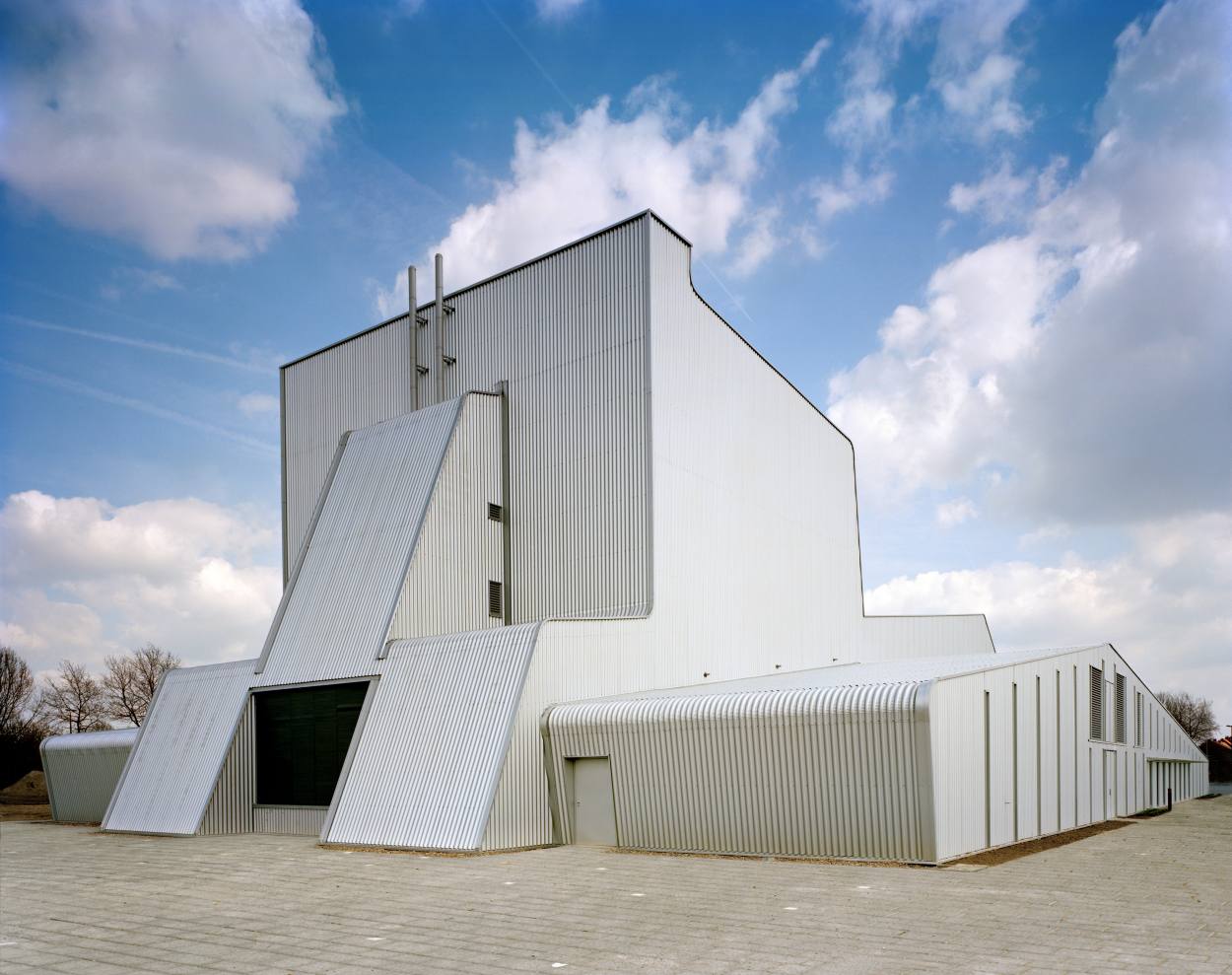
Izegem is known for its former shoe-making industry, and so the town christened the theatre ‘De Leest’. The use of sheet steel alludes somewhat to this old craft. Critics, however, feel that the building, for which the budget was significantly exceeded, ‘lives beyond its means’. It is now up to the organisers to provide the public with suitable footwear through the planned performances.
Architect
Samyn and Partners
Website
samynandpartners.be
Project
De Leest
Location
Sint-Jorisstraat 64b, Izegem
Programme
Theatre auditorium
Procedure
Competition
Client
Dexia Real Estate Banking
City of Izegem
Structural engineering
Samyn and Partners
Setesco
Specialist engineering
Samyn and Partners
FTI
Theatre technology
Stakebrand (mechanics)
EDF (electrical)
Jezet-Seating (grandstand)
Scenography
Samyn and Partners
T.T.A.S.
Acoustics
Samyn and Partners
Daidalos Peutz
Structural works | Plumbing
Flore
Electrical works
Vanden Berghe Electro
Safety
W&B
Heating
Albert Desmet
Facade
MSB
EPB
Vekmo
Asteria
Surface area
2,700 m²
Completion
2009