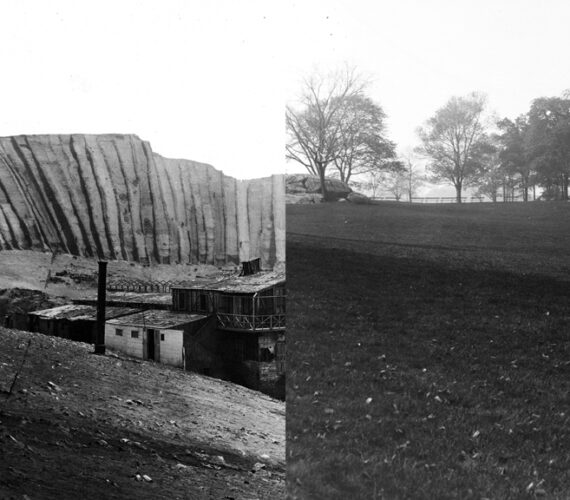
‘Deposits’, ‘urban mines’: the lexical field of mining is now one of the topoi of the literature on reuse and, more broadly, of the circular economy. Attributed to Jane Jacobs, who predicted in the 1960s that cities would be ‘the mines of the future’, the expression has since become widespread. The analogy between mining deposits and buildings has its limits, however, and these deserve to be examined. What conclusions, indeed, are we to draw from this analogy? That buildings are soils to be excavated with no other consideration as long as the operation remains economically profitable? Or that exploiting the materials that are reused as minerals justifies social exploitation or undignified working conditions? Or perhaps that these fabulous deposits can help to increase the productivity and profits of the construction industry? Probably none of the above. Nevertheless, it is regrettable to see so many players in the reuse sector adopting the vocabulary and categories of the mining industry.
Indeed, how can we claim to be fighting against extractivism – that is, the mass exploitation of the biosphere – if we share the same imaginary? Shouldn’t we rather think of buildings as hosts temporarily accommodating the materials they house? Shouldn’t we think of those who practise reuse as guides who accompany materials from one place to another so that they find their rightful place, guides who salvage them from the skip to do justice to them and restore their dignity? Whichever path is explored, other words and images are required. For indeed, if we overuse the vocabulary of extractivism, reuse risks ending up at the bottom of the pit. And yet reuse cannot be reduced to the exploitation and valorization of latent resources. Its value, despite the temptation to turn it into an aid to the construction industry, is not just instrumental, but ethical and political. If its practice is superimposed on the productive uses of architecture, it is to better dissociate itself from them and open up new avenues for renewing contemporary building culture. So let’s leave aside the words ‘deposit’ and ‘urban mines’, which are excavating building culture and exhausting its imaginary. These sensitive words, at once unstable and explosive, can backfire on those who handle them carelessly. But freeing ourselves from them means first of all opening up our material imagin-ation again, which is no easy feat.