
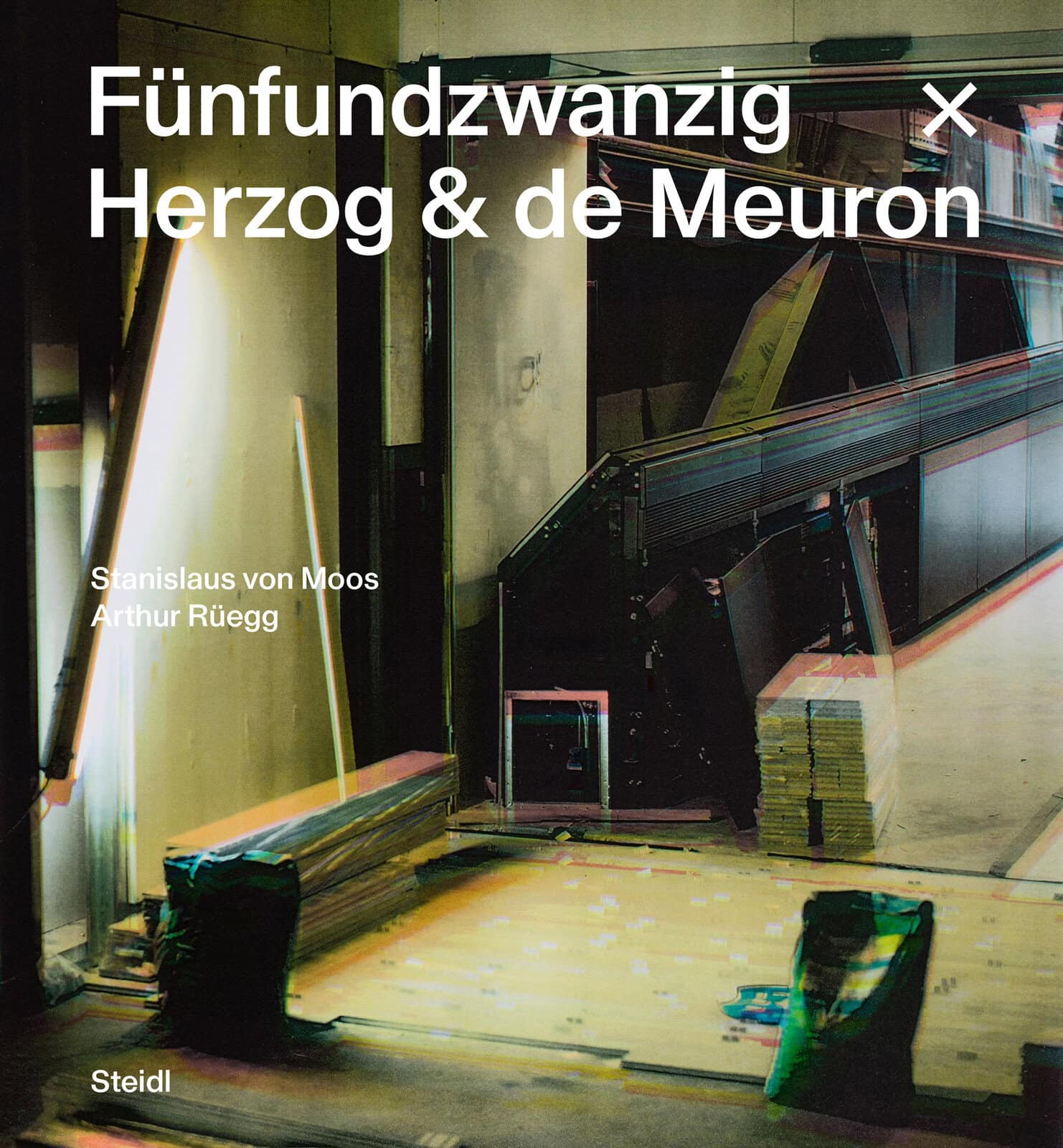
Since its inception in the early 1980s, the Swiss architectural firm Herzog & de Meuron has completed more than 600 high-profile projects around the world. In a sense, this success is a mystery, for the diversity of their body of work is so vast that there is no recognisable ‘style’. One project may seem utterly ordinary, verging on the banal, whilst the next is extremely spectacular and daring. Two leading Swiss architectural critics, Stanislaus von Moos and Arthur Ruëgg, attempt in Twentyfive x Herzog & de Meuron to provide keys to discerning a coherence in this body of work. One succeeds better than the other.
The book opens with a series of images from Pierre de Meuron’s photographic archive. They reveal that the architect has a keen interest in the most diverse manifestations of architecture. Images from antiquity sit side by side with Gothic cathedrals, Islamic shrines, details of buildings by Mies van der Rohe, Le Corbusier or Ground Zero NY, but the series concludes with atmospheric images: not just a sunset but also hazy images of Lucerne.
Von Moos’s essay ties in with this immediately. His basic premise is that the body of work is an attempt to outwit the fleeting, capricious way in which people experience architecture in everyday life. Von Moos argues that architecture today no longer defines the image of a city through buildings such as a city gate, a station, etc. Instead, architecture must give concrete form to impressions, for example by ‘making the beauty of raindrops’ trails on a façade tangible’. In this sense, Herzog & de Meuron, much like conceptual artists such as Donald Judd, call upon the viewer to imbue objects with their own imagination or even an ‘active hallucinatory seeing’. Von Moos thus also arrives at an explanation for the sometimes rather unconventional exhibition concepts of Herzog & de Meuron. However, the essay gradually loses its way in occasionally rather rambling digressions that dilute the point the author wishes to make.
Arthur Ruëgg takes a sharper focus. He examines how the designers deal with existing buildings and contexts. He notes that Jacques Herzog and Pierre de Meuron were influenced during their student days by Aldo Rossi’s lectures at ETH Zurich, but also conducted a thorough study of the historic city centre of Basel, their home base. They are therefore not modernists. This is evident, for example, from their unabashed imitation of stone using wooden panels in the Stadtcasino Basel. Above all, however, the duo is extremely pragmatic: if the brief requires it, they intervene drastically in historical fabric. As restorers, they are thus closer to Viollet-le-Duc than to the Athens Charter. Ruëgg wrote such a thought-provoking essay that it made me look at a project like CaixaForum Madrid with fresh eyes,
Ultimately, the bulk of the book consists of the 25 projects which, in the opinion of von Moos and Ruëgg, provide an overview of the oeuvre. Photographs by leading photographers such as Iwan Baan or Thomas Ruff, carefully selected plans and precise explanations do indeed provide a good insight into the construction, architectural history and critical reception of the projects. That alone makes this publication well worth reading.
Twentyfive x Herzog & de Meuron, Stanislaus von Moos / Arthur Ruëgg – photographs by Thomas Ruff, Iwan Baan, Pierre de Meuron et al, Steidl Verlag, Göttingen, DE, 2024. 496 pp, English, ISBN 978-3-96999-138-1. RRP €95.
