
Few cities have such a complex history as Vienna. Overnight, after the First World War, it went from being the capital of a global empire to a poor provincial town. Yet its intellectual and artistic culture continued to resonate far beyond the country’s shrinking borders. Until the Anschluss to Nazi Germany put an end to that… The country struggled to come to terms with that legacy in the first decades after the Second World War. Artists and architects protested vehemently against that great silence, often drawing on the culture of the interwar period. In the architectural culture that struggled so painstakingly to get back on its feet, Hermann Czech and Hans Hollein played a leading role, albeit in very different ways. Two publications bear witness to this.
Hermann Czech (b. 1936) is, unjustly, little known. This is partly because he built relatively little, and more small cafés, shops and homes than prestigious projects. He also built hardly anything outside Vienna. The main reason, however, is that Czech’s work, unlike Hollein’s shops or the Haas Haus, is hardly noticeable. It is so thoroughly Viennese that one can walk right past it without a second thought.
The elegant bridge connecting the two halves of the Vienna City Park, for example, is his work, as is the charming Kleines Café on Franziskaner Platz. It does not appear to be ‘significant’ architecture, until you notice how that Stadtparksteg subtly corrects the perspective. Or how that café, with its mirrors, sofas and refined wall mouldings, evokes the pre-war atmosphere of the Viennese coffee house, without being a pastiche.
Czech (b. 1936) is, incidentally, much more than an architect. He has published incisive observations on architecture in various journals and books, and has curated several significant exhibitions. He can be quite sharp in his criticism. In 2023, aged 87, he put the Venice Biennale in a tight spot with his proposal for a bridge over the wall of the Biennale site to Sant’Elena. This would have allowed the local community to enjoy the Giardini without paying an entrance fee. The Biennale was quick to put a stop to this, thereby proving his point: the cultural tourism industry robs the residents of their own city.
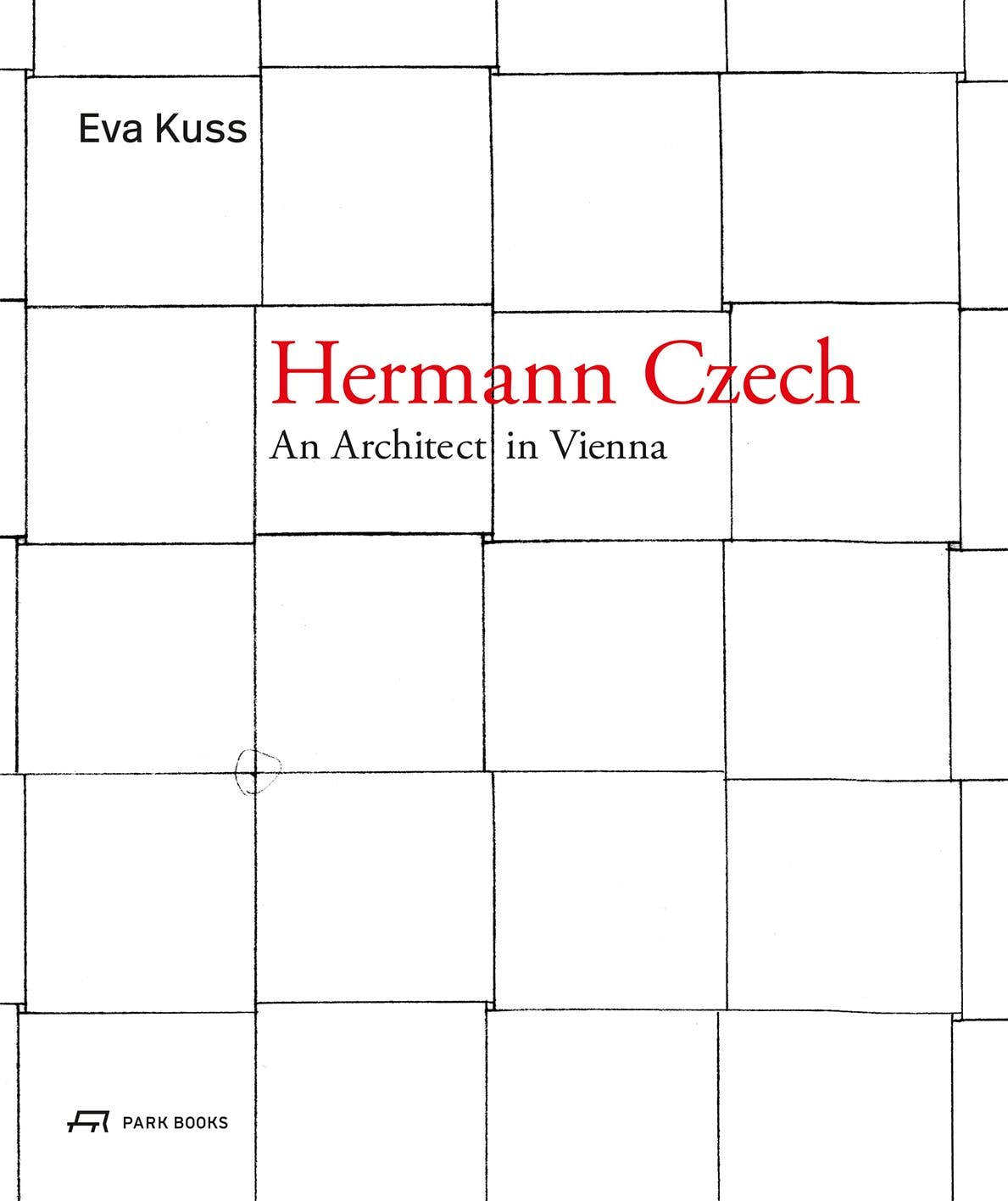
Eva Kuss published the study Hermann Czech / an architect in Vienna on his ideas and oeuvre. Kuss takes a long-winded approach with an extensive outline of Vienna’s intellectual history since the 1920s. A characteristic of authors such as Karl Kraus, philosophers such as Ludwig Wittgenstein, but also architects such as Adolf Loos and Jozef Frank was that they prioritised experience. This made them averse to metaphysics, but also to the abstract modernism preached by the Bauhaus. According to Jozef Frank, this imposed a morality on people that they could not relate to. For Adolf Loos, too, ‘being modern’ was certainly a necessity, but it did not follow that the past should be discarded or that domesticity was out of the question.
Czech connected with this way of thinking when it resurfaced in the early 1960s and took an active part in the cultural life that emerged at that time. Kuss describes this intellectual development in detail. She supplements this with detailed discussions of the ideas that formed the basis of 32 projects. It is particularly these descriptions, plans and photographs that offer a clear insight into Czech’s complex and subtle designs. In every project, he strives to provide a strong rationale for every decision, and takes meticulous account of all possible factors, such as the context or the client’s wishes. For Czech, however, ‘taking the client into account’ is not the same as simply telling them what they want to hear! The outcome of that design process often looks quite ordinary. After all, Czech has an aversion to architecture that seeks to stand out. On closer inspection, however, his designs always turn out to be brimming with unusual, often witty solutions to counter conflicts in programme, context or construction methods. In a distinctive, insightful essay, Elisabeth Nemeth outlines the philosophical underpinnings of his working method. This book is thus an excellent introduction to an underrated body of work.
Hans Hollein was in every respect the opposite of Czech. Not only did he have a penchant for exuberant, eye-catching projects, but unlike Czech, he also advocated an autonomous architecture and a progressive focus on ‘the new’ in all its forms. Yet Hollein, too, had a lively, and typically Austrian, interest in the past, to which he frequently referred in his visual language. His formal bravura earned him the Pritzker Prize as early as 1985. His star waned after his death in 2014, but his work has recently enjoyed a revival. The Vienna Architekturzentrum therefore dedicated an exhibition to the influence of his oeuvre on young, leading practices. This resulted in the somewhat half-hearted book Hollein calling – architectural dialogues. The documentation of 15 projects and the texts on Hollein are brief and shed little light. They seem primarily a contrived means of arriving at a questionnaire that was put to fifteen ‘young’ architects. These conversations form the basis of the book, but vary in quality and depth. It is interesting to note, however, that four of these architects are Belgian or based in Belgium (Aslι Çiçek, Dirk Somers, Doorzon and Kersten Geers), whilst the Dutch architect Job Floris also works here frequently.
Hermann Czech / An architect in Vienna, Eva Kuss, Park Books Zurich 2023. Hardback, 472 pp. ISBN 978-3-03860-346-7. RRP €48. (A German-language edition is also available)
Hollein calling / architectural dialogues, Lorenzo De Chiffre, Benni Eder, Theresa Krenn (eds.), Architekturzentrum Wien / Park Books Vienna Zurich, 2023. Paperback, 220 pp. ISBN 978-3-03860-340-5. RRP €38.
