Materials that require little processing (such as raw earth, fibres and wood) are highly prized today for their excellent carbon footprint and potential circularity. But a veil of suspicion still hangs over them: doesn’t their degrad-ability make them more fragile? It is therefore tempting to subject them to processing so as to make them competitive with their ‘cooked’ equivalents (cement, steel, bricks). And yet, shouldn’t we be arguing, on the contrary, that it is also because their durability depends on the care they receive that they can be described as ecological?
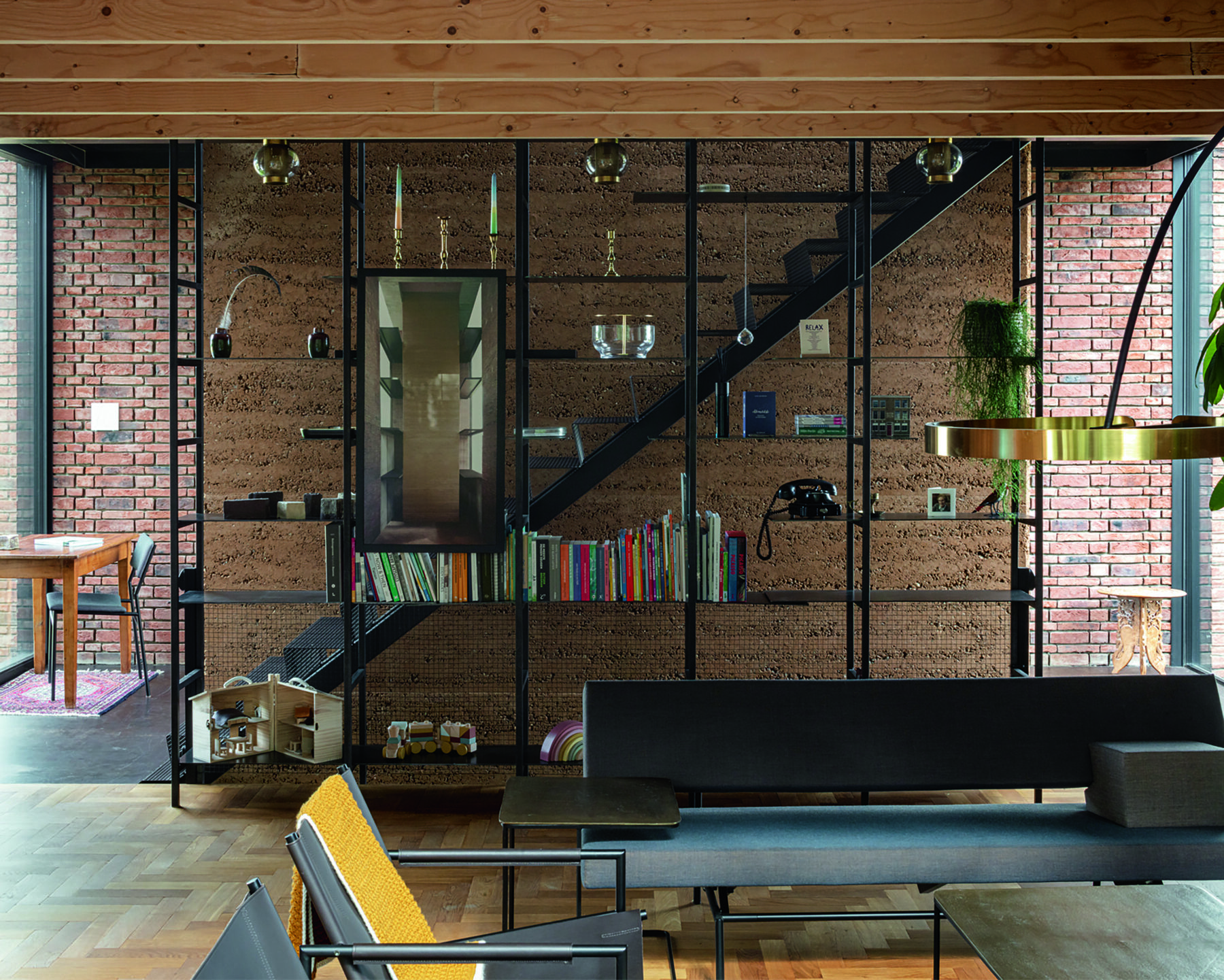
‘Ecological’ materials put to the test of growth The Wall. A wall in rammed earth runs the full height of the house. It presents its edge to the street, as if in a window display. It stands tall at the back of each of the living areas. Sunlight falls sideways across its textured surface. Peter Van Impe, the designer of the house, who lives there with his wife and daughter, sees the wall as a work of art. The wall owes this status primarily to its visual qualities and the labour that went into its making, but also to its relatively high cost. This exceptional status is further confirmed by the precautions it requires. Peter explains: ‘When children come, we tell them, “This is a work of art, you can’t touch it [too much]; it’s like at the museum.” Otherwise, if we keep rubbing it at the same spot, it risks eroding.’ The surface makes you want to touch it, and the friction slightly wears away the surface, covering the black steel landings adjoining the wall with a light layer of earth dust. If the owners need to clean the landings, it is mostly to prevent the particles from scratching the surface when they walk on them. Above all, Peter recounts with enthusiasm the experimental aspect involved in the construction, while acknowledging that the unique configuration of being both architect and client made it at all possible. He still sometimes calls those who helped to build the wall for minor repairs, mainly where more serious (yet benign) erosion was caused by rainwater running down a landing during construction, before the windows were placed. Two bowls on a shelf facing the wall preserve a few pieces of the mixture that have come undone over time.