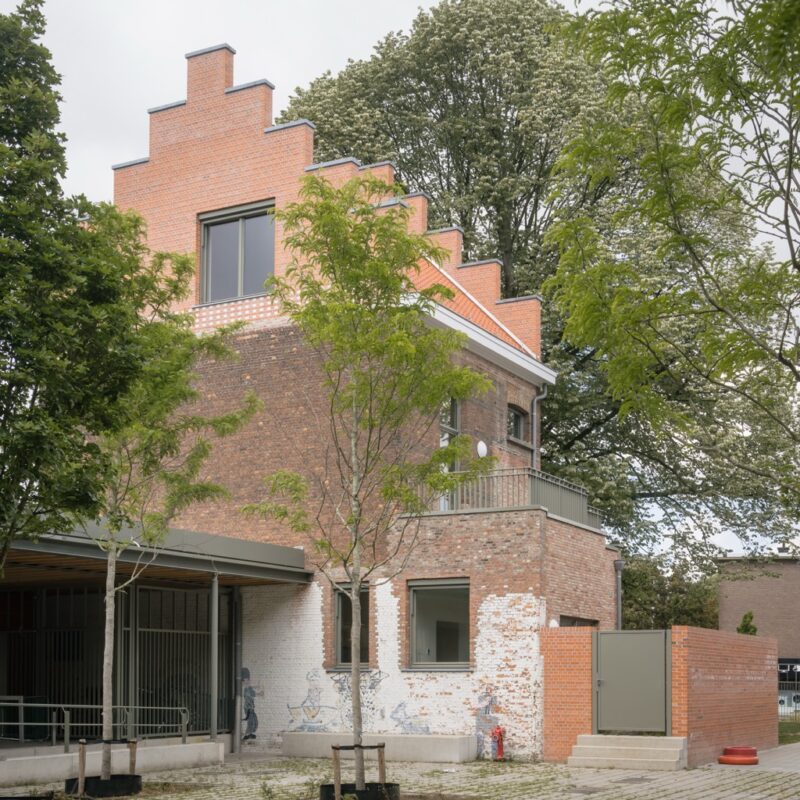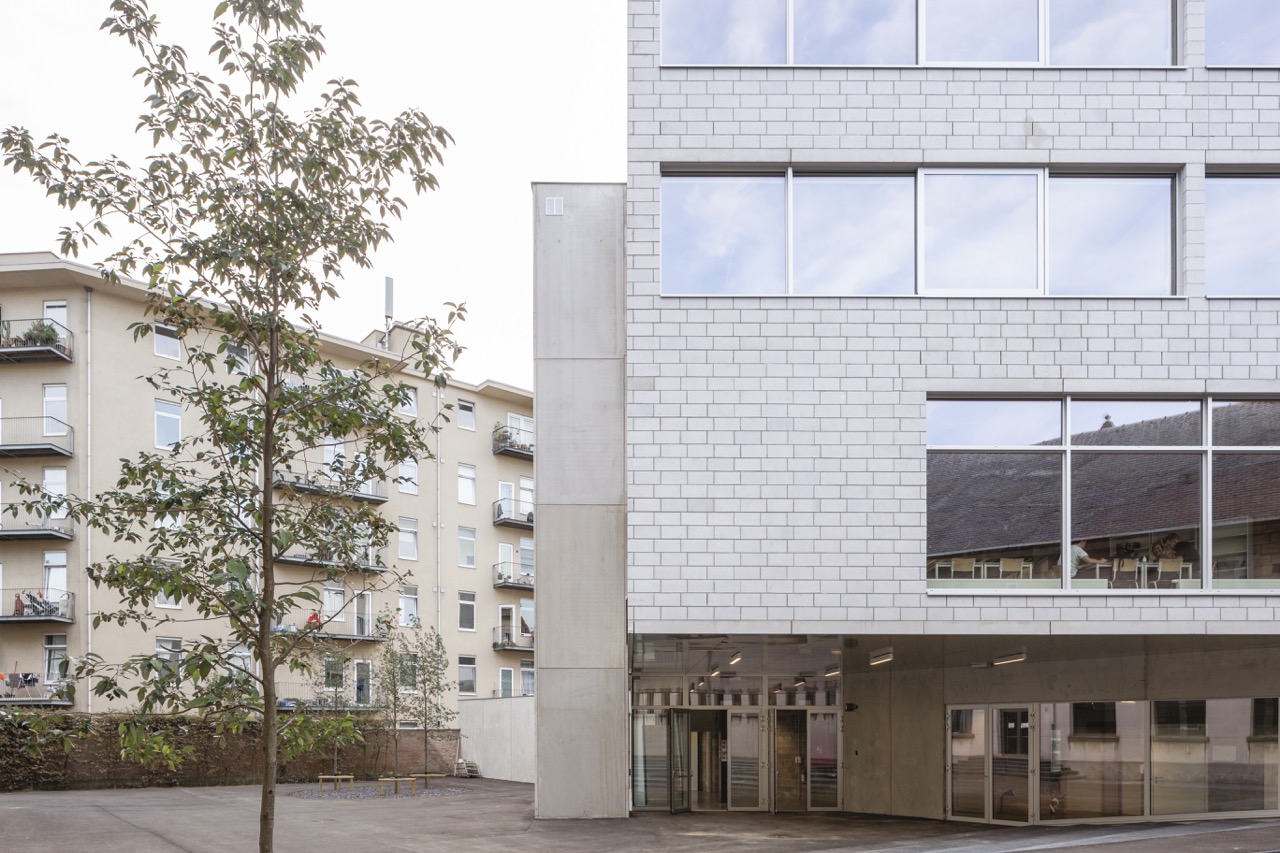
Agwa’s extension to Durlet Secondary School stands out from the Flemish Neo-Renaissance school complex like a floating monolith. This cantilevered quadrangular volume breaks with the institutional winged layout, takes hold of the featureless open space of the playground and shifts the school’s centre of gravity. Comprising ten new classrooms and a ‘learning landscape’, this new volume shapes the school’s identity to such an extent that the school office and management have abandoned their former offices to take up residence on the suspended platform on the first floor.
The distinctive feature of this extension is undoubtedly the articulation of the three-storey square-plan volume at a 53° angle relative to a base that runs alongside the traditional school playground wing, mirroring it. A new façade thus faces the entrance gate, in the corner of the courtyard. The suspended volume provides a covered playground made more intimate by the lift core, detached from the main structure, which appears to support the façade and organises distinct play areas. The reorganisation of the route continues within the building, as a first staircase extends towards the courtyard. It is this staircase that facilitates the connection between the two geometries. Drawing inspiration from the Dutch open-air schools of the 1920s, the classrooms enjoy sweeping views of the façades and roofs of the neighbouring buildings. The angle of the building renders these lateral views dynamic, poetically composing this sense of proximity. The landscape thus reimagined attests that, behind Agwa’s desire to disrupt the tranquil order of this school lacking in particular qualities, lies above all the ambition for a generative, generous disorder.