
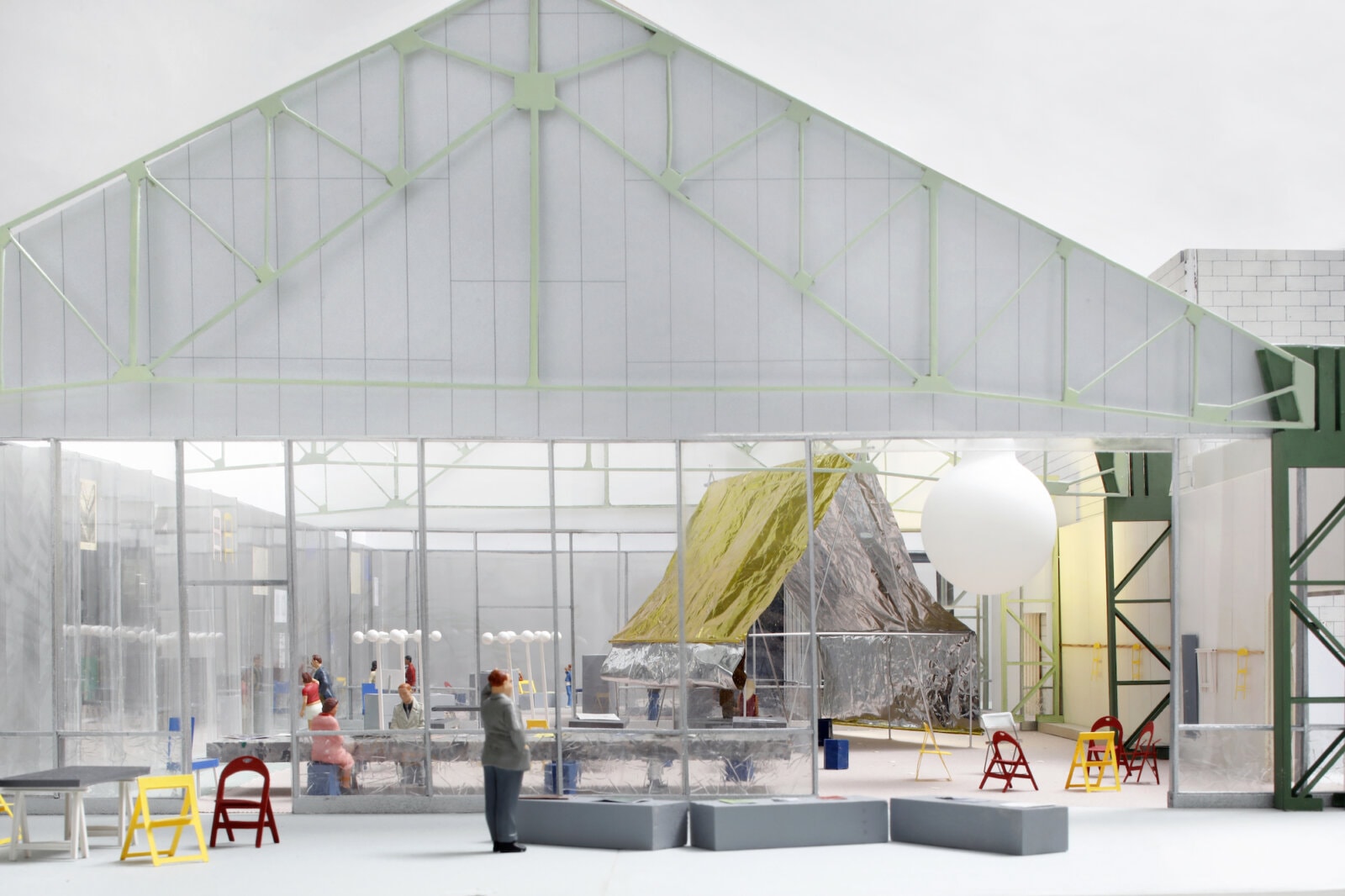
Kanal, the car factory being turned into a museum, is currently undergoing a transformation thanks to the work of noArchitecten, Sergison Bates and EM2N. The demolition work currently underway reveals the building’s gigantic steel structure as you walk along Brussels’ northern boulevard. Recently, Kanal was the subject of a competition for its future bookshop, which will house the CIVA archives. The proposal by Central Architecture, Sophie Dars (architect and editor), Pierre Leguillon (visual artist) and Daidalos Peutz (acoustics) offers a reflection—both theoretical and well-developed—on the role of the now indispensable bookshop within the museum. Their project won over the jury, which had to choose from proposals by various teams including Asli Çiçek, Nord, Traumnovelle, Hé! Architectuur and XDGA.
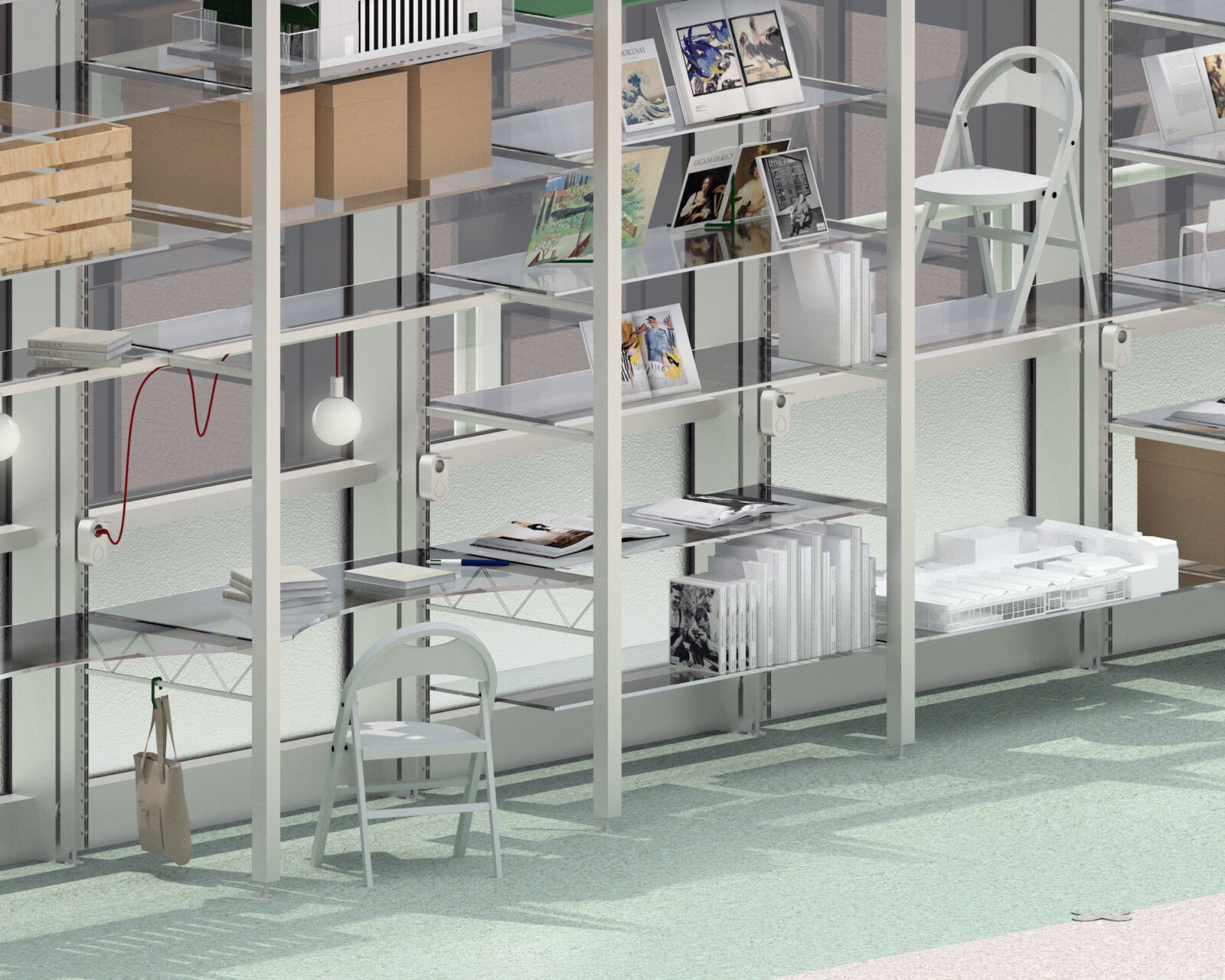
Through three levels of intervention, the project invites visitors to perceive the bookshop as a public space whilst incorporating the intimacy of a domestic room. Taking as its reference the origins of literary salons and their dual purpose—serving as both an intimate bedroom and a public reception room—the aim is to make the space appealing to as many people as possible.
The first level of intervention concerns the floor and the two parallel walls. The floor is a supersurface. A grid of power sockets is laid out, allowing visitors to plug in their laptops and settle down wherever they choose. The two parallel walls also serve as shelves, allowing books to be stored and displayed. The use of the shelves follows the ‘as found’ principle: one is metal, like the curtain wall it reinforces, whilst the other is wooden, matching the brick wall against which it rests. The metal shelf, “à la Munari”, is like a display case, revealing its contents and potential. The wooden shelf, “à la Shaker”, houses the archives and allows objects to be hung, creating a void framed by these two shelf-walls.
The second level, called “event installations”, comprises four installations that define distinct zones. Among them, the mechanical scriptorium—a sort of long table—also serves as a podium when events take place. The electric lighting provides the ideal lighting conditions for the reading room. The information kiosk is a display column in the style of a Parisian Morris column; this totem serves to announce future events and acts as a landmark. The prospective tent, evoking a shelter, is conducive to the intimacy of reading.
The final level of intervention is a collection of objects. On the one hand, the furniture needed to store and display the books. On the other, the curated objects, free to be moved and utilised, without a pre-established, immutable system.
The proposal by the Kanal Museum, which already challenges the traditional museum and is driven by a radical optimism, offers an opportunity to sustain this momentum by questioning the role of the bookshop with equal intensity. Beyond a space dictated by consumption, Central’s initiative recognises the social potential of this venue. Conducive to a more relaxed atmosphere and interaction, it is also a space capable of offering a certain intimacy.
