
With the title of the 19th Venice Architecture Biennale, ‘Intelligence, natural, artificial, collective’, curator Carlo Ratti emphasises the importance of the interaction between different forms of intelligence. Central to the Biennale is the approach to the climate crisis, in which Ratti assigns a central role to architecture: ‘in the time of adaptation, architecture is at the centre and must lead with optimism’. Although the message is often lost in a tangle of excessive data, repetitions and gimmicks, the Biennale also offers moments of inspiration, beauty and confrontation.
In 1980, the first architecture biennale, ‘La presenza del passato’, showcased the now iconic strada novissima. Paolo Portoghesi invited twenty leading architects to design a façade for a new street in the Corderie dell’Arsenale, which had been converted into an exhibition space for the first time. Lea-Catherine Szacka argues in Oase 88 that the exhibition made a clear political statement with ‘a return to traditional city planning and to the use of basic urban elements fostering sociability’. Particularly interesting is the contrast with the analysis made by Johan Van Dessel in A 67 of these ‘column and pediment merchants’ who are ‘intermingled haphazardly to promote the great new anti-modernist fashion’. Van Dessel criticises the fact that themes such as the decline of historic city centres, “neighbourhood movements, with their still significant social ramifications, and the housing difficulties of the Third World” were not addressed.
The days when a curator would invite a few dozen architects to create an installation together, and when the biennial conveyed a political message only between the lines, are over. In this edition, Carlo Ratti opted for a bottom-up approach which, based on an open call, led to “a more inclusive authorship model” and a ‘selection’ of 750 designers and nearly 300 projects. Now that the central pavilion in the Giardini is closed for renovation, the entire exhibition has been housed in the Corderie dell’Arsenale. Seeing the wood for the trees becomes very complex due to the abundance of selected projects and the curator’s apparent horror vacui.
Do the robot
The nineteenth edition can once again count on the usual presence of star architects (and former Biennale curators, Pritzker and Nobel Prize winners, according to Ratti). The requisite gimmicks are also present (fancy a pedal boat ride on a pontoon developed by Norman Foster and Porsche, a dance with a robot, or an espresso brewed with canal water?). Yet ‘Intelligens’ primarily (and repeatedly) emphasises the societal challenge of tackling the climate crisis. This crisis, described at times as complex, and at others as layered, hybrid or multifaceted, can, according to Ratti, be addressed by linking architecture to natural and artificial intelligence. In Ratti’s words: “an invitation to experiment with intelligence beyond today’s limited focus on AI and digital technologies, and demonstrate how we can adapt to the world of tomorrow with confidence and optimism”. The robots in the Arsenale exhibition seem to endorse that statement only haltingly and stammeringly, and the trees popping up here and there (uprooted, sawn off or in flowerpots) reinforce the impression that the exhibition struggles to make the connection between the various forms of intelligence.
“Walk the walk”
The drive for data collection, “it’s a chain reaction, it is an experiment in uniting different voices and forms of intelligence”, is sometimes reminiscent of the utopian early-twentieth-century experiment of the Mundaneum, in which Paul Otlet and Henri La Fontaine sought to bring together knowledge from all disciplines and continents to arrive at the ultimate understanding of the human environment. Does this biennial (amidst hollow slogans such as “it is not enough to talk the talk: we must walk the walk”) offer interesting insights into the state of architecture and the challenges for the future? Certainly, but it takes some searching amongst the datasets, 3D printers, drumming robots and the stream of exhibition texts summarised rather inaccurately by AI. Where collaborations, people and creative processes come into focus, this edition of the biennale manages to strike a chord and prompt reflection. In various national pavilions (both in the Giardini and the Arsenale), pressing social questions and human needs are analysed in greater depth. The curator’s central call to address current crises from a local perspective leads to recurring themes such as the interplay between architecture and natural intelligence, the (re)use of local crafts and materials, the creation of meeting places, and dealing with threat and destruction.
Microclimate
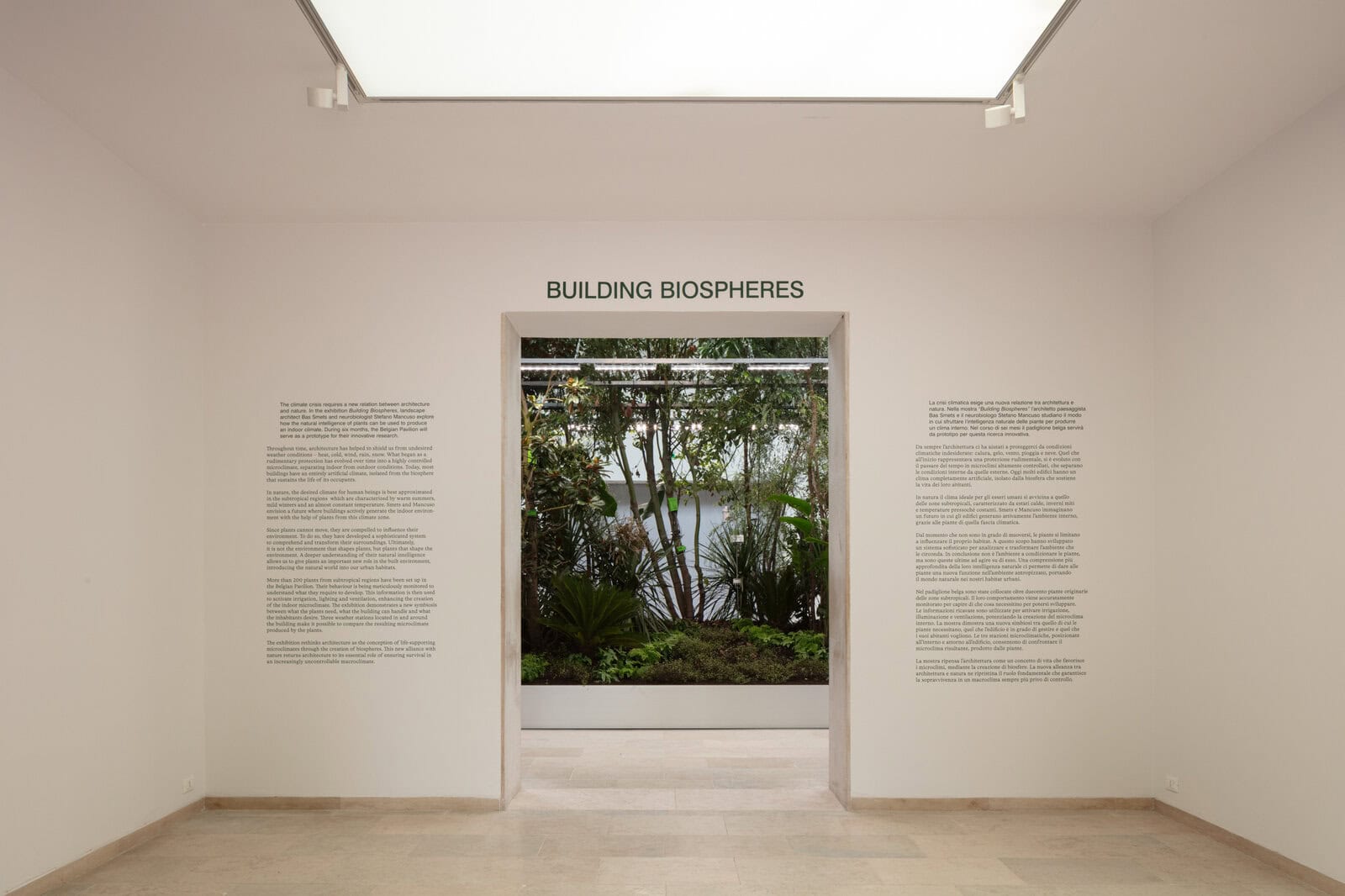
In the Kosovo pavilion, Erzë Dinarama, within a minimalist scenography by Irina Bogdan, depicts the changing seasons through a scent installation based on the experiences of farmers (absent snow, new hail, late frost…). In the Belgian pavilion, Bureau Bas Smets, Stefano Mancuso and Ghent University, commissioned by the Flemish Architecture Institute, are investigating how the natural intelligence of plants can be harnessed to create an indoor climate. For six months, Building Biospheres transforms the Belgian Pavilion into a prototype where a microclimate, composed of more than 200 plants and constantly monitored, challenges the relationship between humans, nature and architecture. Four design teams – Elmēs, Panta, Maud Gerard Goossens and Henri Uijtterhaegen, and Lisa Mandelartz Schenk and Steven Schenk – are investigating how existing and new buildings can integrate natural intelligence into a new approach to architecture. With this experiment, the curators also challenge our fixation on a constant indoor climate. After all, the insulation of (individual and collective) homes is high on the political agenda, which the Estonian pavilion illustrates very aptly. Architects Keiti Lige, Elina Liiva and Helena Männa clad the façade of a palazzo along the quay near the Giardini with insulation panels as a critique of the approach to the renovation of collective housing in Estonia.
Craftsmanship and inclusion
The strong emphasis on local materials and techniques, and the reuse of building elements, comes as no surprise. This recurring theme is explored in various ways: in the Spanish pavilion, Roi Salgueiro and Manuel Bouzas present a classic yet powerfully constructed and aesthetic exhibition on local materials and craftsmanship; Denmark is using the renovation of its own pavilion by Soren Philmann to employ the construction site and the excavated materials as both scenography and narrative; and in the Finnish pavilion, Vokal Projekt uses a video installation to show how Alvar and Elissa Aalto’s fragile wooden pavilion was meticulously restored. The focus on the pavilion itself also raises questions about inclusion in the architectural sector. In the Swiss pavilion, the curators explore an alternative reality through a 1:1 installation: what if, instead of Giacometti, his contemporary Lisbeth Sachs had built an exhibition pavilion she designed in 1958 in the Giardini? The call for an inclusive sector is answered in Sverre Fehn’s iconic Nordic Pavilion by Kaisa Karvinen with a blend of architecture, installation and performance in which the trans body takes centre stage.
Confrontations
The climate crisis is strongly emphasised in this edition of the Biennale (as it is in the Bahrain Pavilion, which won the Golden Lion), but the geopolitical conflicts that form a significant part of the ‘multiple crises’ we find ourselves in are addressed only sporadically. The Russian and Israeli pavilions are closed for obvious reasons, but it still feels bitter that, amidst the whirlwind of opening parties, visits by dignitaries and book launches accompanied by plenty of Spritz, one is only occasionally confronted with the wars that are a daily reality in several of the participating countries. In the Ukrainian pavilion, a study into the reconstruction of historic roofs takes on a strong political significance in the context of the seemingly endless war: “DAKH: vernacular hardcore blurs the boundary between wartime and post-war reconstruction – highlighting that the process of repair has no choice but to begin whilst devastation and danger continue to linger”. The Polish pavilion approaches the sense of (in)security in a disarming way: ‘Lares and Penates’ playfully explores how architecture can alleviate our fears (a fire extinguisher in a shrine, a framed electrical box). Things get truly confrontational in the Lebanese pavilion, which has been transformed by CAL (Collective for Architecture Lebanon) into the fictional ‘Ministry of Land Intelligens’. Despite the fact that one of the curators was killed in an Israeli drone strike a week before the opening, it presents an installation that focuses on the resilience of the besieged landscape. The Latvian pavilion, curated and designed by Nomad architects and Liene Jākobsone and her Belgian partner Manten Devriendt, powerfully highlights the threat along the Russian border by showing its impact on the local population, whilst simultaneously raising questions about the design of ‘landscapes of defence’.
These confrontations raise questions about the role and significance of the Biennale itself. Through the constant repetition of increasingly hollowed-out concepts such as ‘all-encompassing, complex crisis’, and the ‘optimistic’ (and sometimes simplistic) responses, the real urgency is sometimes in danger of being lost. How can a biennial be a critical instrument, how strong must the link with architecture be, and what position does it take in relation to society?
Lea-Catherine Szacka, “The 1980 Architecture Biennale: The Street as a Spatial and Representational Curating Device”, Oase 88, 14–25; 19.
Johan Van Dessel, “Echo’s: La Biennale di Venezia”, A 67, November/December 1980, 61.
Ibid.
