It’s Monday and Bozar is closed. As a scenographer, I’m working on the exhibition about Constantin Brancusi at the Royal Circuit. As I can’t get to the exhibition galleries via the usual entrance, I have to take the lift and walk through the first floor of the labyrinth designed by Victor Horta. It is quiet in the building. The current exhibitions have no visitors for a day; the lights are off and you can hear the air conditioning blowing fresh air into the galleries. Yet there are sounds coming from somewhere in the exhibition galleries. Every now and then, a piano starts playing of its own accord. There are mechanical sounds, not particularly loud, but they stand out because they’re rhythmic. It’s a cadence that begins and ends every time I walk past a new object.
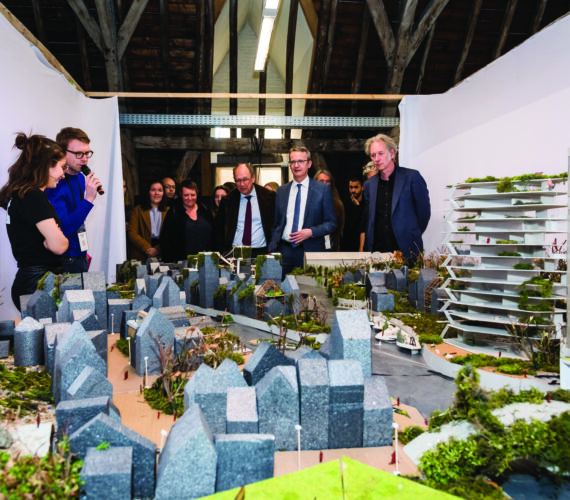
I soon realise that I’m walking through an exhibition that runs continuously, day and night, even on the closing day, whether anyone is there or not. In almost every hall of the exhibition circuit stands a moving object that looks like a strange amalgam of a sculpture and perhaps an old-fashioned robot. The objects are project models by the Brussels-based architectural firm Baukunst. Apart from the models, there aren’t many other objects. Here and there you’ll find a text that serves more to set the context than to offer a proper explanation. The walls are fairly bare and there’s a tranquil atmosphere in the dimly lit halls. Further on, a large lightbox displaying a satellite image of Brussels catches the eye. During a break, I pop over to have a look. The city is immediately recognisable in the image, but if you look more closely, you notice that several landmarks are missing. Iconic buildings have vanished and, in their place, the city stretches on, like a piece of fabric with a pattern of small, irregular patches stitched onto it. The collage emphasises the role of those symbolic buildings in the city, but also just how dispensable they are, because they are replaceable.