
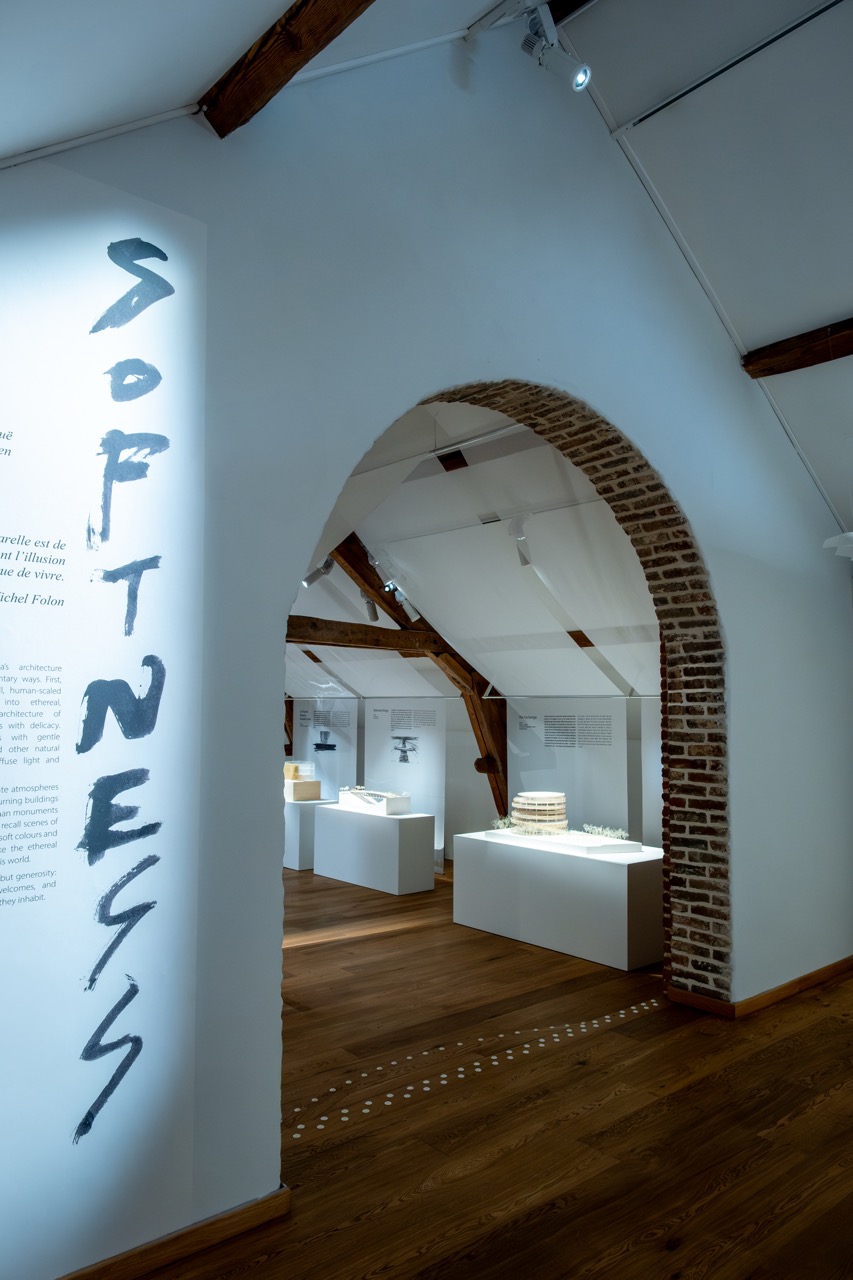
Architecture in Dialogue, an exhibition at the Fondation Folon in La Hulpe displaying the work of Japanese architect Kengo Kuma, came about almost by chance. In 2024, Kuma visited an exhibition of Folon’s work in Tokyo. It made such an impression that he approached Stéphanie Angelroth, director of the Fondation, to discuss the possibility of an exhibition in La Hulpe. The La Cambre Horta Faculty of Architecture contributed through Salvator-John Liotta, a former colleague of Kuma’s, with a lecture and a student workshop. Using random pieces of wood, students created two structures in Solvay Park, which is situated behind the Fondation. They drew inspiration from Kuma’s approach to materiality, detail and craftsmanship.
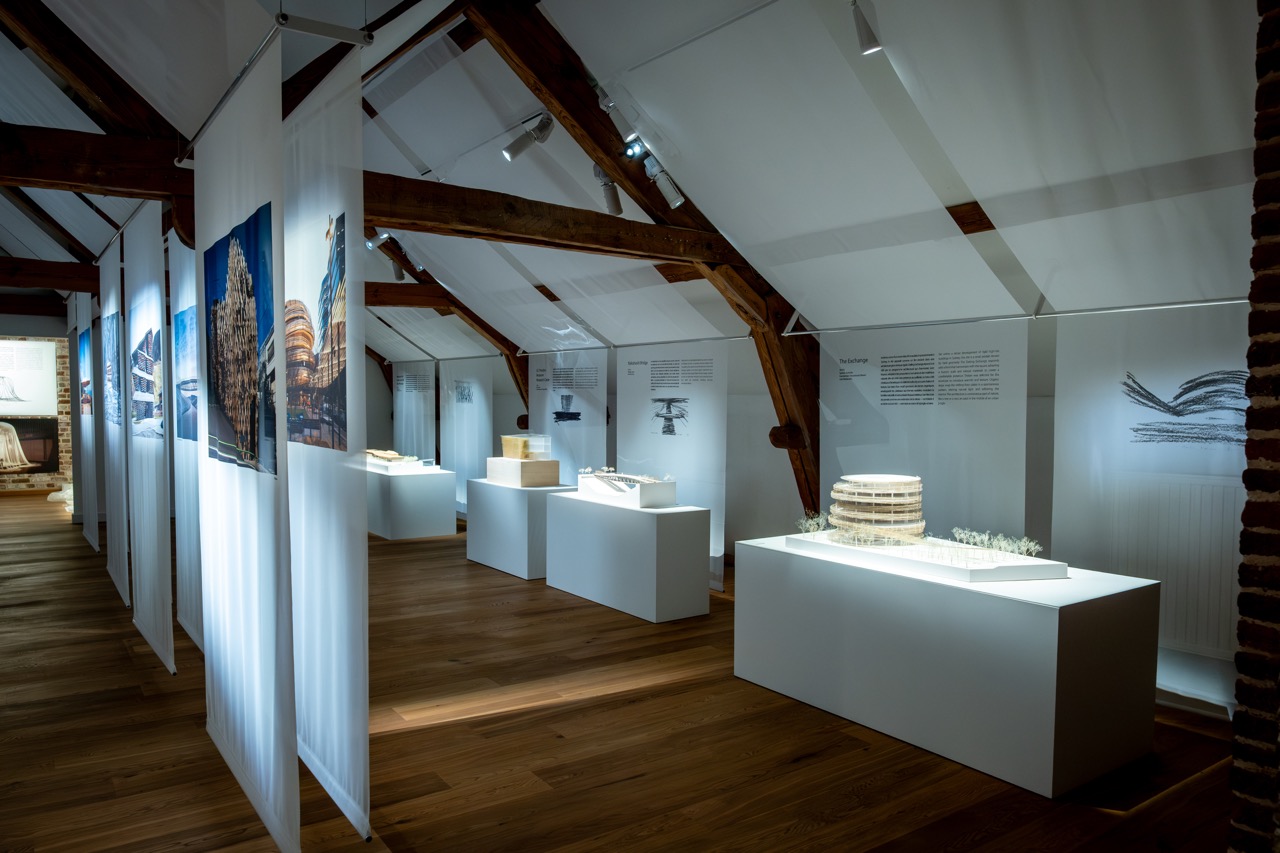
Kuma organised the projects at the Fondation Folon around four themes: lightness, softness, nature and geometry. In terms of its design, the exhibition displays a remarkable layering, an essential aspect of Kuma’s work. His buildings never establish a rigid boundary between inside and outside, but rather blur that transition through sophisticatedly erected screens of bamboo, wood, stone, glass or other materials.
Each project is presented here in three ways. An opaque screen displays the basic data. A pencil or charcoal sketch captures the fundamental concept of the design in a single image. The real eye-catchers, however, are the astonishingly precise models. Some, such as that of the Sunny Hills shop in in Aoyama, Tokyo, are 3D prints. Most models have been exquisitely handcrafted, however, by the team of model-makers led by Hisako Tokai. Finally, a single photograph, printed on semi-transparent fabric that floats freely in the space, depicts the building itself. These photographic canvases in particular create a sense of layering within the exhibition space. As a result, the images seem to merge into one another and refer to one another. In this way, they rightly suggest that the same themes recur throughout the work.
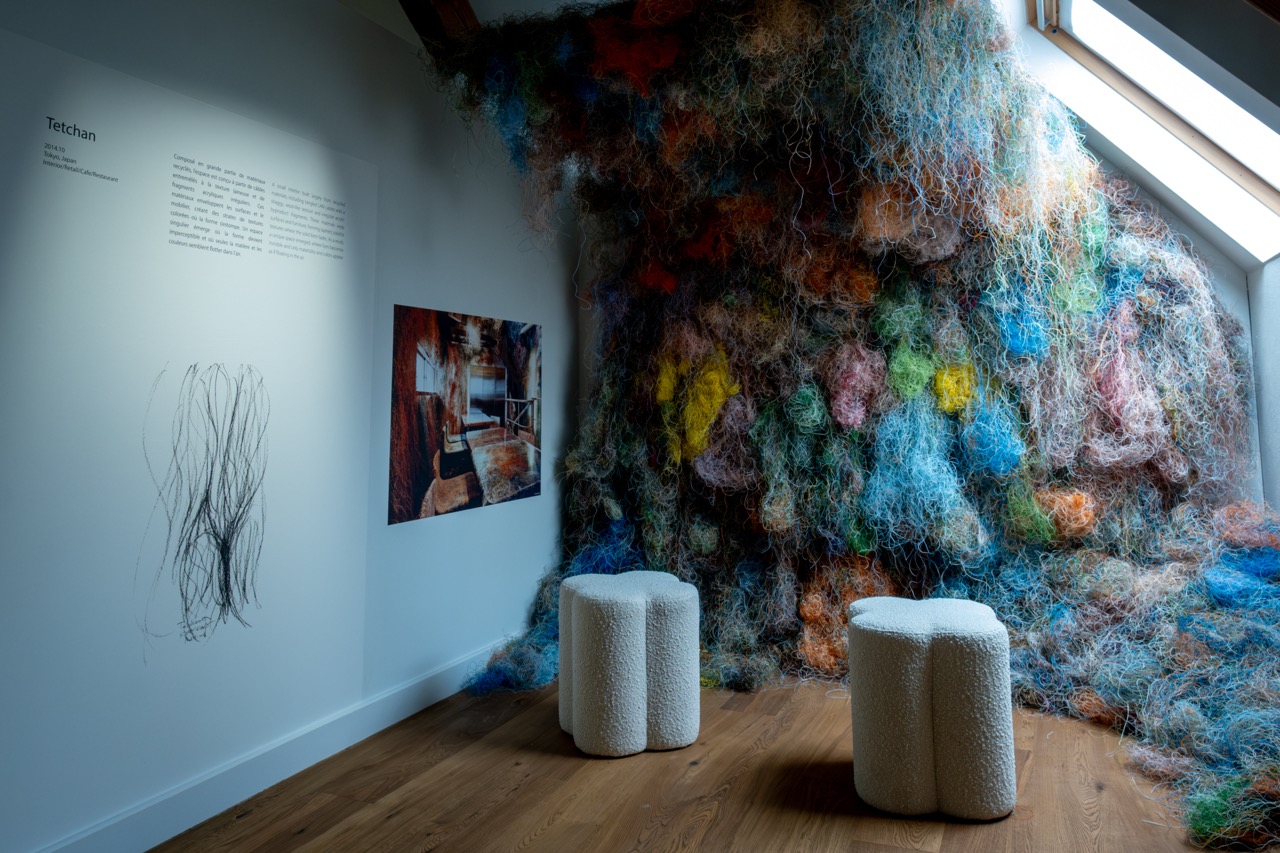
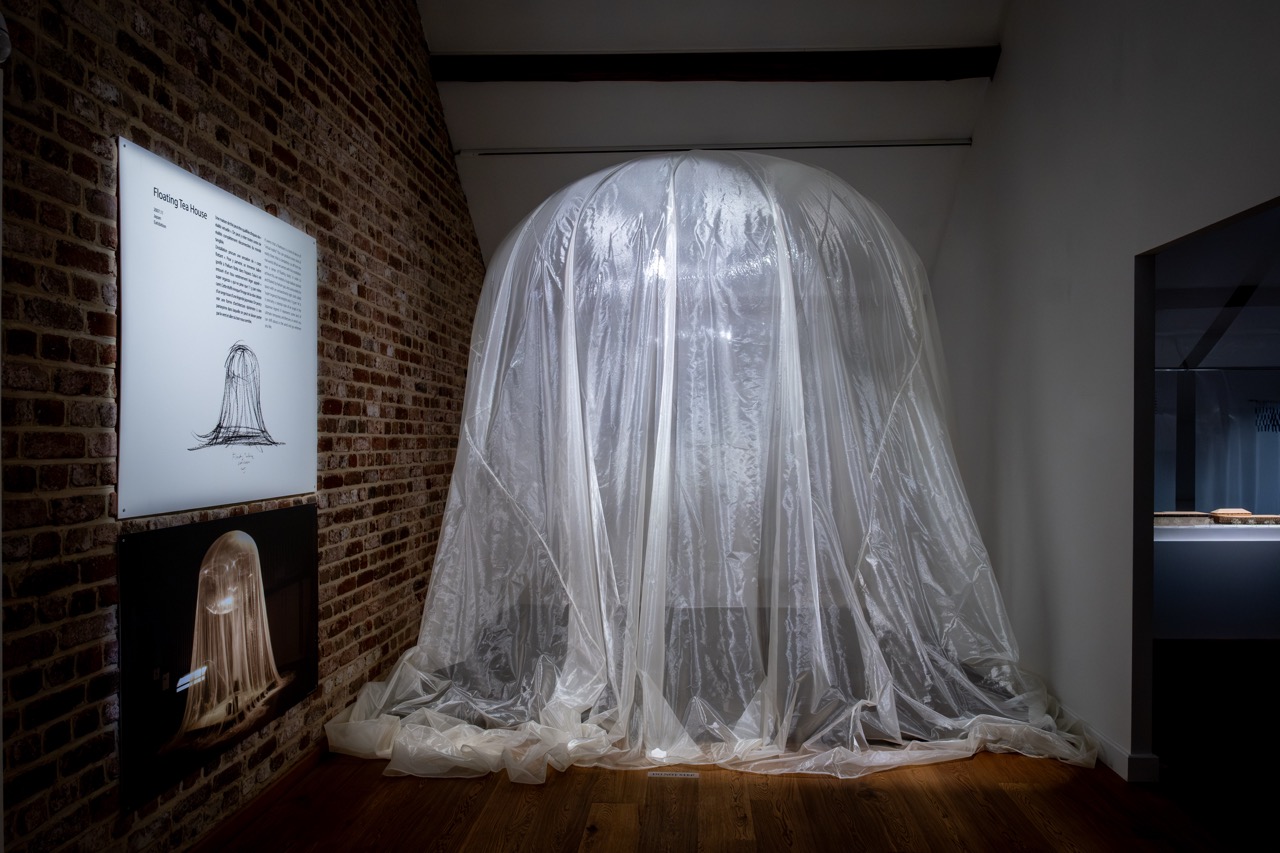
Occasionally, at the entrance and in the section on ‘Softness’, a concrete demonstration of a material upsets the exhibition’s strict structure. The material then becomes the vehicle for an entire concept. Floating Tea House (2007), for instance, consists of a helium-filled balloon draped with an extremely light veil of reflective organza. For Kuma, the work represents an alternative dream reality. Another example is Tetchan. A corner of the attic is clad in the tangled, multicoloured material that defined the design for the Tetchan café in Tokyo (2014).
In his lecture at the ULB on the eve of the exhibition’s opening, Kuma explains what Architecture in Dialogue stands for. He does not regard his designs as independent objects, but as an exploration of their relationship to context and nature. For him, the meaning of a design emerges during the process of construction, or in other words: in dialogue. To illustrate this, he refers to a project from 2000: the museum dedicated to the 19th-century Japanese woodblock print artist Ando Hiroshige.
Even before discussing the building itself, he analyses a print by Hiroshige. It depicts people fleeing across a bridge to escape a sudden storm. He points out how the artist does not suggest depth through perspective, as in Western art, but by constructing the image in successive layers. Layering and filters – such as those between inside and outside – are indeed, as the exhibition demonstrates, a recurring theme in Kuma’s work.
Remarkably, he uses a copy that Vincent van Gogh made of this drawing to illustrate a second motif in his work. Just as van Gogh builds up and breaks down the image with strokes of paint, Kuma often breaks down the image of a building by breaking the material—be it wood, stone, concrete or glass—into particles. ‘Particlising’ is what he calls it. Only then does he reveal how the building creates a link between the village and the surrounding forest through a wide passageway running through the structure. While doing so, he emphasises its materialisation: the roof is made of wooden beams from the forest. That connection with a material culture is essential to him: if we lose that, we lose everything. Hence his interest in traditional craftsmanship and the way in which we can preserve it in the 21st century, as he explains in the following interview.
Pieter T’Jonck – You work all over the world these days. For example, you recently built a porch for Angers Cathedral. How do you establish a connection with local traditions and craftsmanship in such cases?
Kengo Kuma – We actively seek out the best craftsmen and learn about their approach through in-depth discussions and research. We take our time for this. It’s important to preserve this knowledge because, all over the world, craftsmanship is visibly disappearing, in favour of standardised solutions that have no connection to nature or society.
PTJ There’s a paradox in that you also employ advanced digital tools, for example in your installation Domino 3.0 Generated Living Structure at the Biennale: an assemblage of wood from uprooted trees into new structures, thanks to an AI-driven analysis.
KUMA Both approaches are complementary and reinforce one another. In Domino 3.0, we demonstrate that ‘waste wood’ is a viable building material once we forget about standardisation. In this way, we use scarce resources more sustainably. I dream that in the future we will all live in structures like these rather than towers of glass and concrete.
PTJ Even in major cities, your work avoids tower blocks. I’m thinking of the Cultural Tourist Information Centre in Asakusa (Tokyo).
KUMA We had very little space there, so we conceived the building as a stack of traditional dwellings that have an open relationship with their surroundings, yet still offer intimacy. That’s the future. That’s also the power of architecture: it doesn’t need words to reveal possibilities.
Kengo Kuma, Architecture in Dialogue. Until 13 September 2026 at the Fondation Folon, La Hulpe
