
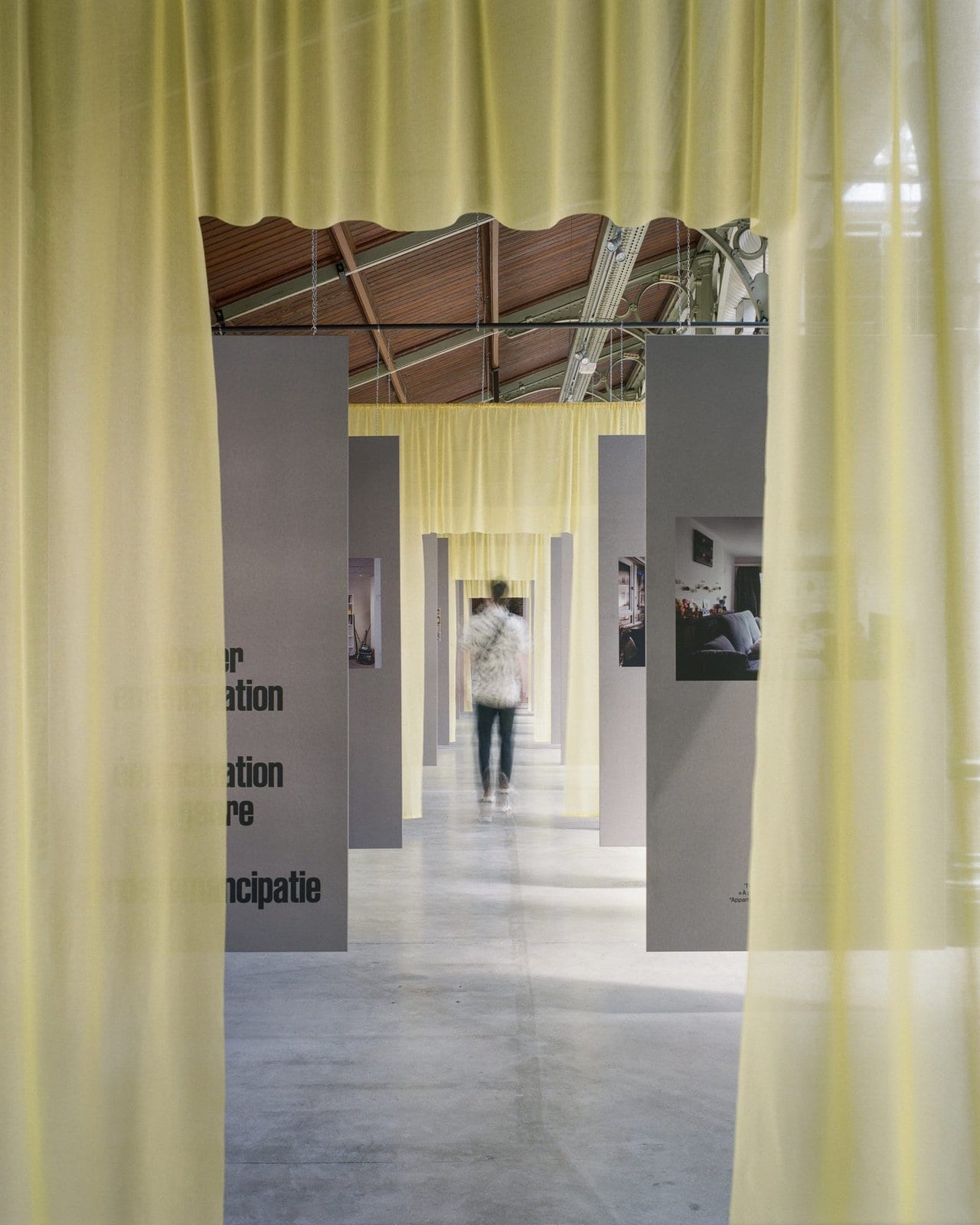
The exhibition “Anders wonen” (in English: “New Ways of Living”) has been running at the Sint-Gorikshallen in Brussels since 15 May. The exhibition was curated and designed by the Brussels-based agencies Dogma and CityTools, on behalf of Urban.Brussels. Taking the diverse landscape of households in Brussels as its starting point, the exhibition aims to provide an overview of alternative forms of housing that can inspire us for the homes of the future.
The exhibition is structured around four core themes: gender emancipation, living and working, alternative ownership structures, and the reuse of existing buildings. Each core theme is explored through ethnographic portraits of ‘non-conforming’ households in Brussels. The theme of gender emancipation sketches a portrait of the precarious living situation of a single mother with four children in a Brussels flat, alongside a portrait of the unique household of a queer community in Ixelles. The decision to focus on individual households – and to push the architects involved into the background – is refreshing and provides space to reflect on the residents’ appropriation, lifestyle and challenges.
Each of these portraits is accompanied by four additional case studies per theme, which contextualise the same theme within a broader geographical and historical framework. Illustrated with richly coloured perspective plans and isometric drawings by Dogma, these projects bridge the gap between the personal portrait and the role of architectural design. The selected case studies are diverse and provide the necessary context to interpret the seemingly ‘new’ forms of housing as revivals and evolutions of existing traditions or experiments.
The scenography, set up on the inner balconies of the halls, presents the four core themes in an arrangement of suspended yellow fabric, amidst which fine grey MDF panels convey the story of the exhibition. Complementing this, a central timeline tells the story of the evolution of Western house designs from the first semi-sedentary settlements to the present day. This is where the curators’ ideological perspective is most clearly evident, as they interpret this evolution as ‘an attempt by those in power to encourage residents to lead a domestic life’.
The exhibition concludes with an explanation of the role of regulation in this broader narrative of living and housing. Although this broader perspective is a welcome addition to the exhibition, visitors are left feeling somewhat unsatisfied here, and the explanation goes no further than a concise summary of current ambitions and regulations. The project page on the CityTools website reveals that concrete policy proposals were also part of the project’s ambition, but that they presumably faded into the background during the process. Nevertheless, the exhibition offers a panoramic view of the diversity of housing forms today, in the past, and possibly also in the future. In times when we increasingly view houses as property rather than places to live, this exhibition is the ideal antidote.
