
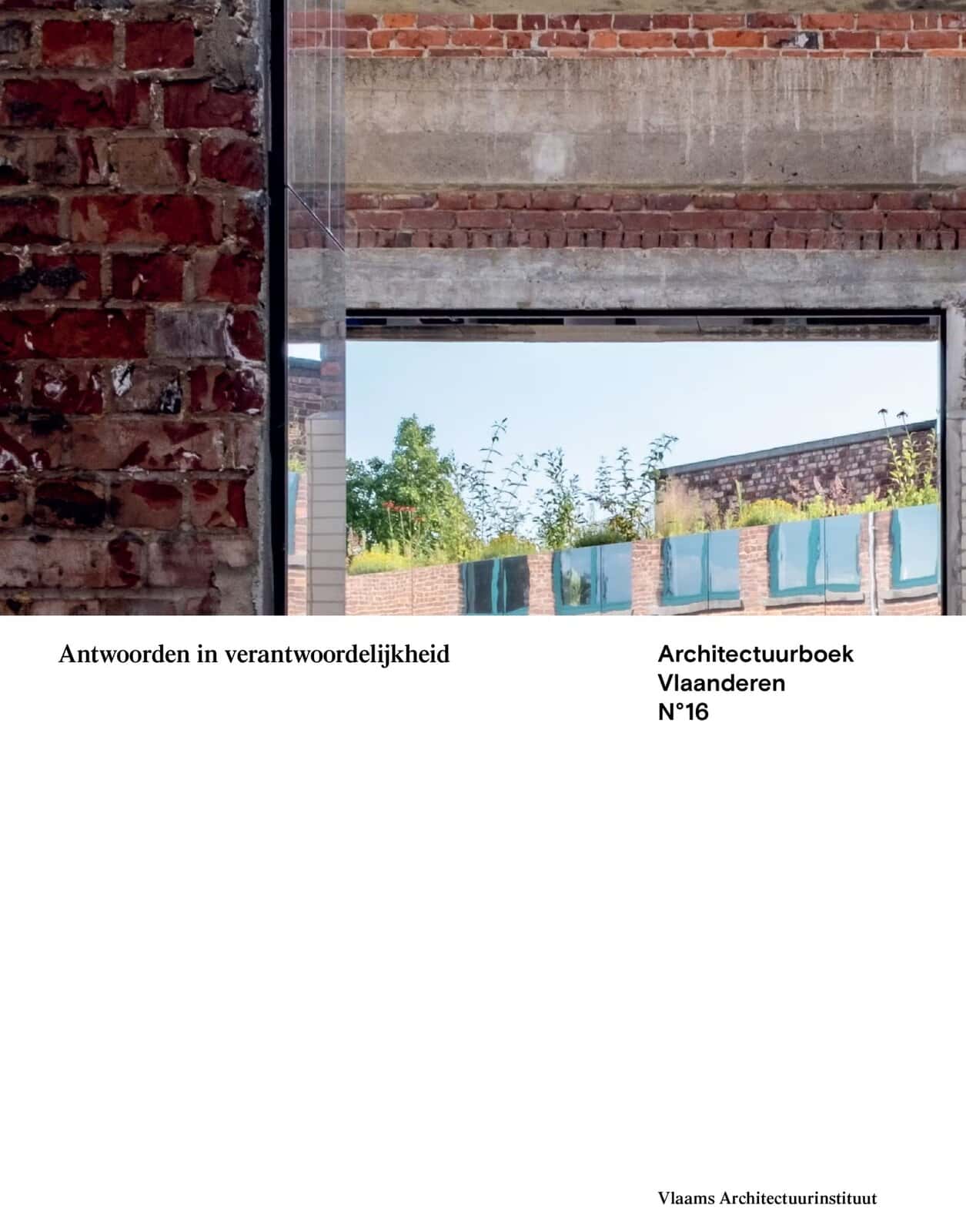
The nine-member editorial board of the 16th Flanders Architecture Yearbook, published by the VAi, called on architects to submit projects, offering a clear guideline. Under the motto ‘Responsible Responses’, it asked entrants to ‘demonstrate how the project (…) critically addresses social and environmental crises, and how it navigates between regulations, ecological commitment, building conventions and economic constraints’. The editorial team was also curious about ‘projects that question typical relationships between clients, designers, builders, material suppliers, local residents and non-human organisms’.
The selection of 42 projects they made from the approximately 300 entries reflects this. It rarely highlights the architect’s signature, but invariably deals meticulously with the context and a much wider circle of stakeholders than just the client. This also led to some remarkable processes. ‘Caring architecture’, is how Sofie De Caigny describes it in the book’s introduction. However, the eleven essays framing this selection grapple with the question of who the architect still is and what they are responsible for.
Although the architecture book selected 42 projects, it did divide them into an A and a B category. The A category is given a separate discussion in the style of the Dutch Architecture Yearbook: a short text without attribution, a few black-and-white photographs, and plans, sections and elevations on a small scale. The B category is covered in the essays with only photographs, the most essential data and very brief plan material. However, this distinction is not explained anywhere. It is, however, commendable that Vai sent six photographers out to document all the selected projects. This extensive photographic series often documents the use of the building rather than the architecture as an object. This is also in keeping with the book’s motto.
Several essays address the architect’s responsibility within that motto. The most perceptive is that by Carlo Menon: he argues that the architect has increasingly become an editor of circumstances and processes, and less and less an author. Which does not prevent Hülya Ertas, in the concluding essay – quite rightly – from calling on designers to dare a little more.
This is quite different from the old notion of the architect as a heroic figure in the service of the good, the beautiful and the useful. This notion shines through in the introduction by Sofie De Caigny and Dennis Pohl: ‘Caring architecture takes responsibility at the highest level for the care of the planet and demonstrates this down to the smallest details’. Els Nulens takes this a step further in her essay: ‘The complexity of spatial challenges and architecture is great today. This relates to, among other things, climate adaptation, sustainable energy, regulation, urbanisation and spatial clutter, affordability and accessibility. To achieve spatial quality, beauty and justice, a collaborative effort is needed that can only be achieved if all parties join forces’.
However, designers have little control over the majority of the issues Nulens raises, if only because the ever-increasing regulation and legalisation of construction practice prevents them from doing so. In the essay ‘Housing beyond the table’, Petrus Kemme and Sofie De Caigny call a spade a spade on this point. They note that housing does not provide a cohesive and equitable environment because the playing field of housing development is divided between three parties. Developers, social housing associations and alternative models such as co-housing are, each for their own reasons, retreating into their own enclaves. Despite many promising projects, they argue that ‘trees with deeper roots are needed to anchor a sustainable housing vision in Flanders and Brussels’. The government holds the levers to achieve this through instruments such as area development, provided that the Region abandons its compartmentalised policy approach.
Dennis Pohl, however, gives architects who wish to set an example through circular construction a dressing-down in his essay ‘Ecologies that Matter’. He understands their aspirations but believes they must think on a larger scale, and beyond the technical approach of circular building, in order to carry weight against the dominant technocratic (and extractivist) approach to the ecological crisis. The essay ‘Generous Sharpness’ by Saar Meganckis is the only one in this book that, using five well-chosen designs – three primary schools and two housing projects – explains precisely and without pompous language in what areas and in what ways architects can indeed take responsibility for contributing to a better world, even without such a heavy agenda.
The sombre note in the book is provided by the essays by Evelien Pieters and Vjera Sleutel. Using dozens of startling diagrams, they demonstrate that architects are not performing well when it comes to promoting diversity, the position of women or staff remuneration. All too often, the business model of architects turns out to be flawed. This is certainly a consequence of the fact that, according to the EU, architectural practices are businesses and must therefore compete without the safety net of the minimum rates that the Order used to provide. Within a strong competitive culture, this has led to a race to the bottom. However, these abuses persist because architects are attributed – and also attribute to themselves – a social role as public intellectuals and/or guardians of the quality of the environment. The result, as Reyner Banham noted 50 years ago, is that architects take on (or are forced to take on) an extreme amount of responsibility. A consultant would never accept such a burden without commensurate remuneration. This structurally saddles ‘responsible’ architects with a workload that is out of proportion to their fees. Staff bear the brunt of this. If architects are to respond with a sense of responsibility, that should be the starting point.
Architectuurboek Vlaanderen No. 16. Responding with Responsibility, Flemish Architecture Institute, 2024. ISBN 978-9-492-56734-5.
