
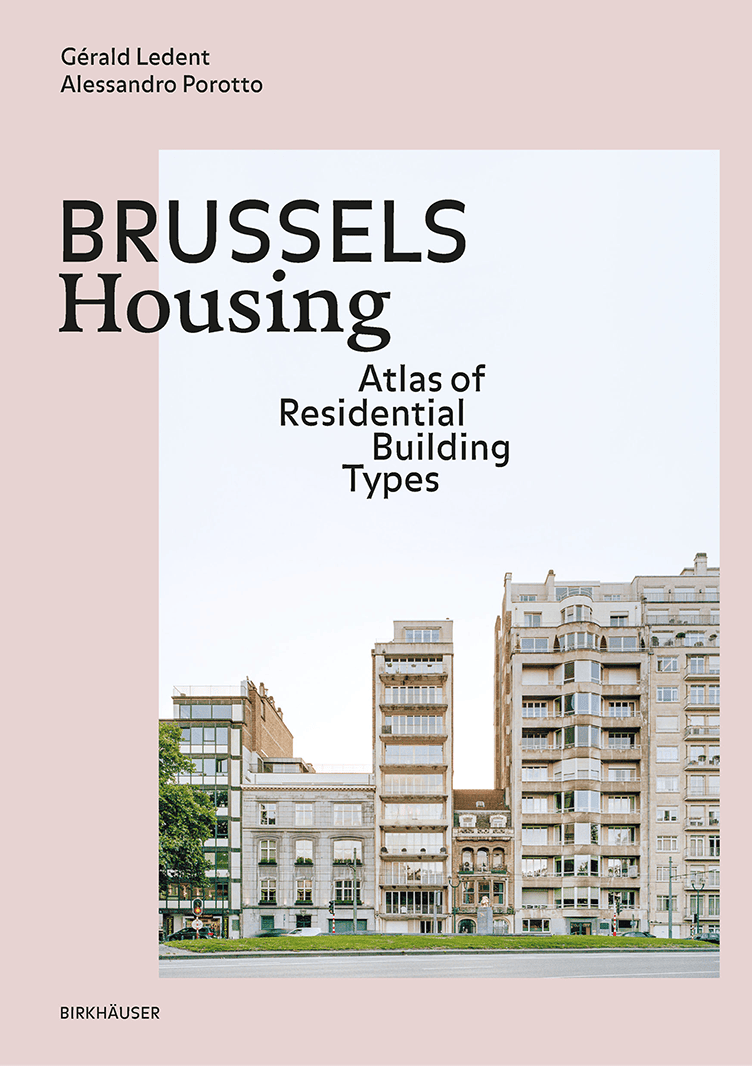
A photograph by Maxime Delvaux on the cover of *Brussels Housing – Atlas of residential building types* by Gérald Ledent and Alessandro Porotto speaks volumes (sic). It shows an avenue where apartment blocks from the interwar period and the 1950s and 1970s flank a grand patrician residence and a stately, yet only half as wide, 19th-century townhouse. This is unmistakably Brussels, a somewhat chaotic collection of dwellings with the classic townhouse as the baseline. The book provides a thorough and illuminating inventory of that housing stock, but also explores the society it reflected and shaped.
Brussels housing comprises three main chapters, each featuring an introductory text, a series of photographs by Maxime Delvaux and a selection of plans for projects documenting a specific evolution. This planning material is the book’s greatest asset. Following the example of the impressive study Typologies 1 & 2
by Christ and Gantenbein (Park Books, Zurich), which we discussed here previously, it provides a refined view of the floor plans, without indicating furniture or functions, but systematically on the same scales (1:100 for ground floor plans, 1:500 for upper floors, elevations, sections and site plans). This allows for a quick and effective comparison of the sometimes subtle differences in the organisation and composition of the buildings.
In the first part, the authors analyse, with a long historical introduction, how ‘la bonne maison moyenne’ and the closed block came to dominate the cityscape in the 19th century. Even today, these houses still account for 30% of the housing stock. They also explain why, within that single type, considerable variation arose depending on the social class of the residents.
A second chapter focuses on the alternatives to that model, which emerged as early as the second half of the 19th century. For instance, in the Cité Fontainas, Antoine Trappeniers and Hendrik Beyaert exchanged the model of the closed block for a crescent based on the English model. The cité looks like a palace, but in reality comprised 32 modest dwellings. This and other cités formed an alternative model for lower incomes. They heralded garden districts such as Le Logis-Floréal and the Cité Moderne. Art Nouveau architects such as Victor Horta, meanwhile, transformed the internal layout of the townhouse so that light could penetrate right to its heart.
The social upheavals following the First World War and the rise of the car brought about more profound changes to the layout of houses. At the same time, the wealthy bourgeoisie increasingly sought out the city outskirts. The detached house began its rise there. But the apartment block also experienced a steady rise. However, the stately flats of the late 19th century in the city centre cannot be compared with the ‘minimum
subsistence’ flats of the Cité Modèle from 1958.
In the final section, the authors explore the projects that have set the tone since 2000. Brussels has long since ceased to be the city that Jacques Brel sang about: the diversity of its residents, in terms of origin and family structure, calls for solutions very different from the ‘bonne maison moyenne’. This prompted new typological solutions.
Naturally, this book does not showcase every unique home in Brussels. It selects the most talked-about and qualitatively leading projects. That choice, however, is excellent. It features exceptional properties such as the Palais Stoclet, but also documents housing estates and apartment blocks. Only the ‘pomo’ period (1980–1995) gets short shrift, though I myself am not particularly sorry about that. Here you are presented with a wealth of reference points that allow you to reflect on where things might be heading in the future. Anyone wishing to discuss ‘typically Brussels’ housing will find it difficult to ignore this work in any case.
Brussels Housing – Atlas of residential building types, Gérald Ledent and Alessadro Porotto, 352 pp, English. BirhauserVerlag, Basel, Switzerland. RRP €78. Also available in electronic format.
