
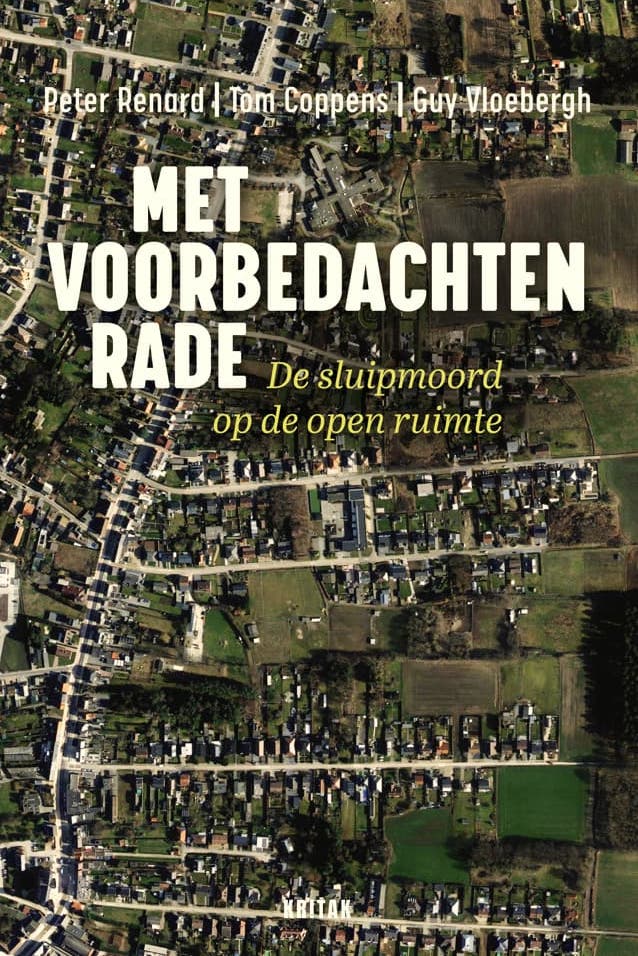
The authors are not saying anything new when they argue that the landscape in Flanders has fallen into disrepair, with harmful consequences for the climate, biodiversity and nature. Yet there is a wealth of legislation in place to ensure that spatial planning is managed effectively. Following the national regional plans of the 1970s, Flanders took over with the Spatial Structure Plan (RSV) in the 1990s. This broke with the zoning logic of regional plans. The RSV aimed for ‘decentralised clustering’, in other words: strengthening local centres and towns whilst also enhancing open space.
The RSV was laid to rest with the Flanders Spatial Policy Plan (BRV). From then on, the regional government would draw up policy frameworks – which are still not in place – based on a strategic vision. At the same time, it handed over part of the policy to the municipalities. A ‘codex train’ sealed the deal. Pending a Flanders Spatial Policy Plan (BRV), a ‘Green Paper’ was published, which the authors describe as the ‘Dag Allemaal version’ of the RSV. A ‘White Paper’ was supposed to provide greater clarity in 2016, but in the absence of maps and an implementation strategy, it was conspicuous for its vagueness. The term ‘concrete ban’ did make an appearance, but on the ground, just as much land was still being dug up. Up to 7.3 hectares a day in 2017! The 2018 Instruments Decree was no step forward: according to the authors, it serves primarily to further undermine the already meagre ambitions of the BRV. What remains is an absurdly generous compensation scheme for planning damage…
The book then examines other anomalies in Flemish spatial policy, such as the debates over non-zoned housing, the distasteful manoeuvres surrounding residential expansion areas—which suddenly turned out to be nothing more than building land—and the endless saga of ribbon development. In this way, they work towards the conclusion that in Flanders the exception is the rule, and urban planning is a matter for lawyers, not for planners. Enforcement is virtually non-existent. Open space in Flanders bears the brunt of this, but built-up areas are generally in a sorry state too.
The book concludes with a few suggestions for a policy shift regarding planning, permits and enforcement. It all sounds logical and reasonable enough. Whether anything will come of it is another matter: the authors themselves spent 180 pages arguing that the chances of that happening in Flanders are non-existent, and they do so with a great deal of expertise. You won’t catch them out on any errors. That makes the book essential reading for anyone concerned about open space in Flanders. But the reader be warned: this is not a cheerful read.
With Malice Aforethought / The Assassination of Open Space, Peter Renard, Tom Coppens and Guy Vloebergh, Kritak / Lannoo NV Publishers, Tielt, 2022. EAN 9789401476072. €24.99.
