Affordable housing is a broader concept than social housing. While social housing is a highly regulated form of affordable housing, the term affordable housing is not defined anywhere in legislation. A spoke with six different stakeholders – architects, cooperatives, an urban development company and a project developer – who each sought to provide a better understanding of affordable housing from their own perspective.
1. AgwA – Studio Tuin en Wereld
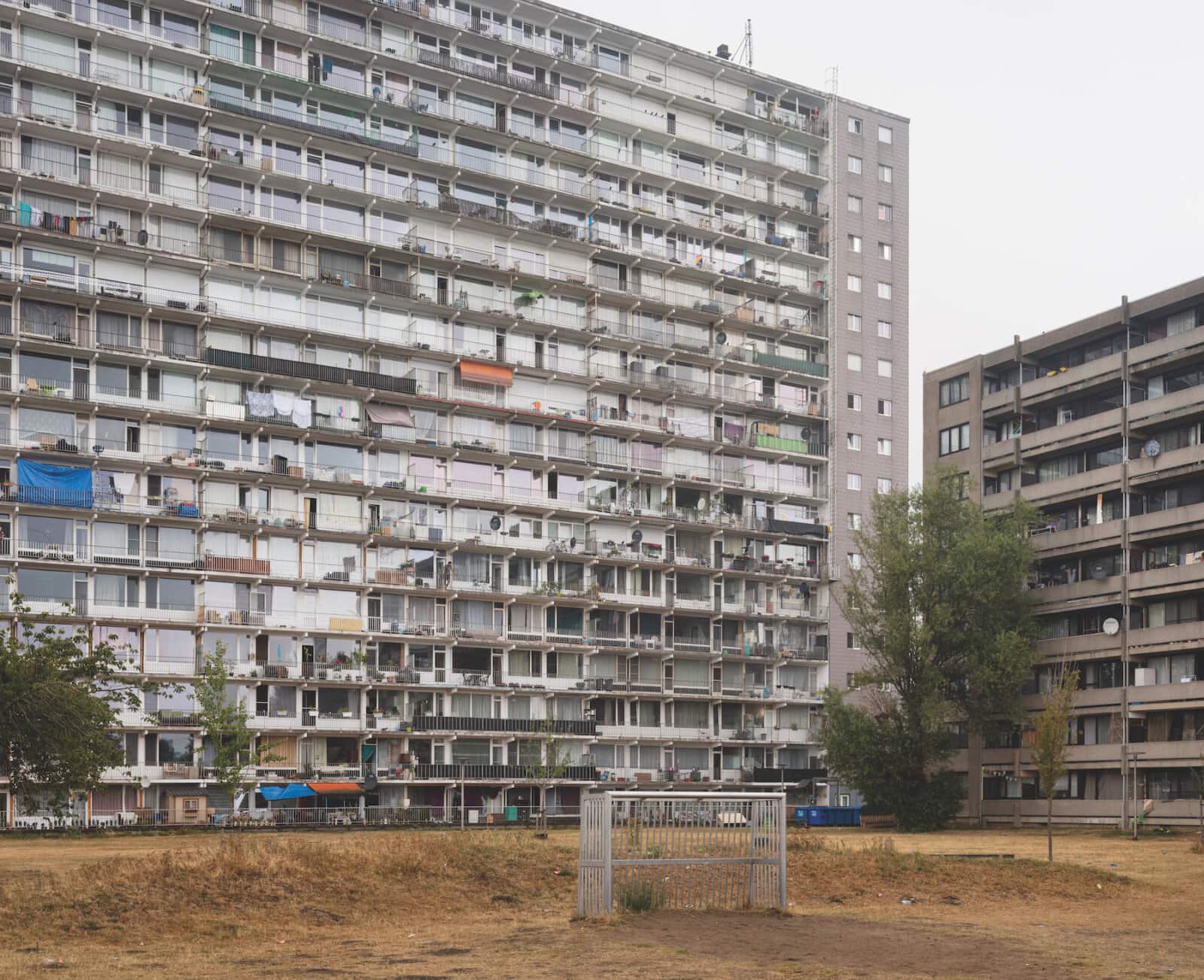
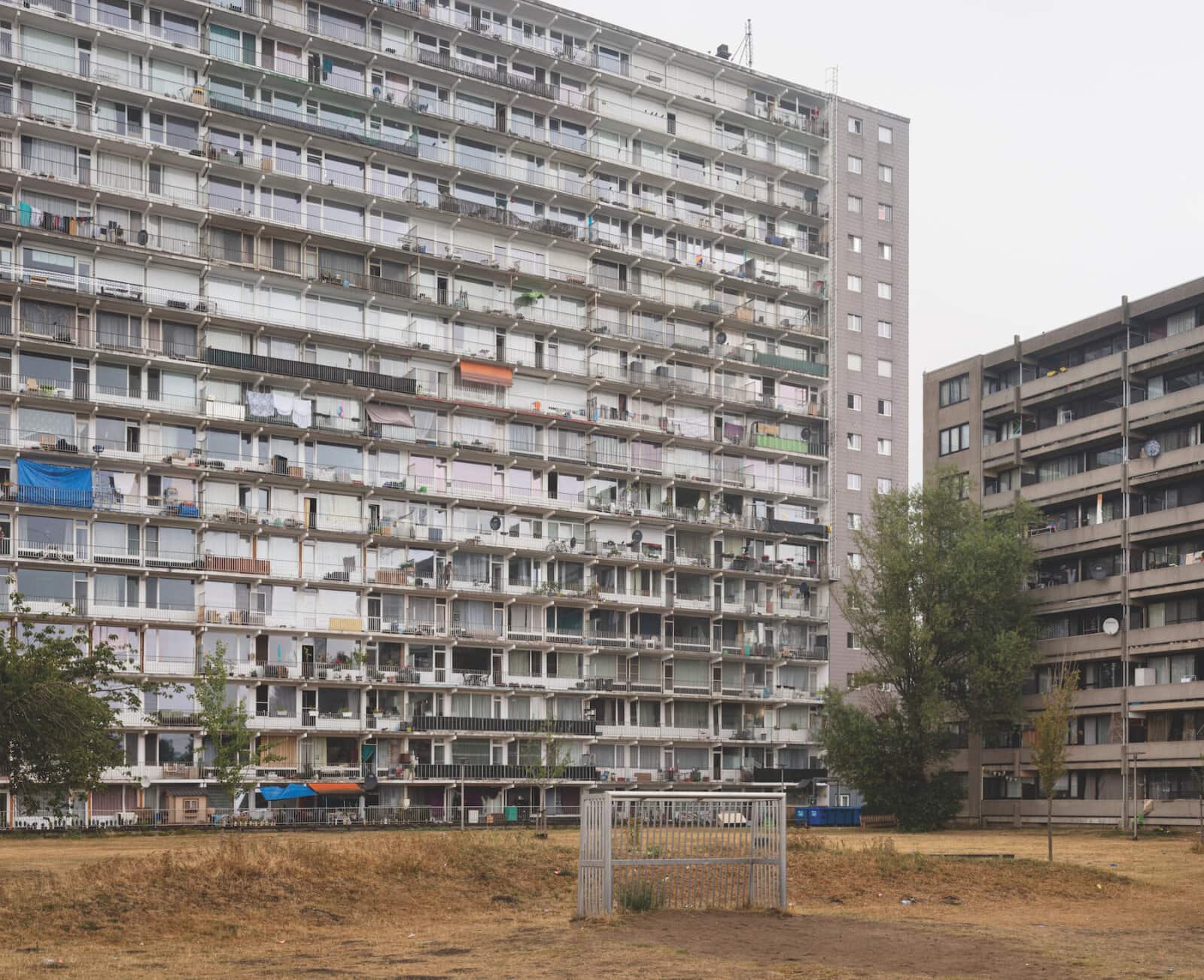
The Scandinavia blocks consist of two apartment buildings in the former port area of Ghent with more than 300 homes. These were built in the 1960s as a social housing project by a private developer for people on low incomes. Today, almost all of the residents are owners, but they are economically fragile, which means that the necessary renovation of the buildings will force many to sell their homes. On the initiative of the city of Ghent, in collaboration with the Ghent City Architect and with the support of Stedenbeleid Vlaanderen, a concept study was commissioned last year into the possibilities for urban integration, energy transition and the quality of living in the buildings. A spoke with Tomas Ooms (Studio Tuin en Wereld) and Harold Fallon (Agwa), who are working with Domus Mundi to develop the concept study and present it to the City.
A+ What exactly does your research involve?
Agwa – Studio Tuin en Wereld – The Scandinavia blocks consist of two buildings, the ‘Sweden building’ and the ‘Finland building’. Our research focuses mainly on the ‘Sweden building’ – 224 flats, spread over 17 floors and 3 cores. All flats are monogically oriented to the east or west with two to three bedrooms and large balconies. They are high-quality homes but poorly maintained. Interventions are needed in the areas of fire safety, energy and maintenance. We are looking at the problems and possibilities that the building itself offers, not only in terms of energy, but also the human aspects: who lives there? What communities, cultures and languages are present? …
Given the economically vulnerable situation of most residents, the co-ownership will not be able to pay for the work, or some of the residents will be forced to give up their homes. That is why the plan is to develop a new building on the site itself or on an adjacent plot of land through a land swap, thereby finding a financial solution. To this end, we are investigating the possibilities for integration into the urban development of the neighbourhood, both according to the OMA master plan of the time and the future RUP.
A+ How can a new development provide a solution?
Agwa – STW A new development offers various possibilities. The building could become a cooperative in which residents could buy shares after selling their own homes. Through a collaboration with Wooncoop, there would also be room for 7 to 8 per cent financially vulnerable profiles. Another possibility is the Community Land Trust model, in which the City of Ghent becomes the owner of the land and the residents only buy the homes themselves.
A+ What are the possibilities for the building itself, independently of a new development?
Agwa – STW The City of Ghent, the cooperative or another partner could buy up the homes and then rent them out as social housing through a social rental agency. You could also consider the building as a vertical subdivision, expropriating the common areas such as the cores, but also the roofs, the boiler room and the facades. These would then become the property of the City of Ghent, which would carry out the necessary work.
We are also looking at other instruments such as existing energy subsidies, microcredits, or the principle of ‘Gent Knapt Op’ (Ghent is improving), which provides bullet loans to finance the energy transition. These loans, up to a ceiling of 35,000 euros, are repaid in one lump sum at the time of sale or upon inheritance after the owner’s death. These are all complex financial models, and the first challenge is to provide the right information and guidance to residents. The overarching question here remains how to counteract the almost inevitable gentrification.
A+ Why is gentrification inevitable?
Agwa – STW With a few exceptions, the residents all own their homes. You cannot force them to sell their homes or impose a specific renovation, buyer or price on them. When selling under a cooperative model, the sale price is below market value. In exchange, you receive shares and capital – the calculations are currently underway – but you still have to pay rent. In a balanced Wooncoop model, there is only room for a maximum of 8% of financially vulnerable residents, while almost all owners fit that profile. It is inevitable that a number of residents will still have to sell their flats. These will then partly end up in the hands of the middle class. The result will probably be a mix of all the above systems, which will also allow for a certain degree of diversity.
A+ What is the conclusion and what are the next steps?
Agwa – STW The study with all the different possibilities will be submitted to the City of Ghent and to Stedenbeleid Vlaanderen (Flemish Urban Policy). Given the high pilot project content of the proposal, we propose to apply for a project subsidy from Europe in order to take the next steps: developing the architectural project, bringing the neighbours together to discuss land exchange, working out the details of the cooperative, etc. Based on the study, we will also formulate a number of recommendations for the various policy levels (VME, City, Flanders, Europe, etc.) in different areas. These range from subsidies to VME statutes and from energy to neighbourhood activities. In this way, our research can be applied to similar buildings in other cities. There are many such buildings in Flanders alone. A key point in this advice is the appointment of three profiles: a technical worker, a social worker and a crisis manager, who together can tackle the complexity of such projects in a participatory manner. It is clear that a board of directors and a property manager do not have the time, capacity or authority to develop such buildings in an inclusive manner.
2. Sogent
Sogent, the urban development company of the City of Ghent, is jointly responsible for urban policy in the field of urban development and property management. It is increasingly focusing on high-quality and affordable rental properties as a permanent alternative to budget owner-occupied homes. A conversation with Sylvianne Van Butsele (Director of Strategy and Operations), Rebecca De Vos (Property Manager) and Sofie Van Ginderachter (Area Development Manager).
A+ For some time now, you have been focusing on increasing the supply of affordable rental properties. Why is that?
Sogent – A large proportion of Ghent’s residents want to become homeowners. At the same time, we see that the proportion of tenants in Ghent is almost 50 per cent. That percentage is much higher than in the rest of Flanders. Ghent is not only a growing city, but also an expensive place to live. Nevertheless, we want to keep it inclusive: we want people with modest incomes and the growing group of single people to be able to continue living there.
For a while, housing policy focused on subsidising owner-occupied homes, for example through social loans or by offering budget homes, whereby city homes were sold below market value. However, this approach had too limited an impact on the target group. This is certainly the case if we also want to reach the group of people just above the social housing target group, who often do not have the start-up capital to buy their own budget housing. If we also want to provide them with sufficient affordable housing, we have to lower the purchase price so much that the need for public input becomes far too great. Subsidised purchase programmes can therefore only make a limited contribution to the affordability of housing.
Moreover, we also noticed that the target group can quickly outgrow the budget home. One of the conditions for eligibility is that you do not sell the property during the first ten years. Your job or family situation can change quickly, much more quickly than in the past, and so owners often want to sell their homes sooner. But if we allowed that, we would miss our goal of affordable home ownership and instead encourage speculation and ultimately unaffordability.
That is why it is crucial that urban housing policy continues to focus on increasing the supply of affordable rental housing. Housing policy focuses on both social housing and budget rental housing. The housing association Thuispunt Gent focuses on social rental housing. At Sogent, we are responsible for the shift from budget-friendly owner-occupied homes to budget-friendly rental homes. The target group for this consists of people who are just unable to access social housing, or for whom the private rental market in Ghent is just too expensive.
A+ How exactly do you achieve this greater supply of affordable rental homes?
Sogent In each of our housing projects, we strive for a healthy mix of owner-occupied homes, social rental homes and budget rental homes – this is important for the financial success of the project. We aim for a composition of 60 per cent conventional, market-conform homes, 20 per cent social homes and 20 per cent budget homes.
Ten years ago (in 2013), our subsidiary Huuringent was established: an urban letting agency that rents out private homes at a fair price to people on modest incomes. Huuringent will take on the role of affordable landlord in Sogent’s future housing projects. The Kaai 24 project on the Voorhaven in Muide, designed by Dierendonckblancke and Lust architects, is a good example. We are realising a housing project of 72 energy-efficient flats around a communal courtyard garden. Twenty-seven flats will be offered for sale and 20 flats will be rented out by a social housing association. The remaining 25 flats will be marketed as budget rental properties by the urban rental agency.
For a high-quality residential project with a certain percentage of budget rental properties to be successful, it is crucial that the project developer is convinced from the outset and adapts his business model accordingly. A successful example of this is the development of the new S-shaped building on Koningin Mathildeplein, on the south side of Gent-Sint-Pieters station, a project by 360 architects. Sogent entered into a cooperation agreement with the private partner Acasa Group for this project. The building will contain 63 affordable rental homes, all with an indoor terrace. There will also be a communal courtyard garden, a roof terrace and a garden pavilion with a kitchen where residents can get together or organise private activities. The homes will be marketed by Huuringent at pre-determined rental prices.
It is necessary to both upgrade renting and improve the rental offering and make it affordable. In order to achieve the paradigm shift from buying to renting, it is very important that everyone is on board: the authorities, project developers, rental companies, private owners and, of course, the actual future residents. A gradual change in thinking about housing and buying is needed; call it a change in mentality, a generational shift, or a different kind of systems thinking. This is a slow process. The current economic downturn is not exactly helping us, quite the contrary. But we firmly believe in the inclusive city, and we are convinced that this requires, among other things, affordable rental housing. We are in a pioneering phase, exploring what works and what doesn’t, learning and refining. A paradigm shift cannot be achieved in a day; it requires not a revolution, but a continuous evolution.
3. 51N4E – Cast
The Cast studio of the Brussels design agency 51N4E focuses specifically on creating adaptable buildings that serve multiple purposes and energise their surroundings. One of those purposes – which they approach in a multifaceted rather than linear way – is housing affordability. An exploratory conversation with the project leaders of 51N4E-Cast – Wim Menten, Matthieu Moreau and Aline Neirynck – about adaptability, collectivity and densification, and the possible connections between them.
A+ When you talk about ways to achieve affordable housing, you are not so much concerned with the concepts of social, modest or fair housing, or with alternative financing models and forms of ownership. 51N4E is primarily concerned with very concrete spatial interventions that allow people to meet each other. Can you clarify the link between shared space and affordability?
51N4E – Cast – When we look at past and present examples of social housing, we see that all too often the focus is on a minimum number of square metres or bedrooms, on sufficient light, air and hygiene, and on insulation, ventilation, energy and consumption. These are monetary or quantitatively measurable factors. That is very important, but we believe that social housing is approached in a rather ‘technical’ way. So little emphasis is placed on the ‘social’ aspect of social housing; the importance of cohesion between residents, of being able to integrate into a residential community.
We believe this is crucial, especially for the often vulnerable residents of a social housing estate. They need more than just acceptable housing. They need connection, integration, a neighbourhood where people care for each other, even outside the strict family unit. A place to hold a large family party, play safely, help with homework or childcare, chat spontaneously with neighbours.
A+ Are you talking about combinations of individual and shared spaces that strengthen neighbourhoods? About neighbourhood-building architecture?
51N4E – Cast Yes, there is a beautiful word for that in French: le voisinage. We are designers, so we think spatially. We are looking for an architectural alphabet to promote encounters, relationships and collectivity. This could be a shared garden or terrace, a wide staircase, an oversized footbridge or an open entrance hall that can be used as an outdoor room. Places where chance encounters can take place or ordinary, everyday things can be done together. But it also involves large windows, for example, which allow visual contact between residents and their surroundings.
A+ I don’t think that’s only important for social housing.
51N4E – Cast Certainly not, but it is particularly important in that context. Because shared spaces not only give vulnerable residents more space than they could normally afford, but also the opportunity to integrate into a neighbourhood, to make a place their own together with others, to form a community. Research by sociologist Dirk Geldof (University of Antwerp) shows that there is currently much less green space in neighbourhoods with greater diversity and lower incomes. There are fewer private gardens and parks. This is very problematic, because more families with children live there. They are the ones who end up in the least green neighbourhoods of our society. So a new dynamic is needed, one that redistributes space and makes room for greenery and social interaction.
To create a resilient neighbourhood, where old and new residents live together and not only accept but also embrace each other, a mix of people is needed. Otherwise, you end up with segregation and ghettoisation, with Flemish villa neighbourhoods at one end of the spectrum and the capital’s social suburbs at the other. Our ambition is to use our architecture to bring people together and mix them, old and new residents, with different identities and backgrounds, and at different levels of the income ladder. We are looking for a model for the ‘dense, village-like residential core’. And that is why those shared spaces are so important: they form a mechanism for welcoming social residents into the neighbourhood.
A+ Are there also limits to collectivity?
51N4E – Cast We are not really concerned with formal forms of collective living. We are more interested in robust housing models in which shared spaces play an important role; places for informal moments of togetherness based on concrete, everyday experiences. That is slightly different. Because, of course, there are limits to collectivity. To quote anthropologist Ruth Soenen, with whom we collaborate on projects such as the Moscou-Vogelhoek neighbourhood structure sketch in Ghent: community should not be a social obligation. Too much ‘togetherness’ can destroy coexistence. So it’s mainly about an ambivalent version of community, where disconnection is possible alongside connection. About a subtle interplay of meeting and avoiding. That is why gradations are necessary in the sharing of space within the same project. There can be no successful shared space without sufficient semi-public and completely private space.
A+ You link affordability not only to collectivity, but also to adaptability and densification. Can you explain this on the basis of some of the social projects you are working on?
51N4E – Cast Smart, adaptable models can transform existing neighbourhoods into attractive places to live and thus respond to changing family structures. At the same time, collective, robust living environments offer opportunities to preserve the limited open space that is available and to increase its natural carrying capacity. Densification leaves more space for greenery: a shared garden or a play forest, an allotment or a bicycle shed for the neighbourhood. So yes, densification and adaptability, collectivity and inclusion, greening and ecology go hand in hand. They are part of the same whole, in which the design of shared, open space is crucial.
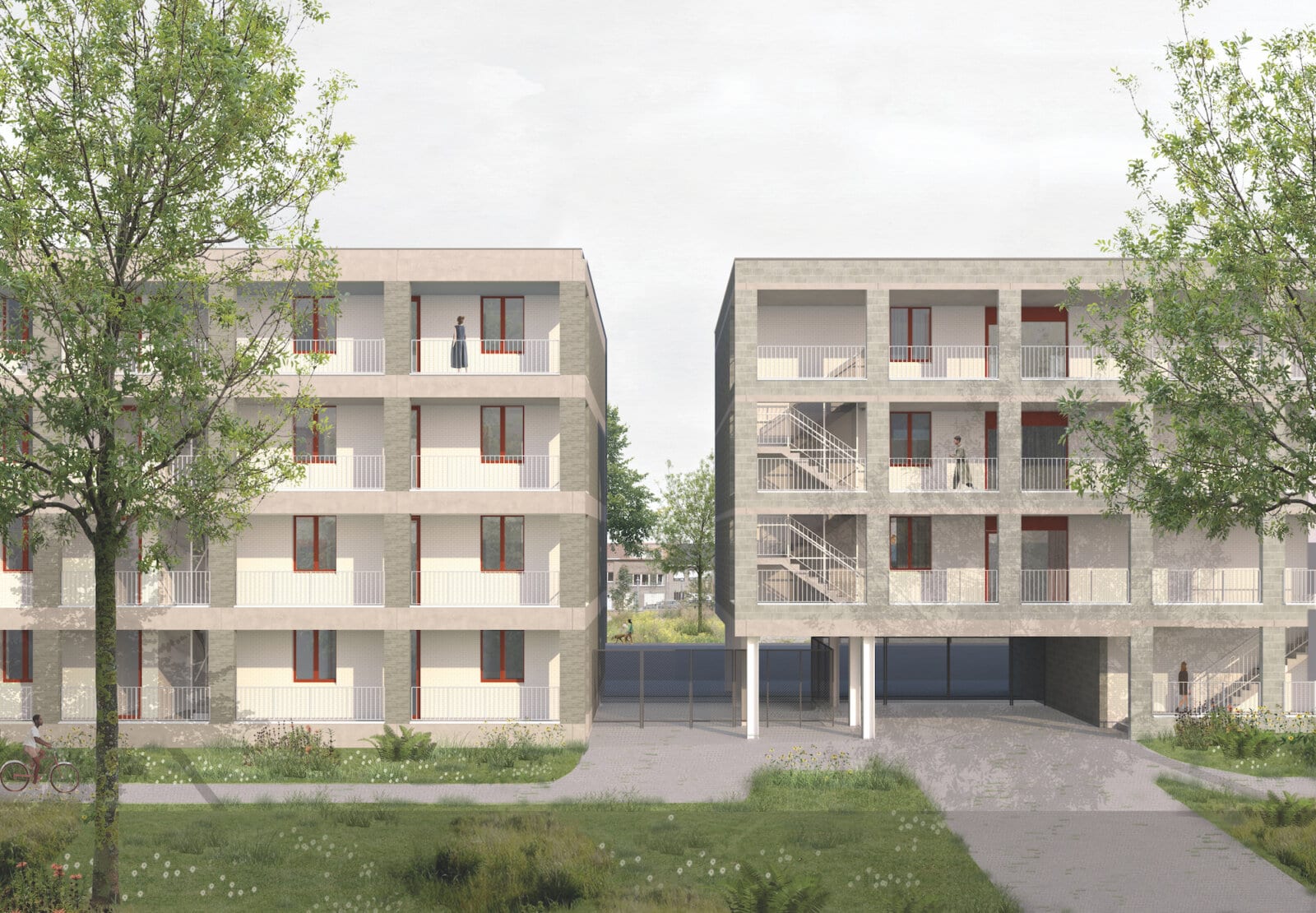
Because construction budgets for social housing are limited, as a designer you have to focus primarily on what is essential for promoting engagement. We often opt for small interventions with a big impact, as simple and high-quality as possible. This was also the case in our project for the Brussels garden district of Homborch, built by the Uccle cooperative for affordable housing in 1930. The garden district has 120 existing homes – small, white houses along cobbled streets – built on a plateau with a unique topography. Commissioned by the Brussels Regional Housing Company (BGHM), we are building 90 additional affordable housing units (social and middle class). We are providing most of them with spacious outdoor staircases and living spaces with large windows and different views.
Our main objective is to rethink the landscape quality of the garden district so that it can fulfil several roles at the same time. That is why we must focus on densifying residential areas and finding new ways to traverse the neighbourhood. To this end, we are making use of the topography of the landscape. The monotonous grassland is disappearing and we are creating different types of green meeting places in its place: sometimes wild, sometimes landscaped, sometimes vegetable gardens, sometimes sports fields, sometimes completely public, sometimes somewhat hidden and private. We are working closely with sociologists and landscape architects (Coloco); after all, our aim is to create a ‘shared landscape’ that will help to form a Homborch community.
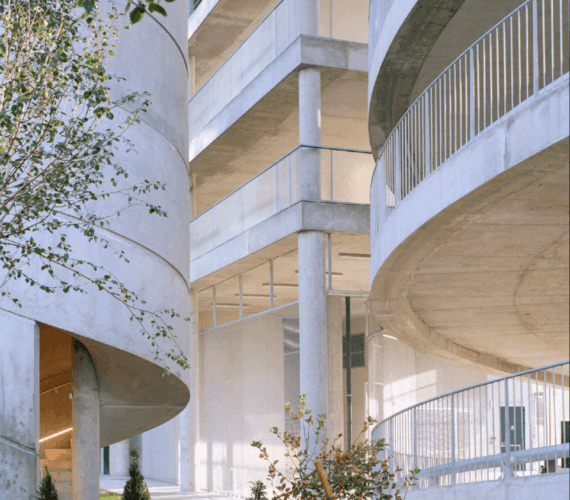
In the Peterbos neighbourhood in Anderlecht – also known as ‘the most dangerous neighbourhood in the country’ because of its drug problems – we are currently renovating a residential tower with 81 social housing flats in collaboration with Lacaton & Vassal. In projects like this, where the budget is limited, it is extremely important to make well-considered decisions: what do you renovate and what do you leave as it is? On the one hand, we are focusing on adding a structure to both long facades so that each flat has a winter garden, and on the other hand, we are investing in shared, semi-public spaces in the plinth that connect with the street and the ground level. The project therefore not only improves the quality of the residential units, but also creates space for collective, social anchoring in the neighbourhood.
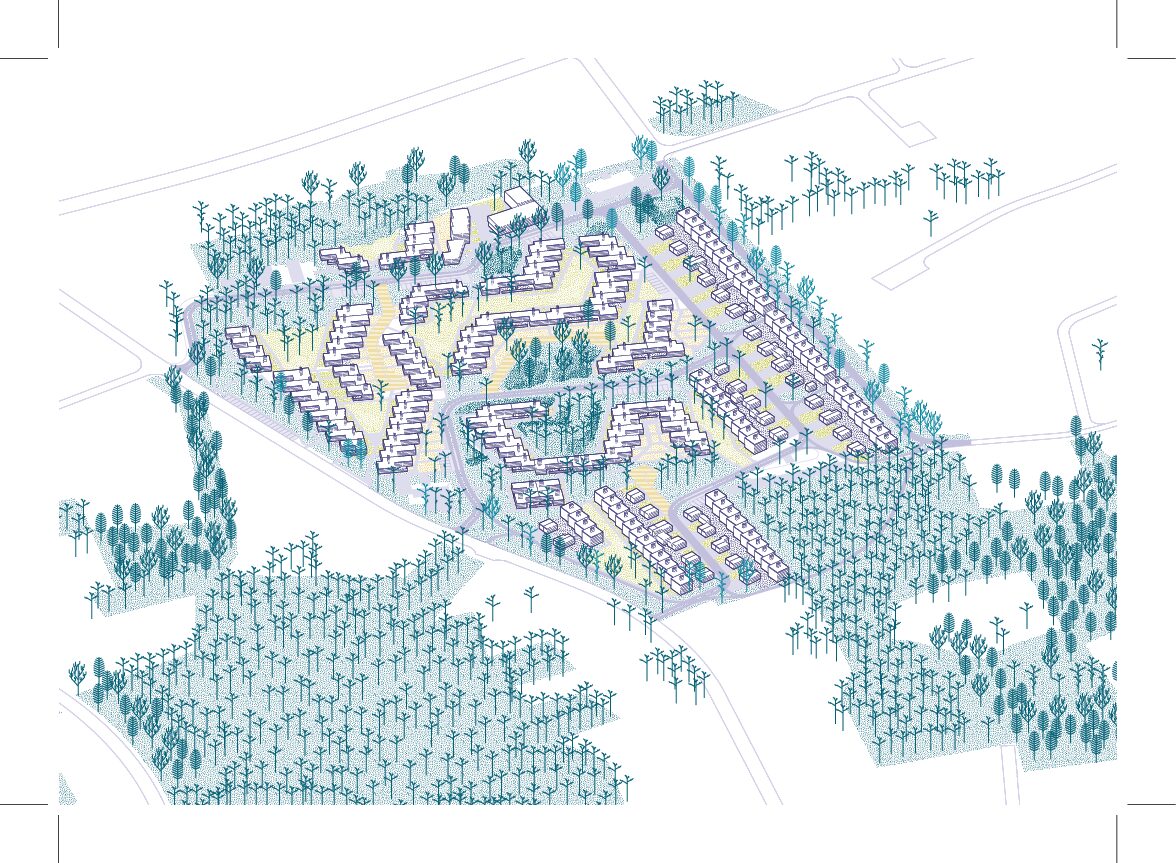
In our master plan for the Groothuis social housing estate in Verrebroek, the renovation of the homes is also the reason for protecting the undeveloped residential expansion area from paving. At the same time, we are increasing the density of the neighbourhood and focusing on soft mobility, transforming a car street into a living street. Such living streets enable residents to make the neighbourhood their own; they encourage encounters and interaction, typical of village density. We are keeping the surrounding polder landscape open and developing it into a natural, productive and biodiverse biotope, accessible to the residents of the neighbourhood and surrounding areas.
A+ Your collaboration with anthropologists, sociologists, ecologists and landscape architects is striking. This multidisciplinary approach seems necessary for the social, caring attitude in the way you create architecture.
51N4E – Cast We don’t talk about inter- or multidisciplinarity ourselves, but about integrative urban planning and architecture. This means that we combine different areas of expertise so that they complement each other and form a whole. Together with Acte, another studio within 51N4E that focuses more on urban planning and the incremental transformation of a city or district, we are broadening our spatial knowledge with social expertise. After all, architecture is about appropriating space. It is about the choices residents and users make to spend time here and not there, whether it is a shared or private space. Can we recognise patterns in this appropriation? Where does the strictly private living circle begin and end? Where do we see opportunities for connection, for togetherness?
As integrative designers, we are concerned with creating a qualitative space for those everyday habits and experiences, creating a framework that remains adaptable and flexible so that new possibilities and circumstances can also arise. When you make a spatial intervention as an architect, you are responsible for what can or cannot happen there for a long time to come. For us, this integrative attitude is also something inclusive, and therefore something fundamentally caring.
4. Wooncoop
Wooncoop is an autonomous organisation of individuals who voluntarily unite to represent housing needs throughout Flanders. A spoke with Karel Lootens, who co-founded the cooperative in 2018.
A+ Why did you establish Wooncoop five years ago? What was the objective?
Wooncoop – Mainly for social reasons: housing is a basic right, but because quality housing is becoming increasingly expensive, it remains a distant dream for many. That basic right is therefore coming under increasing pressure. At Wooncoop, we dream of a future in which everyone can live in quality, sustainable housing. In our opinion, this requires first closing a gap in the housing market. Broadly speaking, there are still only two types of housing in Flanders, two extremes of the housing spectrum: (social) rental housing on the one hand, and owner-occupied housing subject to speculation on the other. We want to offer an alternative to this, a radically new housing model that removes housing from the pure profit motive and eliminates the hard line between buying and renting.
A+ What does this alternative housing model look like?
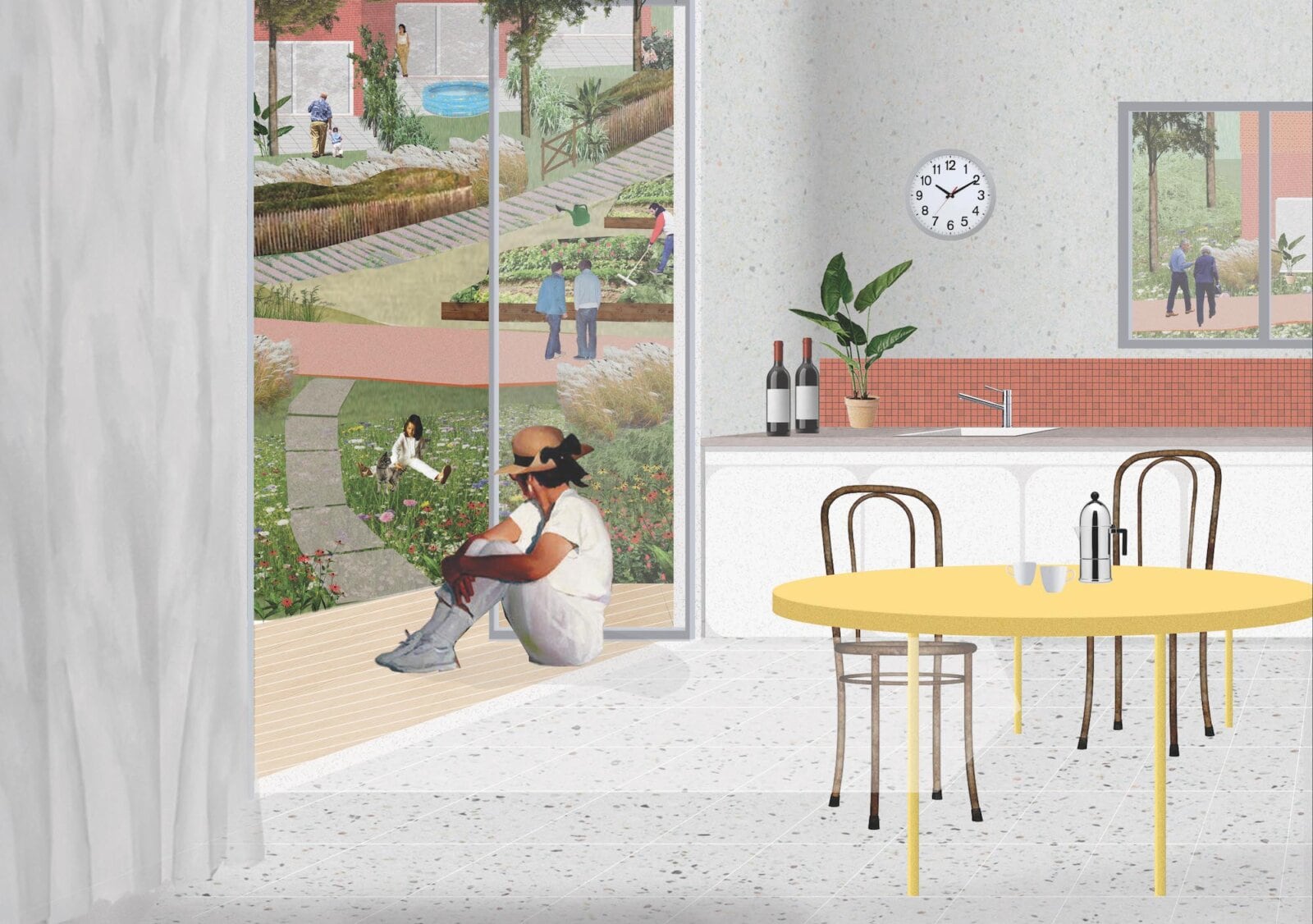
Wooncoop At the request of citizens, we purchase properties or land, plan and supervise the renovation or construction of the housing project, and manage it properly during occupancy – which takes the burden off the residents themselves. We achieve this with financial contributions from various possible sources: firstly, from the resident-cooperators themselves, who buy shares in the cooperative. The greater the capital contribution, the more favourable the rental conditions become. As a resident, you determine your own monthly costs, depending on your financial situation. This also allows you to save more or less capital over the course of your housing career. Family and friends (the supporters) or other non-residents can also contribute capital. As an ‘ethical or impact-driven investor’, you invest in shares in the cooperative and help to realise a local housing project with a target return of 2 per cent per annum. And if you don’t want to become a cooperative member but do want to invest, you can lend Wooncoop an amount starting at 5,000 euros with a return of 2 or 3 per cent, depending on the duration of your loan.
A+ But it’s about more than just a financial model, isn’t it? Wooncoop stands for ethical investment and social entrepreneurship, in which ecology and sustainability, coexistence and collectivity are paramount.
Wooncoop Yes, we don’t just want to solve problems in the housing market, we also want to generate a broader social impact. Because you own a company together with others and it is managed and controlled entirely democratically, you quickly detach yourself from any individualistic, linear and monetary aspirations and inherently hold the above-mentioned values in high regard. Personal returns are transformed into social gains. That is why at Wooncoop we do not talk so much about ‘affordable housing’ – even though a growing percentage of our residents are able to live in quality housing on a more limited income – but about ‘sustainable and fair housing’.
A+ What exactly is the difference between affordable and fair housing?
Wooncoop ‘Affordable’ is a subjective word: what is affordable for one person may be unaffordable for another. That is why at Wooncoop we focus on ‘housing at a fair price’. It is this fairness that makes living at Wooncoop more affordable. To achieve this, we have developed a number of ‘smart systems’. The first and most important is that when you live at Wooncoop, you rent from yourself at the actual cost price. Only the costs of the building and its management are charged – no more, no less. There is no double standard, and we remove all forms of speculation from housing, which is the main reason why regular housing has become so incredibly expensive.
Another system we use to make housing more affordable is to evaluate the capital requirement as a group rather than per person. When you take out a loan to buy your own home, the bank expects you to contribute part of the capital yourself. At Wooncoop, we also only start a project when the future residents and their supporters can raise a third of the capital, but the big difference here is that we calculate the contribution across all residents of the housing project, rather than per person. With this solidarity mechanism, people who can contribute more capital help others who have less.
By sharing capital and living at actual cost, thanks to discounts from supporters and shareholders who waive their returns, we are also working together on a form of ‘prevention’. This is because the need for more affordable housing is growing among a large part of the Flemish middle class. In the longer term, Wooncoop’s fair, inclusive and solidarity-based model can actively ensure that the waiting list for social housing grows more slowly, or perhaps even shrinks.
A+ Does this new housing model also have an impact on the architecture and typology of our housing?
Wooncoop Certainly. Wooncoop is pioneering in every respect. There are, of course, examples of the cooperative housing model abroad, such as in Austria, Switzerland and Sweden. But we cannot simply copy them; we have to rethink everything, taking into account our own typical, historically grown housing culture. The foreign examples did teach us a lot about the architecture and typology of collective or shared living: the relationship between collective and private spaces, how to centralise technology, which sustainable materials are best to use (because you live there for life), and how to organise walking routes. We have created a pool of architects who want to help shape this progressive housing concept and who are committed to high-quality architecture that connects people. There are currently 26 Wooncoop projects underway, 16 of which are under construction. These include De Drukkerij (Havana) in Ghent, Moosherk in Hasselt (ectv) and De Wasserij in Antwerp (Stramien).
A+ How do you assess the long-term effects of this new housing model?
Wooncoop At this point, we cannot say from our own experience what the long-term impact will be. But if we look at examples from abroad, we see that cooperatives can offer their homes at up to 20 per cent below market price. Cooperative housing requires progressive thinking, not only from residents and architects, but also from the government, the banking sector, developers and suppliers. Because it breaks with existing system logics, it is a very slow process and a long-term endeavour. We are taking it step by step. Our motto is: tomorrow we will do even better than yesterday.
5. CLT Brussels
Ten years ago, CLT Brussels was founded, the first Community Land Trust based on the American model in Belgium. Last year, they received the United Nations World Habitat Award for this. A spoke with coordinator Geert De Pauw about the organisation’s contribution to a more inclusive housing policy in Brussels.
A+ Who are you and what exactly does CLT Brussels do?
CLT Brussels – CLT Brussels was founded ten years ago by associations and activists committed to the right to housing in Brussels. We start from the principle that housing can only remain affordable if you neutralise speculation, which artificially drives up prices. This can be achieved by removing land from the property market and ensuring that homes can only be sold with a limited added value.
We are supported by the Brussels Region and currently have six housing projects underway, comprising a total of 120 homes. Not all of these homes are new builds; the CLT model can also be applied perfectly to renovations. But in each of these projects, we remain the owner of the land. The homes are partly built or renovated with subsidy money, and the rest is paid for by the buyers through mortgage loans. If an owner of one of these homes wants to resell it, they can do so at the initial sale price plus a maximum of 25 per cent of the estimated added value. In concrete terms, this means that a home that had an estimated value of 250,000 euros at the time of construction, in which 50,000 euros in subsidies were invested, and which is estimated at 290,000 euros at the time of sale, can be sold for 210,000 euros. That is what sets us apart from other affordable owner-occupied homes: they remain affordable, even when they change hands. If you cannot regulate the profit on the capital gains from property after sale, property once again becomes an object of speculation and subsidies for owner-occupied homes are a waste of public money.
A+ You focus on ownership rather than the rental market. Why exactly? And who are CLT homes for?
CLTB Our homes are for the lowest income groups, for people who are entitled to social housing. We work with an application system and waiting lists. The sale price depends on the buyer’s income. We ensure that the monthly repayment does not exceed one third of the buyer’s income.
We focus on owner-occupied homes because we believe that ownership has many advantages. Owning your own home means security, capital accumulation, independence and also a legacy for your children, allowing you to break out of the cycle of generational poverty. We believe that our system is a good complement to the social housing provided by the government.
A+ Ownership also costs money. How do owners deal with the costs of maintenance and renovation?
CLTB We try to guide buyers as much as possible in their status as owners; we provide training on co-ownership, saving, household budgets, and so on. We also have a right of supervision. In cases of clear neglect of a property, CLT can intervene. Major renovation work has not yet been carried out on our buildings as they were only completed recently, but we know from studies by the Champlain Housing Trust in Burlington, the American model on which our CLT is based, how to tackle this in order to guarantee affordability.
A+ One hundred and twenty homes in ten years for a city like Brussels is still a drop in the ocean. How do you see the future?
CLTB We continue to question the prevailing ownership model, but in order to have a real impact, it is important to grow. In the future, we want to build larger projects with more residential units so that we can also build more cheaply. We also want to focus more on renovations and less on new construction, given the reality of the Brussels context. We are looking at how we can do this, for example by purchasing properties from the municipality as part of a neighbourhood contract.
Furthermore, we want to continue to investigate how we can remove existing homes from the market and tackle vacancy rates. We are also collaborating with the Renolution project of Leefmilieu Brussel, in which the land under the homes of people who cannot afford the necessary energy renovation is sold to CLT and the work can still be carried out through a supplementary premium.
A+ Last year, you realised Calico, an atypical project. What exactly does this entail?
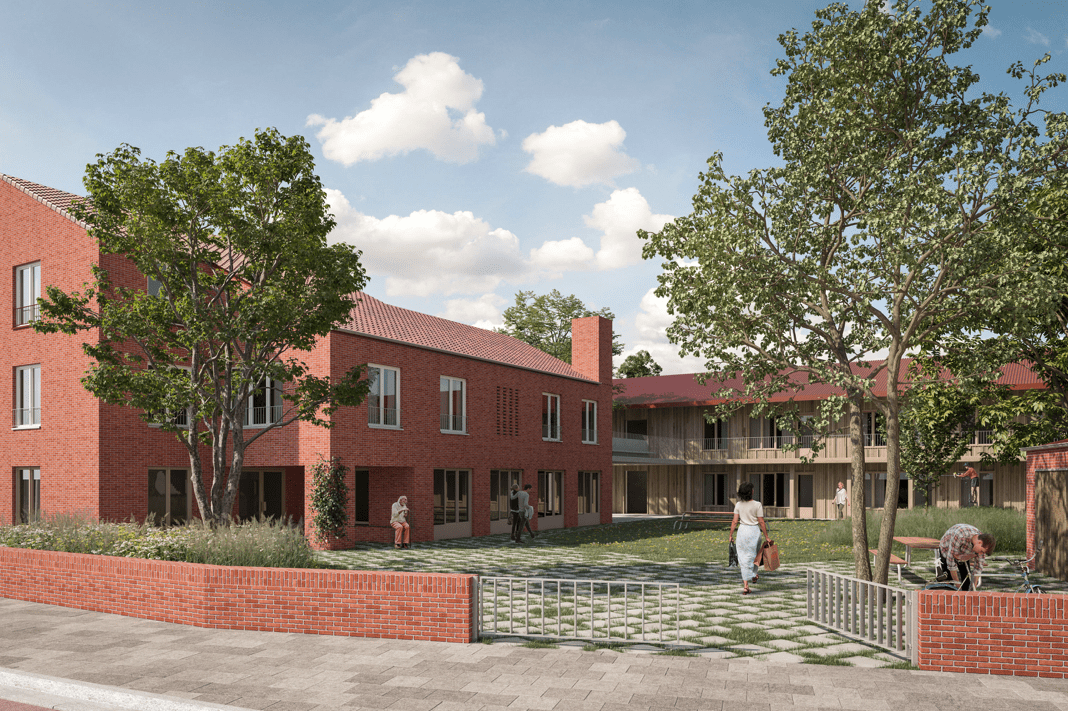
CLTB Calico is the abbreviation for Care and Living in Community. It is an atypical project because it was a collective initiative of various organisations that all want to support a different, more involved way of living together in their own way. This is also reflected in the programme, which, in addition to a dozen classic CLT homes, also includes cooperative homes, ten rental homes for vulnerable women, a birth centre where you can give birth safely outside a hospital, a hospice and homes for homeless people. All programmes share a communal garden, there is a meeting place for people with mental health issues, and extra attention is paid to intergenerational mixing.
When we bought it, the building itself had already been planned and approved but had not yet been built. It was realised on the basis of CLT and is now in use. We encourage initiatives for social cohesion, such as a neighbourhood kitchen with unsold products from the supermarket, a homework class on Wednesdays and, through Housing First, support for homeless people to reintegrate into society.
6. Triple Living
At the end of 2022, Antwerp-based project developer Triple Living opened an exhibition on affordable housing and emergency housing in the oeuvre of Japanese architect Shigeru Ban, with whom they are currently building a residential building in Antwerp. A talks to CEO Stefan Paeleman about their ambitions to make or keep housing in Belgium affordable.
A+ What exactly does affordable housing mean to you?
Triple Living – Affordable housing is a broad concept. Together with Architecture Workroom Brussels, we conducted a study to gain a better understanding of the issue and to gain insight into how we, as a project developer, can provide a solution.
Today, an increasing proportion of the population – those in the first, second and sometimes third income quintiles – can no longer afford to buy a home. Yet we are convinced that home ownership is an important way to combat poverty. Belgium does not have a well-funded pension fund like the Netherlands or Switzerland, and our pensions are too low to live on at current rental prices, especially for the lowest income groups. We advocate affordable owner-occupied homes as a means of building wealth that can supplement pensions and thus form a pillar of social security. Furthermore, home ownership also leads to better neighbourhoods, as owners are often more settled. This has a positive impact on social cohesion within a particular neighbourhood, which in turn improves safety.
We believe that access to a system of ‘living below your means’ is important because it can reduce dependence on subsidies and support, thereby making citizens more independent. In that sense, it is an appealing story. Moreover, it is the vision that previous generations have pursued and that has created a great deal of prosperity in the past. It is important, however, that these homes are of high quality and can last a long time. We believe that we are building this type of ‘solid’ housing.
Of course, affordable owner-occupied homes already exist today, but they often score poorly in terms of energy efficiency and are usually located in municipalities without good public transport connections and with low employment rates. Indirectly, these homes are therefore very expensive, because you pay a lot for mobility and energy. Furthermore, this fragmented spatial planning means that open space is scarce and the social cost of living is rising. That is why we need to build in the economic core area. We need to think about how we want this metropolitan area to function, hyper-connected, with well-functioning public transport. Urban expansion in the right location should not be taboo, but could perhaps be the lever for more open space, space for agriculture, nature and water.
It is important to note that metropolitan does not mean hyper-urban, but rather refers to a type of urban planning area where there is room for all forms of housing. The metropolitan area focuses on the efficient organisation of infrastructure and public transport, based on a sound urban development vision.
A+ What are the obstacles to building affordable owner-occupied homes in this metropolitan area?
TL People often think that cheap construction has to do with specific building techniques and materials, or with a different kind of design, but in that respect, the fat has already been skimmed off the soup, at least if you want to build properly. There are many different approaches in different areas, from system construction to community land trust models, but what is missing is a systemic attitude. A holistic view that makes connections between different social themes and where the solution to one problem may also be the lever to solve another. I believe that our regional plans are at least partially flawed. These plans were created in an era when the car was considered the primary means of transport. I believe there is a growing consensus that this is not the right approach. To achieve this, we need affordable land, legal certainty and a realistic set of requirements.
Land is scarce, but this scarcity has been created by various authorities themselves. Too many projects get caught up in the permit process but are never finally implemented due to legal proceedings. Sometimes you are allowed to build less densely, less high, the homes must be larger or there must be more space for greenery. It all sounds nice, but the result is even greater scarcity of land and therefore unaffordable land prices and end products.
The lack of legal certainty, or clarity about what and how exactly you can build and the associated risks of procedures that can halt the construction process, open the door to speculation and drive up prices. In turn, the list of requirements, with ever-increasing regulations, drives construction costs ever higher and, here too, the risk of additional procedures increases. Political courage is needed to decide to reduce certain matters to their essence and ask the question: ‘What do we really need?’. Only then can we build decent homes.
A+ You are talking about new construction, but what about existing buildings?
TL Only 3 to 5 per cent of the housing stock is currently adapted to energy and comfort standards. A large part of the real estate cannot be adapted. What should be done about this? Should we demolish it all or renovate it to make it more energy efficient? Or should we rather think about sustainable energy supplies that feed this less efficient housing stock? Furthermore, part of the housing stock consists of valuable heritage. It is not always easy to renovate this in an energy-efficient manner. There is a very large market in Q2 and Q3 for decent, affordable owner-occupied homes, but it is precisely there that it is so important that they perform well in terms of energy efficiency, otherwise you cannot talk about affordability.