Edito
Eline Dehullu – Editor-in-chief
Now that the discourse on architecture is dominated by major themes – affordable housing, densification, depaving, inclusion – it can be beneficial to focus attention on the smallest architectural element, the detail. If it is not merely a technical solution but actually an integral part of the design, the detail can also become a carrier of meaning. A point where material and ingenuity, context and history, collaboration and connection meet.
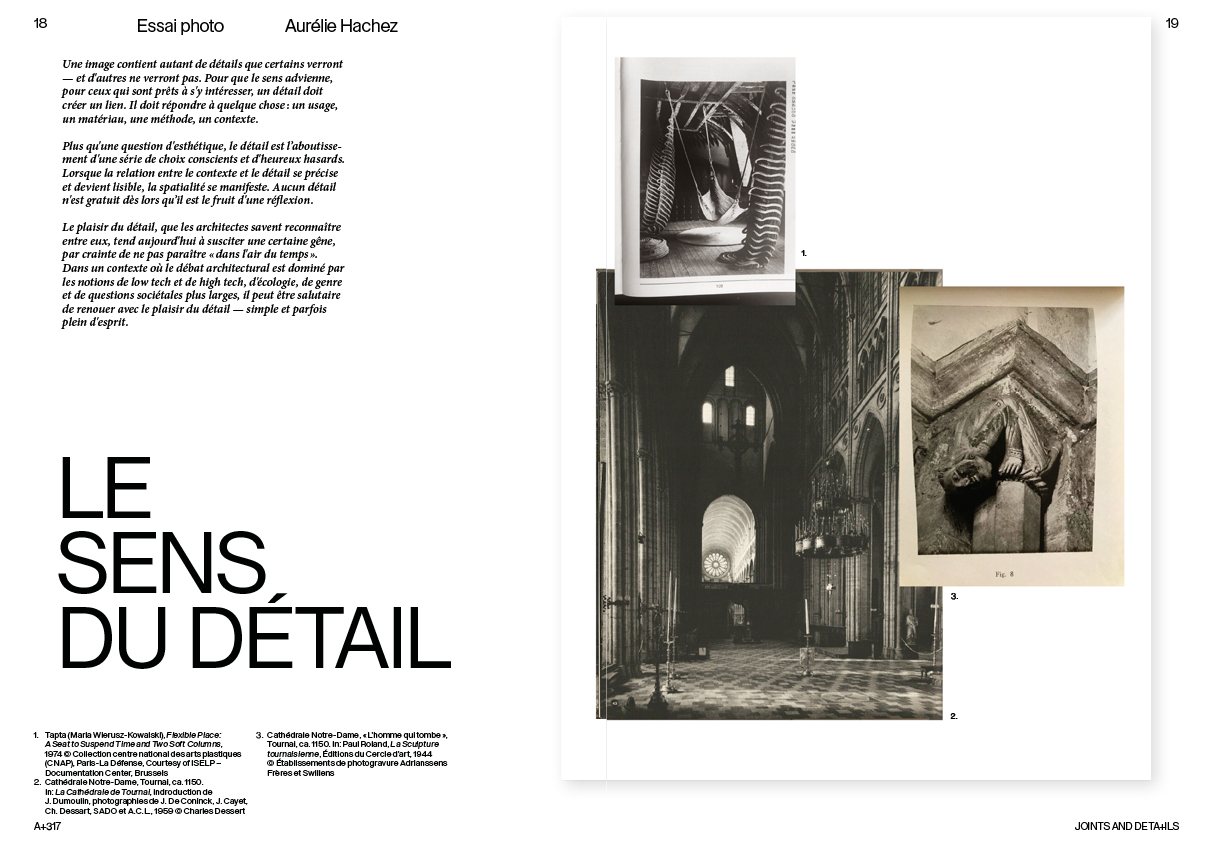
Together with architect Aurélie Hachez, the editorial team of A+ explored the different roles that the detail can take on. Aesthetic – as a source of spatial poetry and sensory pleasure. Fundamental – as a strategic design tool to realize the basic concept of a building. Cultural – as a conveyor of traditional uses, craftsmanship and local knowledge. Historical – as an evolving element, from simple and experimental to complex and normative. Political – as an activist and lever for circularity and inclusion.
Details are therefore anything but neutral. Aurélie Hachez shows that meaning emerges precisely when details relate to their environment – in the past and today. They are the result of choices and precision, but also of lucky finds and coincidence. And it is in that field of tension that the pleasure of the detail becomes tangible and spatiality grows.
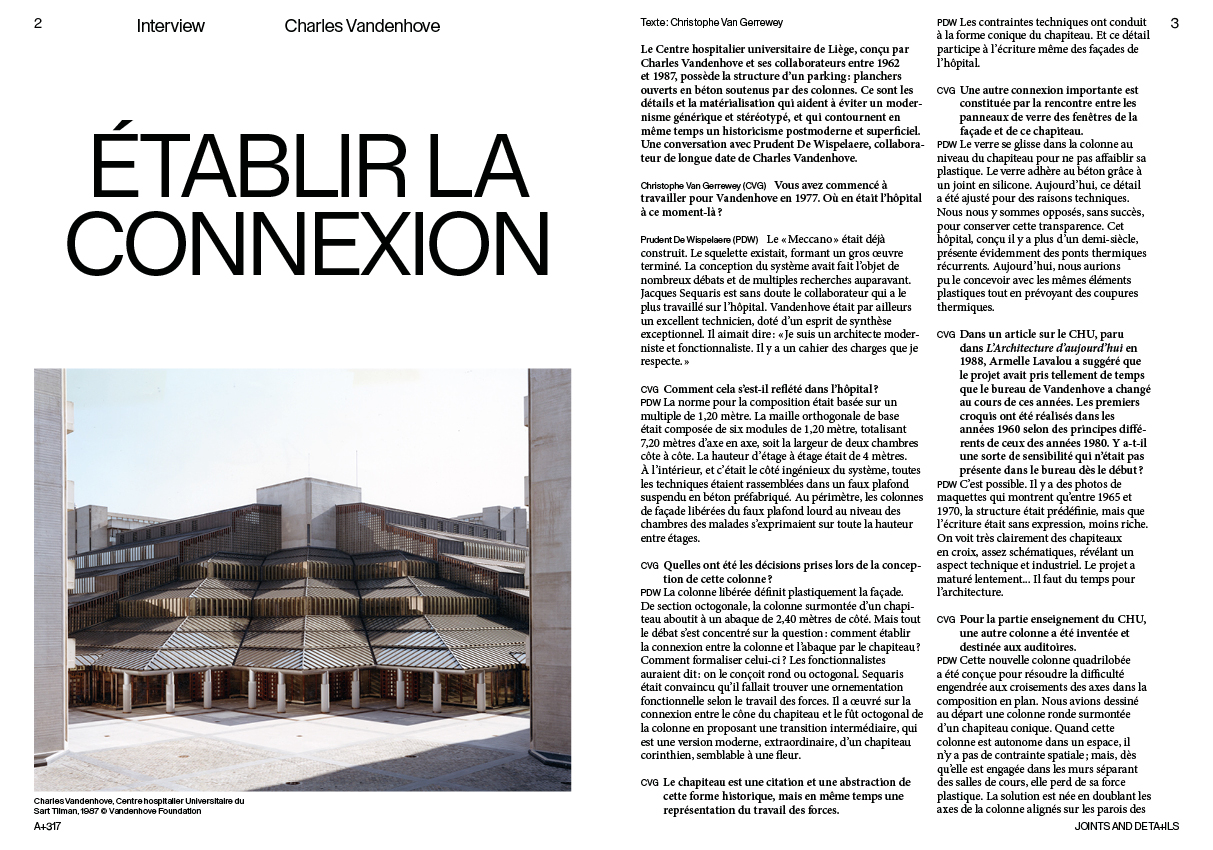
That spatiality was also the driving force of Charles Vandenhove (1927–2019) when he conceived details, not only with verve, but also with the utmost care. A conversation between former colleague Prudent De Wispelaere and Christophe Van Gerrewey about the design and construction of the Centre Hospitalier Universitaire (CHU) in Liège (1987) reveals that details were decisive for Vandenhove in determining the character of the architecture. At once playful and dignified, they were key in creating a certain homeyness in the hospital.
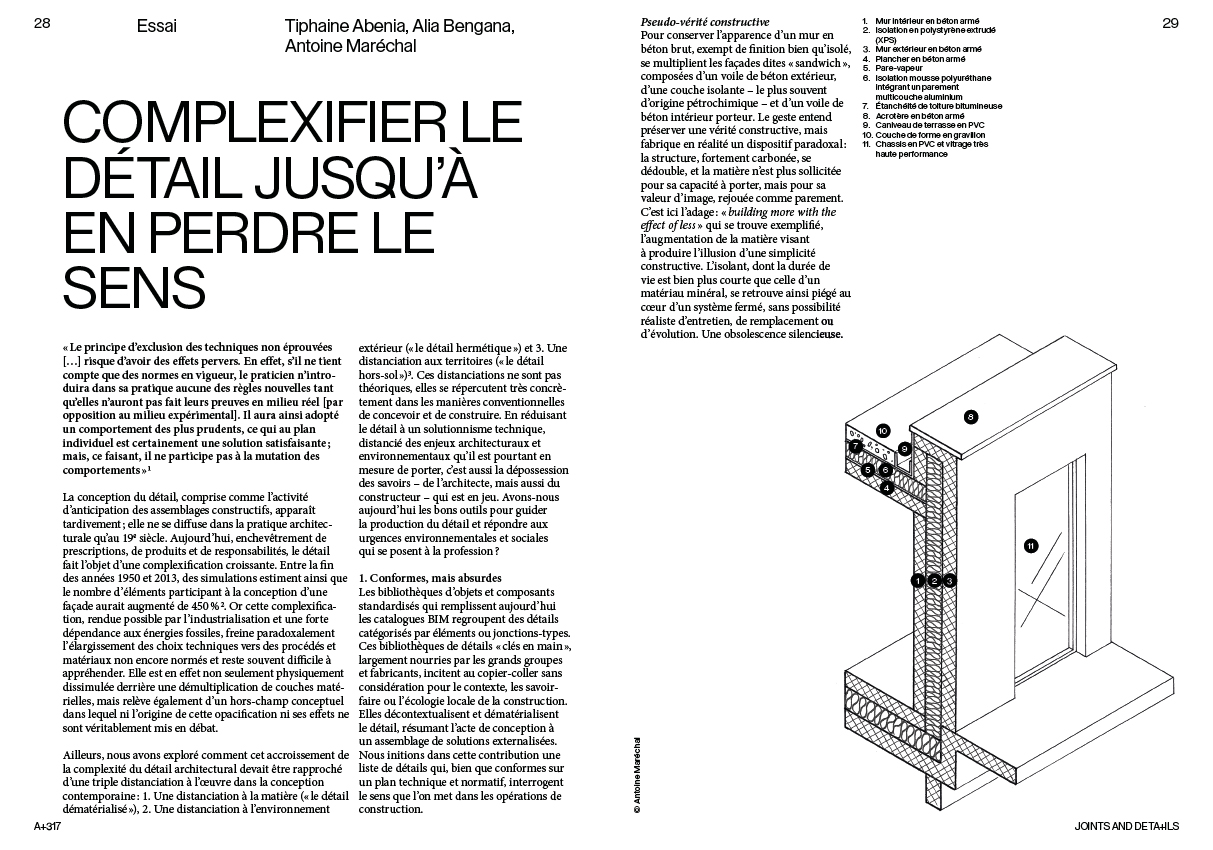
But the detail is also where the complexity of our time accumulates. Tiphaine Abenia and Alia Bengana show how the exponential increase in regulations over the past decades has led to virtually absurd architectural details. The number of elements in the design of a façade, for example, rose by no less than 450 per cent between the late 1950s and 2013. The question is whether this rise in the number of norms and the complexification of details and connections is leading to better architecture or, on the contrary, to its impoverishment.
Caroline Voet also advocates a genuinely sustainable and pragmatic approach to details. Instead of dealing with them in a hyper-technical way or over-designing them, a combination of traditional craftsmanship, bio-based and reused materials, open knowledge sharing and 1:1 experiments can produce architecture that not only serves to connect people ecologically, but also socially and culturally. Materials then follow their own logic, and craft, history and local context converge in the detail.
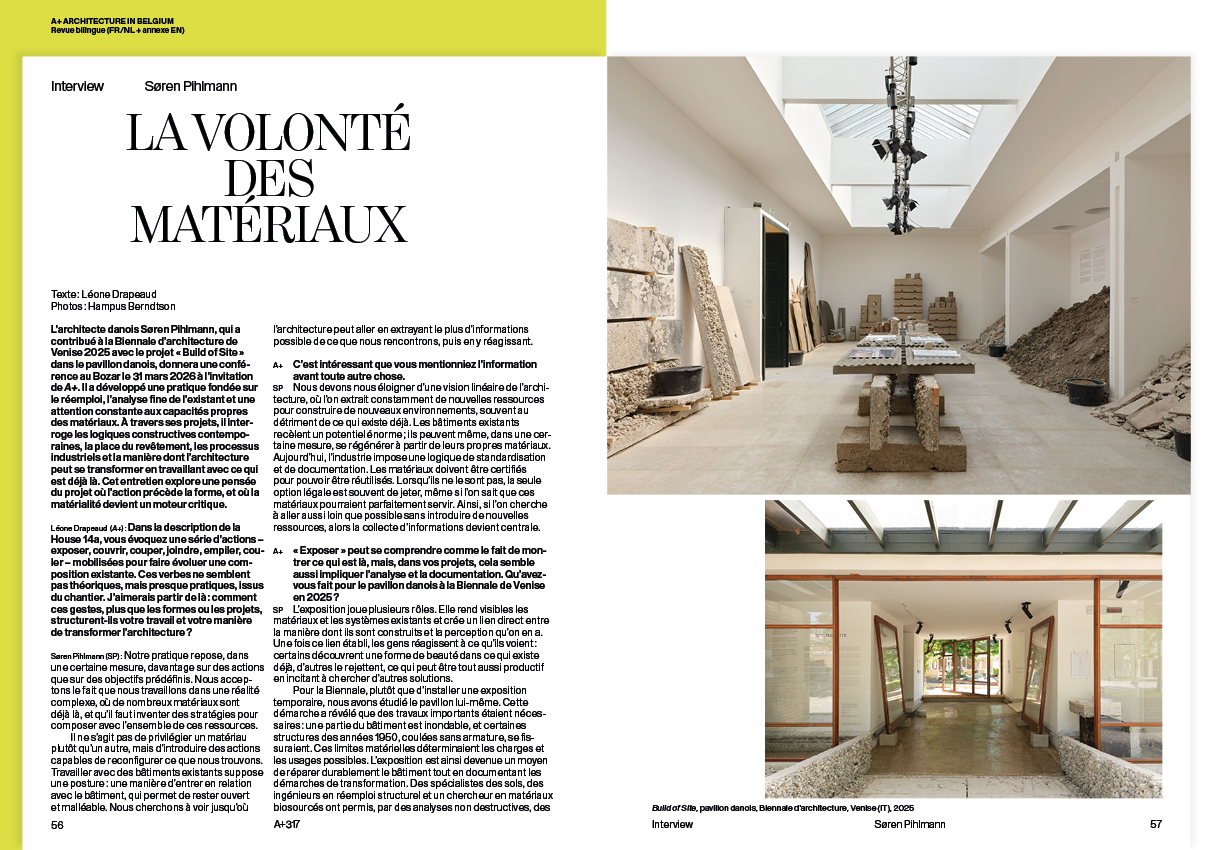
Sam Stalker and Eireen Schreurs further unravel the detailing through reused materials. There are no predetermined solutions here; details arise from the ongoing interaction between architect, contractor and the materials available. They are the result of collaboration, improvisation and direct interaction on the construction site. In this way, the salvaging of materials fundamentally rearranges the sequence of design and construction, and details become a powerful lever for this changing practice.
At the same time, details also have a sociopolitical dimension. Juliane Greb argues that, despite their small size, they wield great power. By designing details that are complex or hidden, it is left to architects and professional experts alone to understand and change the construction. However, when architects make the process of creating details visible and simple, residents and end users themselves can repair and adapt the structure. Details therefore determine the degree of accessibility, autonomy and appropriation. In that sense, they are activist: they can perpetuate existing hierarchies or enable a more democratic use of the built environment.
Taken together, these contributions show clearly how the detail extends beyond its own physical scale. However simple or playful, the architectural detail often captures the entire world of thoughts and considerations underlying the overall structure of which it is a part – a fragment in which architecture speaks in its most concentrated, vulnerable and convincing way.
Eline Dehullu
Editor-in-chief A+
Table of contents
JOINTS & DETA+ILS
Eline Dehullu
Christophe Van Gerrewey
The detail as cultural mediator
Caroline Voet
Aurélie Hachez
Complexifying the detail until meaning is lost
Tiphaine Abenia, Alia Bengana, Antoine Maréchal
Eireen Schreurs, Sam Stalker
Fill in the voids
Carla Frick-Cloupet
Opinion — Details as activists
Juliane Greb
PROJECTS
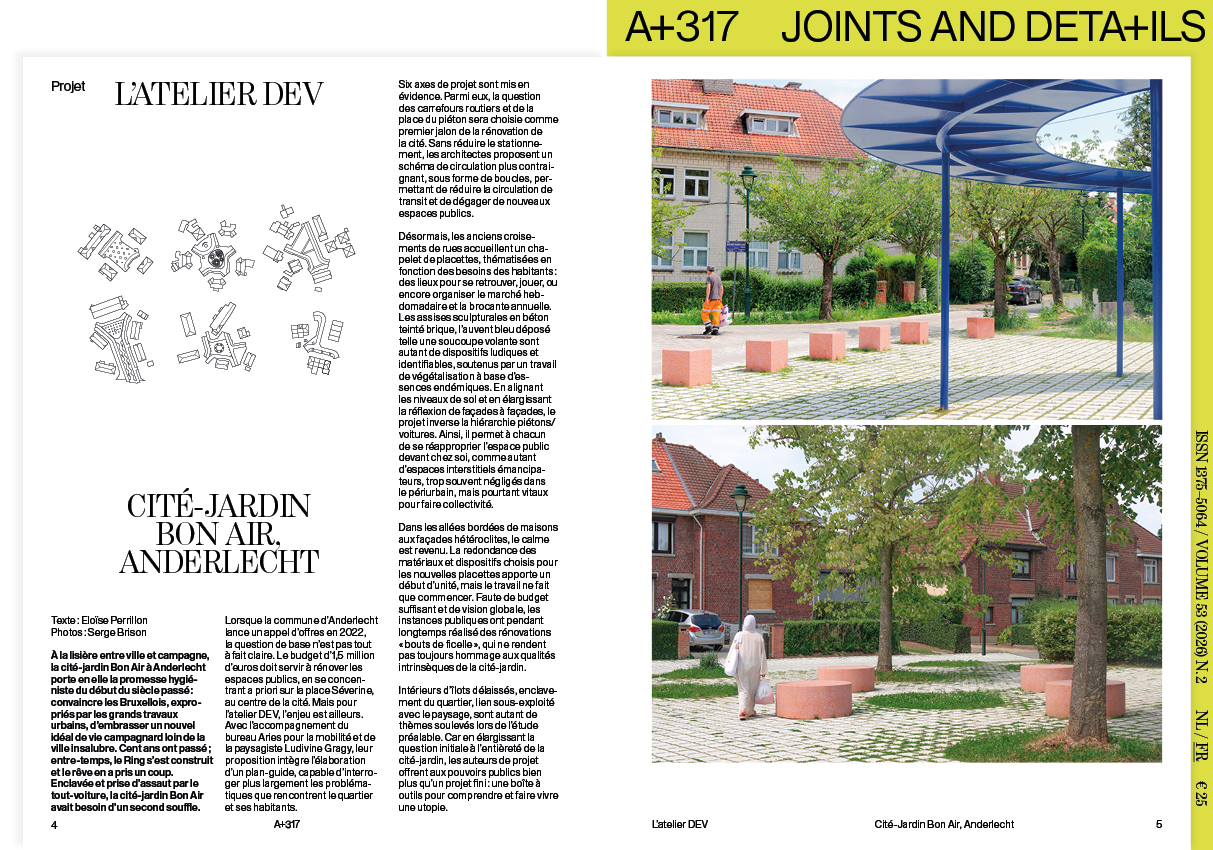
Garden City Bon Air, Anderlecht
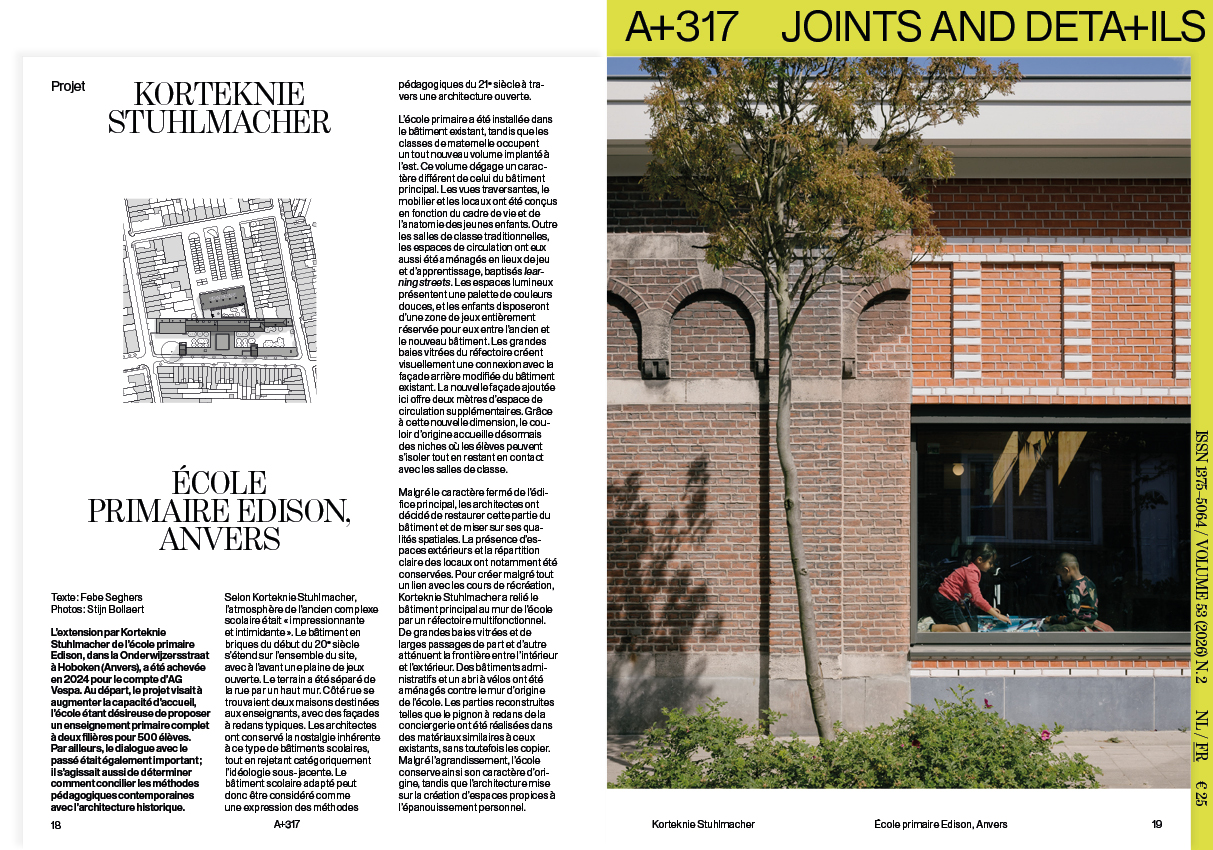
Edison Primary School, Antwerp
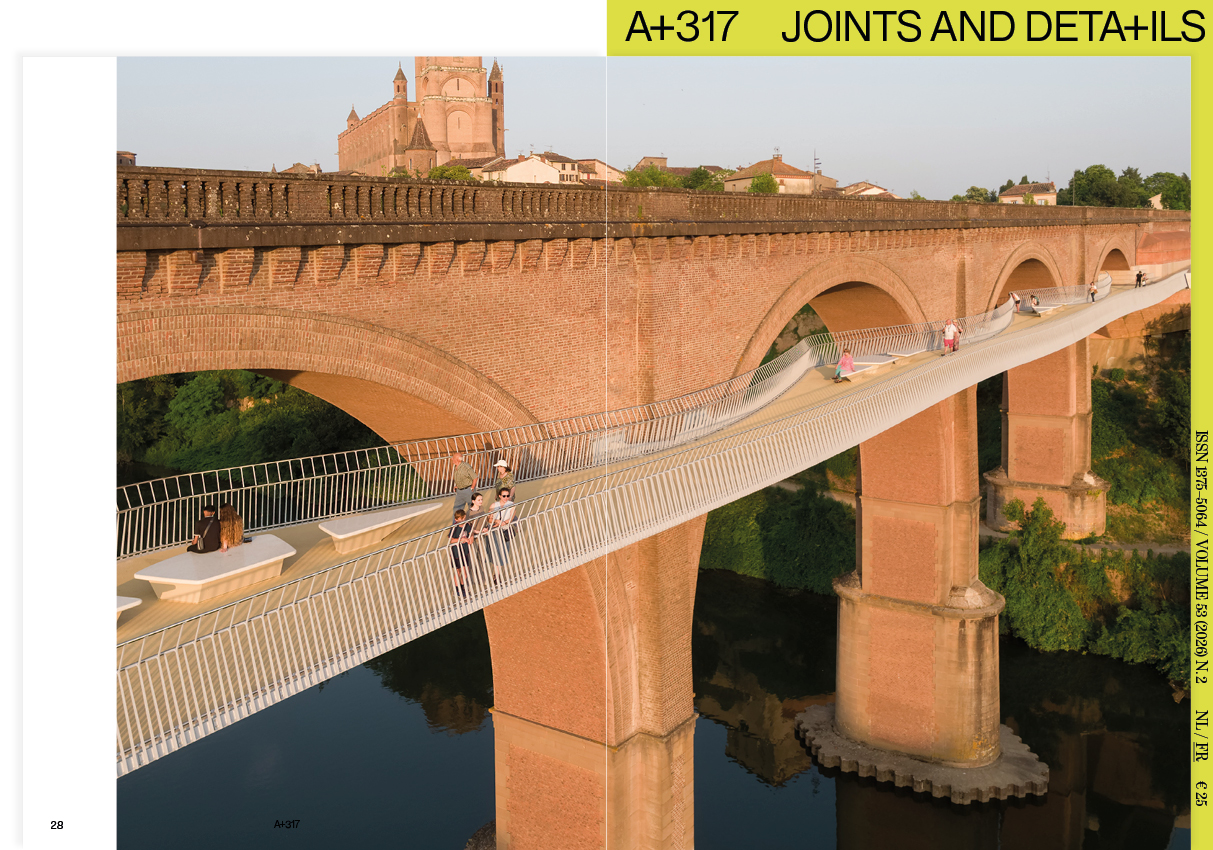
Pedestrian and cyclist bridge, Albi (FR)
Bles, Laeken
Robbrecht en Daem – Olivier Salens
COMPETITION
Open Oproep Saint-Amand Church, Strombeek-Bever
Dirk De Meyer
INTERVIEWS
Léone Drapeaud
Eline Dehullu