Edito
Lisa De Visscher
Editor-in-chief
Brick is omnipresent. Beyond being ingrained in our identity and local building traditions, it is literally the most widely used material for buildings and architecture in our cities, churches and housing estates – and has been since the Middle Ages. Since the 19th century, the industrial revolution has accelerated its production and use. Faced with population growth and rapid urban expansion, there was an increasing demand for building materials. With its compact size, ease of use, modularity and local production, brick was ideally suited to this construction boom. In the 19th and early 20th centuries, bricks conveyed an image of craftsmanship and, thanks to complex techniques and details, were the aesthetic vehicle for the styles of the time. In post-war Belgium, however, they were suddenly relegated to a much more functional role. Industrial production, the advent of concrete, the emergence of cavity walls, the expansion of housing estates and the proliferation of regulations changed the place of brick, both in construction and in culture.
In his essay, Lieven Nijs highlights what he considers to be the two “paradoxes of brick”. The first concerns the function that brick fulfils in load-bearing structures or in the cladding of a building. At a time when the thickness of insulation – and therefore of the cavity – is increasing, anchoring the exterior part of a cavity brick wall is becoming increasingly complex. ‘The image of architecture is changing,’ explains Lieven Nijs. Bricks stacked on the façade, increasingly replaced by thin and lightweight materials, are being relegated to the status of cladding. ”
This brings us straight to the second paradox, namely the role of brick in sustainable development. Indeed, everyone now knows that brick production is very energy-intensive due to the high firing temperatures. Manufacturers are looking for environmentally friendly solutions, namely thinner, lighter bricks that require less raw materials and energy, and which also meet the criteria for lighter façade cladding. Two birds with one stone! However, in a circular economy, these lighter bricks are significantly less reusable than their predecessors.
more
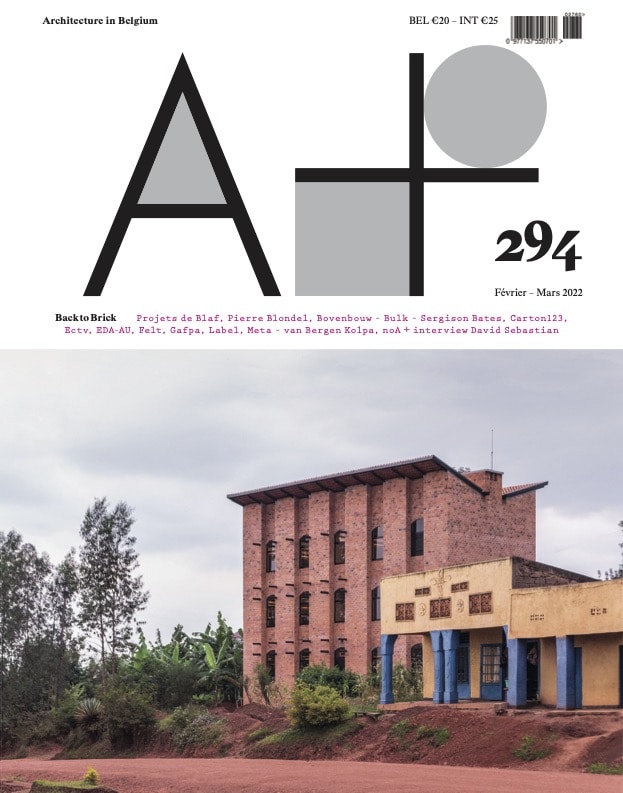
The major advantage of bricks often lies in their local production combined with their ease of use. For projects developed in a complex socio-economic context, this factor is decisive. The Friendship Hospital Satkhira, recently built in Bangladesh using local bricks by Kashef Chowdhury/URBANA, which recently won the RIBA International Prize 2021, and the work of Indian architect Anupama Kundoo – invited by A+ in mid-March 2022 for a conference at Bozar – are fine examples of this. It is also the backbone of the project for a new school in Rwamishiba, Rwanda, by the Belgian firm EDA-AU in collaboration with local craftsmen, which has won several awards, including the 2021 Grand Prix d’Architecture de Wallonie.
In this issue, we present the current paradigm of brick culture. Beyond taking a retrospective look at the authentic qualities of brick in terms of durability and aesthetic language linked to its infinite potential for creating details, ornamentation and composition, this paradigm also invites us to go beyond the brick we know today. Meanwhile, alternatives to traditional brick are multiplying, whether it be compressed raw earth, bricks made from recycled old sanitary equipment, or the reuse of old bricks on an industrial scale.
The Belgian Brick Federation has also responded to this issue: “Today more than ever, ceramic materials are the subject of numerous innovations. We are witnessing a redefinition of materials and construction systems with the aim of making the Belgian brick sector even more sustainable and circular. ” And with this issue, A+ is also contributing its small brick to the edifice.
Table of contents
OPINION
IN THE SPOTLIGHT
40 years of competition culture
Lode Janssens – A Balloon Home
BACK TO BRICK
Sergison Bates – Bovenbouw – Bulk
Archiducs, Watermael-Boitsfort
Beyond Brick: innovative developments and alternatives in bricks
Art academy and youth centre, Lo-Reninge
Brick: building block of paradoxes