
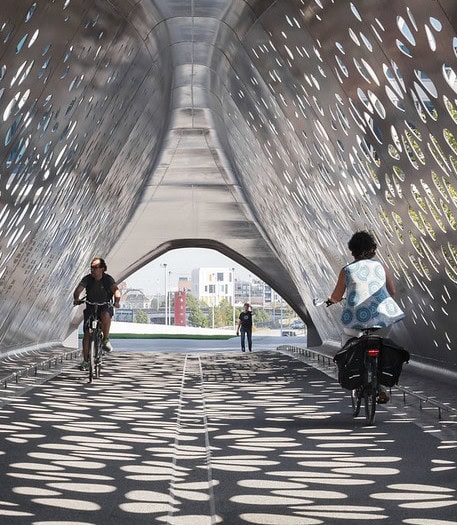
Mobility is constantly evolving. From travelling by horse and cart to electric cars, on foot or by bike. In recent years, the latter has been gaining popularity (once again). Traffic jams and the carbon footprint are making the car less appealing. Thanks to advances in cycling – lighter, faster and electric bikes – as well as more and better infrastructure, people in Flanders are increasingly turning to the bicycle. For several decades now, the network of cycle lanes and cycle highways, tunnels and bridges has been growing throughout cities and the wider surrounding areas. Cycling facilities are becoming increasingly safe and pleasant. Wider cycle lanes allow cyclists to overtake others, gently sloping ramps make cycling more comfortable, and car-free green zones bring peace and safety. Whereas infrastructure used to be purely functional – a way to cross the railway, a path over the motorway, the river or the canal – it has evolved significantly today. Increasingly, people are also seeking added value for the public realm, people and nature. Creating rest areas that connect passers-by with their surroundings, integrating nesting boxes or bat roosts into the structure, stimulating the senses with unusual textures and materials, or creating a play of light and shadow.
With the exhibition ‘Op de fiets!’ (On your bike!), Architectuurwijzer advocates the careful design of cycling infrastructure, as a symbiosis of the brief and the design process. Drawing on Vitruvius’s triad of architecture – utilitas (utility), venustas (experiential value) and firmitas (future value) – the exhibition highlights a selection of cycle bridges designed by Ney & Partners, each offering unique qualities for cyclists, pedestrians or the natural environment. In the architecture exhibition space at the Hasselt Cultural Centre stands a wooden structure in the shape of a Latin cross, rotated at a slight angle. Informative panels are suspended by a steel cable from a cornice reminiscent of a bridge deck. A horizontal shelf provides extra space for photographs here and there. Visitors can walk around the structure or step through the openings provided. Light wooden stools invite visitors to take their time and linger in the space for a while. They bear a sticker with facts about the evolution of cycling in recent years. The delicate structure dedicates the four quadrants to the three basic principles from Vitruvius’ De Architectura and a brief introduction. The large corner facing the spacious foyer – the structure is positioned at the side of the hall – introduces visitors to the theme of cycling infrastructure and its evolution over the last few decades. The two smaller corners highlight strengths in the use and experience of Ney & Partners’ bridges. The final quadrant is dedicated to future value and features a large, angular yet inviting table. The openings in the walls of the cross seem like symbolic gateways to the future. A future in which, in dialogue with the environment, people and nature, mobility and infrastructure are discussed in an integrated, sustainable and high-quality manner between clients, experts, engineers and architects.
At the same time, a second exhibition by Ney & partners is running at the Hasselt Cultural Centre. A photo reportage highlights 21 generic bridges through their unique characteristics, which they owe to the distinctiveness of their surroundings. A contradiction with the cycle bridges as unique works of art that are context- and site-specific?
