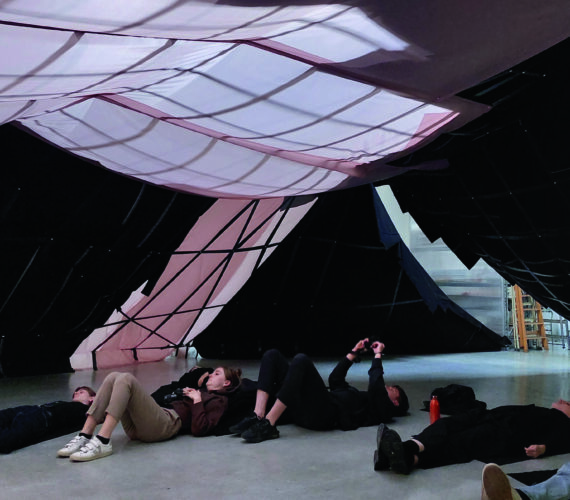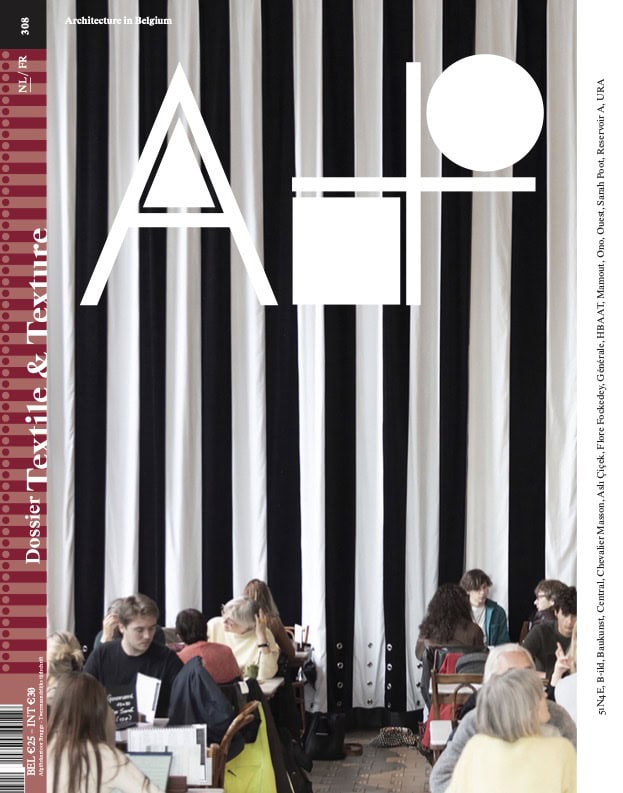
“Architecture borrows from crafts such as pleating and weaving,” write curators Fredi Fischli and Niels Olsen in the introduction to Art Applied (2024), a comprehensive overview of the work of Petra Blaisse and her design studio Inside Outside. Blaisse focuses on the interplay between inside and outside. “I have been working on the emancipation of the curtain for more than 35 years,” she says. Her intuitive approach seeks to orchestrate and valorise architecture through movement. With her experimental textile applications, she has acquired a unique position in architecture. Her striking interventions have given many buildings, by OMA and others, a striking appearance.
Transdisciplinary collaborations between architects and textile designers enrich architecture. They broaden the horizons of the work of architects and designers and explore different statuses and dimensions of textiles. Soft textile architecture influences the affective qualities of the inhabited space. Designing for an architectural context encourages experimentation and technical innovation. For many years, the textile duo Chevalier-Masson has been working with Belgian and foreign architectural firms such as 51N4E, Baukunst and Bruther. The fabrics of Anne Masson and Eric Chevalier are an integral part of the success of their buildings.
Art integrations help to shape the texture of a building and give meaning to our community space. This A+ issue showcases a number of collaborations between architects and artists, including Philip Aguirre (Ono architecture) and Edith Dekyndt (Tank Architectes). Valérie Mannaerts created a monumental curtain for the headquarters of Pleegzorg Vlaams-Brabant, designed by Ura. Like a warm cloak, the curtain embraces the caring function of the building. ‘I seek autonomy in the dialogue with the space and the architecture for which the work is created,’ says Mannaerts. The associations in her exuberant drawings and opulent compositions, skilfully woven by TextielLab Tilburg, are left to our imagination.
Blaisse, Mannaerts, but also Flore Fockedey or Marie Mees… Is textiles a women’s business? Crafts such as knitting and weaving were historically considered feminine because of their associations with housework. Even at the Bauhaus school, a progressive institution that would accept men and women as equals, textiles were a purely female affair. The Bauhaus offered women unprecedented opportunities, albeit only at the loom. Nevertheless, the women in that department did groundbreaking work. Anni Albers became the first textile designer to have a solo exhibition at MoMa in New York. Together with her husband Joseph Albers, she mentored Sheila Hicks at Yale University, who later became world-famous for her colourful textile installations.
Textiles and texture, their tangibility, tactility, sensitivity, scent and acoustic qualities, are elements that create atmosphere. In his text Atmospheres (1996), Peter Zumthor describes a series of themes that play a role in his work in achieving architectural atmosphere. The experience of atmosphere is determined by the simultaneity of “real things” such as material, texture, sound, temperature, rhythm, light and, at the same time, shadow, through the way in which these aspects come together. For Zumthor, atmosphere ensures that architecture touches people.
Table of contents
TEXTILE & TEXTURE
Eireen Schreurs en Caroline Voet
Bookshop and restaurant Kanal-Centre Pompidou
Théâtre Le Vilar, Louvain-la-Neuve