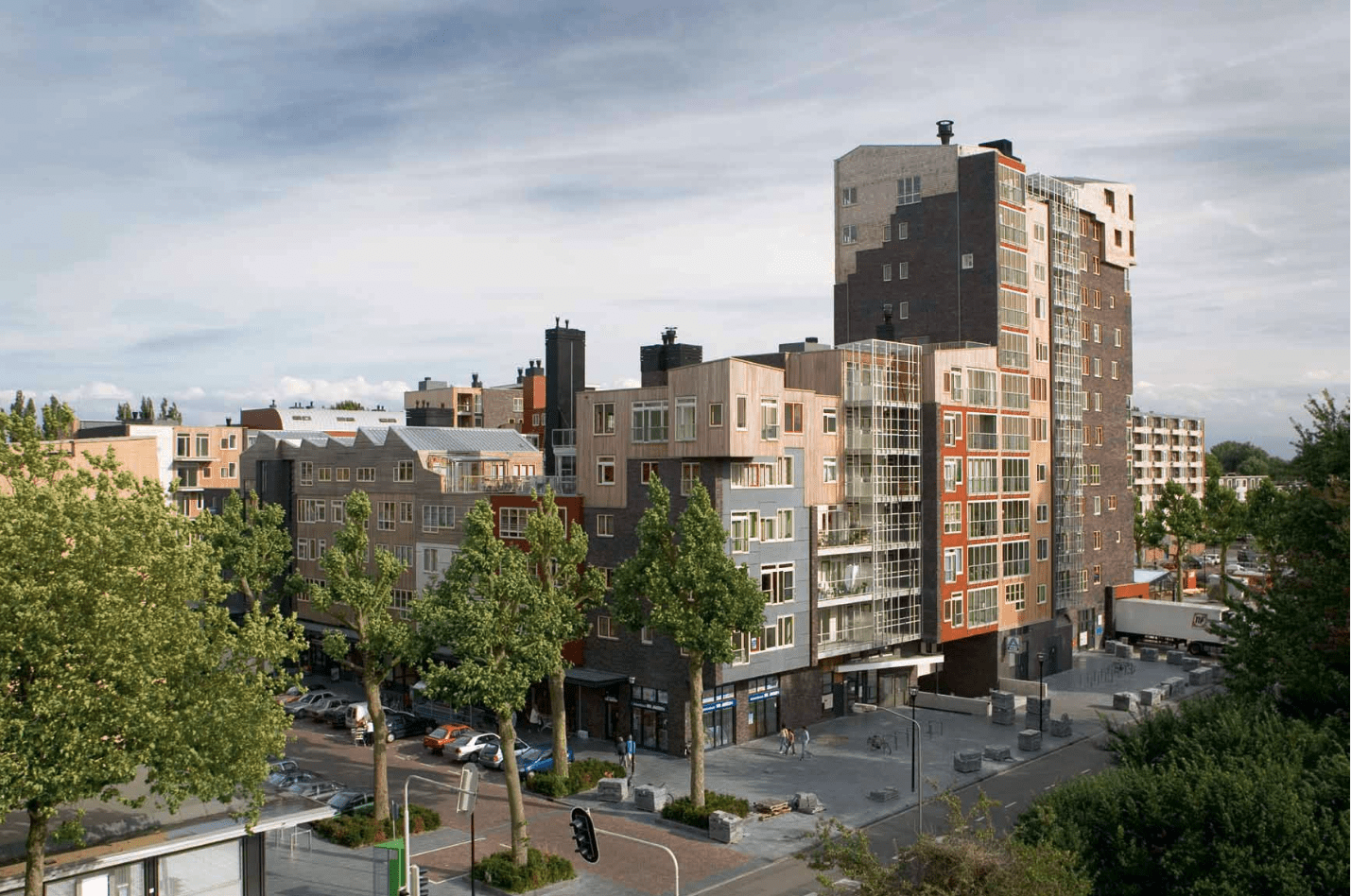
He is a pioneer in the eyes of some, the architect of a few controversial buildings in the eyes of others. As a prelude to this summer’s retrospective at Bozar, Dag Boutsen takes a closer look at the body of work and methods of 89-year-old Lucien Kroll.
Lucien Kroll has been building and writing for over sixty years. It is no easy task to identify a single, simple thread running through that work. This is reflected in the exhibition’s itinerary, which takes on very different forms. Does the retrospective at the Centre for Fine Arts provide an opportunity to look back on his life’s work, or does Kroll’s thinking offer the architectural world an unexpectedly rich source of material for deeper and more critical reflection on the future of architecture? Kroll’s multifaceted and sometimes contradictory personality is not always easy to understand. The seven lessons learned below are not based on Atelier Kroll’s most emblematic projects, but rather on the key characteristics I have distilled from my many years of interaction with Lucien, his wife Simone, the entire team and their built works.
Archibelge
Brussels has the frayed edges of a metropolis. Jagged edges, shabby and seemingly superfluous back-alley structures. Belgian in the Braems style: ‘suddenly, a patchwork quilt, cobbled together by a madman, appears among us’. Brussels-based Lucien Kroll is regularly asked whether there is anything Belgian about his architecture. And whether La Mémé (a student accommodation project for the Faculty of Medicine at the UCL, Woluwe-Saint-Lambert, 1972) could be seen as a form of commentary on Belgian architecture. A hesitant “yes” is invariably his answer. Just as Renaat Braem compels a certain reserve, Kroll’s answers to these kinds of questions remain cautious and nuanced because he wants people to think seriously about Belgian beauty and ugliness.
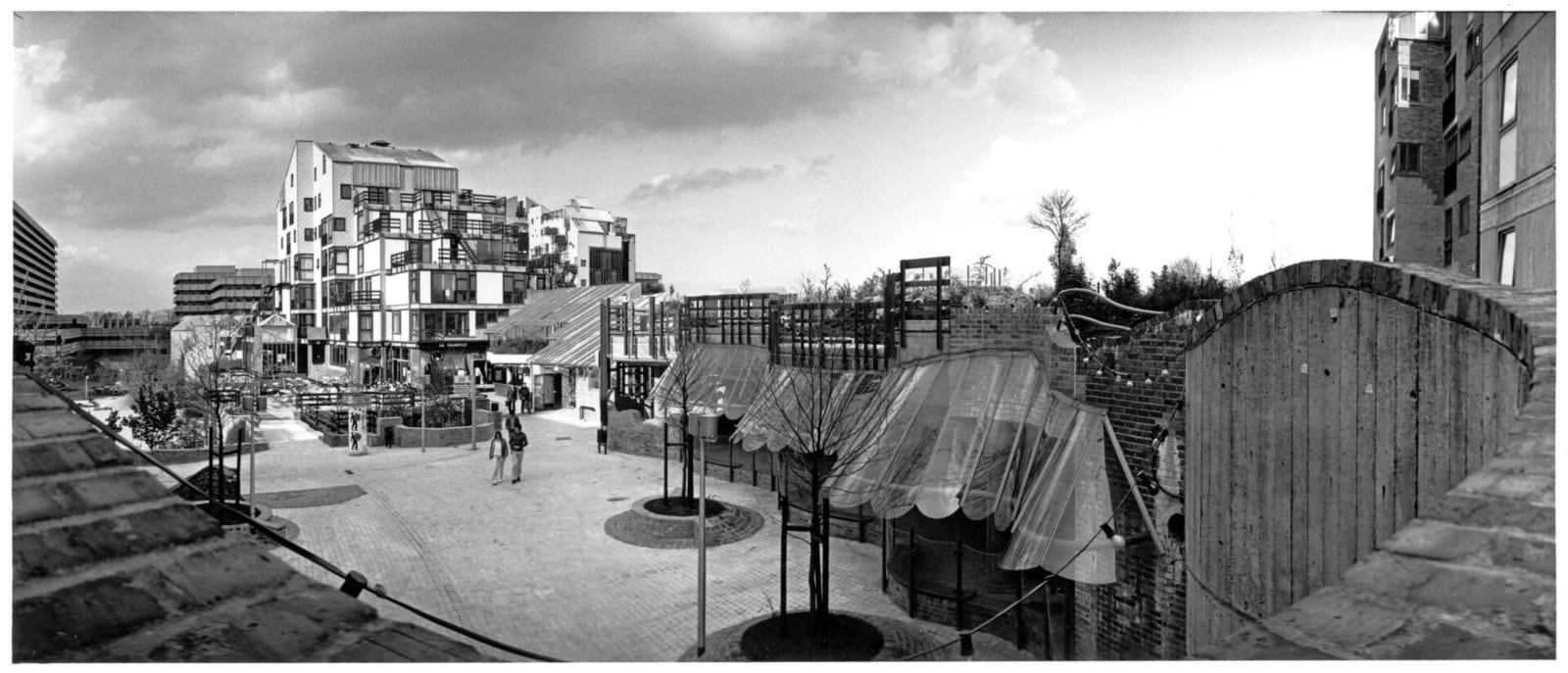
Freedom must be organised, says Braem. Kroll counters this with a straightforward adage: where people walk along paths, a road emerges. When they cross paths, a junction emerges. And when they meet there more often, a square grows. It is as simple as that. This is how cities came into being and grew, and top-down organisation had nothing to do with it. This spontaneity – not so much Belgian as universal – underlies Kroll’s entire thinking and his architectural and urban planning oeuvre. It also forms the basis of the second characteristic: habitability.
“Une architecture habitée”
The French architect Patrick Bouchain describes Kroll’s approach as follows: “If Lucien Kroll defines himself as much as an architect or urban planner as a simple citizen, it is because, for him, architecture is a matter of relationships, linking individuals to one another and to their environment.” Bouchain therefore uses the term “une Architecture Habitée”, which is difficult to translate into English. In other words, the approach is landscape-based, and thus holistic, relational and long-term. Here, the landscape represents a naturally constructed whole of criss-crossing and interwoven decisions. If we view every piece of architecture as a conglomerate, the boundary between urban planning and architecture becomes paper-thin.
Every project a small town
Almost every project by Atelier Kroll can therefore be seen as a small town. Time and again, a ‘body language’ is developed by structuring the landscape, the location or the buildings as a cluster. Without fail, a square, an alleyway, a twist, a break in rhythm or a dancing façade creates a neighbourhood atmosphere. Anonymity is never an option.
In this logic, the participation of residents or users in the design therefore guarantees good neighbourliness. Kroll describes this as “vicinitude”, or rather: “the opposite of solitude. (…) a friendly co-ownership of neighbours. (…) Everyone has the right to argue with everyone else, but without jeopardising the liveability of the whole.”
Co-design
Participation and co-design form an essential part of Lucien Kroll’s working method. A large proportion of his projects were designed through a varied system of workshops to which all possible stakeholders were invited to participate in the creative process. Not to build exactly what the stakeholders wanted, but to allow the richest possible history to emerge, preferably even before the project is realised. This is to build a living environment that belongs to everyone and from which the architect can withdraw over time without fear of future developments. In this way, each project forms a visible expression of the community of end-users.
All coincidences, clumsiness or contradictions are utilised to increase the complexity of a project and allow diversity to emerge. To break through homogeneity, seemingly non-architectural elements are patiently welcomed.
Experiments
IT, sustainability, flexibility, participation: in many respects, Lucien Kroll can be counted among the pioneers of his generation. He experimented with concepts and methods that were ahead of their time. For instance, he was one of the first European architects to begin using IT.
La Mémé, although drawn entirely by Kroll himself, is the manifestation of a collective design process, inspired by participatory or co-creative methods. In terms of structure, it is also one of the first examples of the Open Building, the initial application of the SAR method (Stichting Architecten Research), in which a concrete structure is combined with flexible fit-outs and changeable façade elements. At a time when reconversion in architecture was not yet commonplace, this building already offered the possibility of evolving with the times. With the Maison familiale (1965), a school for children with mental health issues in Braine l’Alleud, Kroll developed an architecture based on a pedagogical project. The Don Milani primary school in Faenza (Italy, 1997) was, in turn, inspired by children’s drawings. With the housing project in Bethoncourt (France, 1994), Kroll carried out a large-scale conversion of a post-war block of flats. And the Caudry secondary school (2000) was designed very much in line with the French HQE sustainability criteria, which were not yet established at that time.
Writing versus building
Lucien continues to write about architecture to this day. It is not easy reading; a pleasant narrative thread is usually lacking. The texts are constructed much like the architecture that emerged from the studio around him: assembled, combined, pieced together. The content is – once again – never easily reduced to a few key points, but the essence is admirably timeless and fundamental. In a typical Kroll text, the same message recurs in different paragraphs, but is presented in a different way each time, or underpinned by a different argument. He is constantly seeking a new guiding logic to substantiate the utopia of his architecture.
An evolving landscape
In the 1960s, Kroll mainly built attractive single-family homes. This continued until the large-scale participatory project with UCL medical students for the La Mémé building complex and, a few years later, the Alma metro station. That turbulent period did not immediately result in follow-up commissions. The innovative discourse found little resonance, until Kroll published it himself. The participatory concept for La Mémé – which had been largely unseen until then – led to a number of projects in which co-design with residents was developed in more extreme forms. A good example of this is Les Vignes Blanches, a new town district in Cergy-Pontoise, France (1979): each family chose its own plot and what it wanted to build on it.
At the same time, the construction methodology of La Mémé also gave rise to the desire to translate the rational SAR geometry into a computer-aided design of various building elements for diversified social housing such as Les Chênes d’Emerainville in Marne-la-Vallée (France, 1984). A proprietary drawing programme called Paysage was developed using self-financing.
It is these developments that converged into a multifaceted ecological thinking, as Félix Guattari described it in 1989: “l’écologie environnementale, l’écologie sociale, l’écologie mentale”.
However diverse Kroll’s schools, residential and care buildings, new builds, conversions, restructurings, urban and rural environments and post-war neighbourhoods (in the Netherlands, Germany, France, Belgium, etc.) may be: they are all connected by that same spirit.