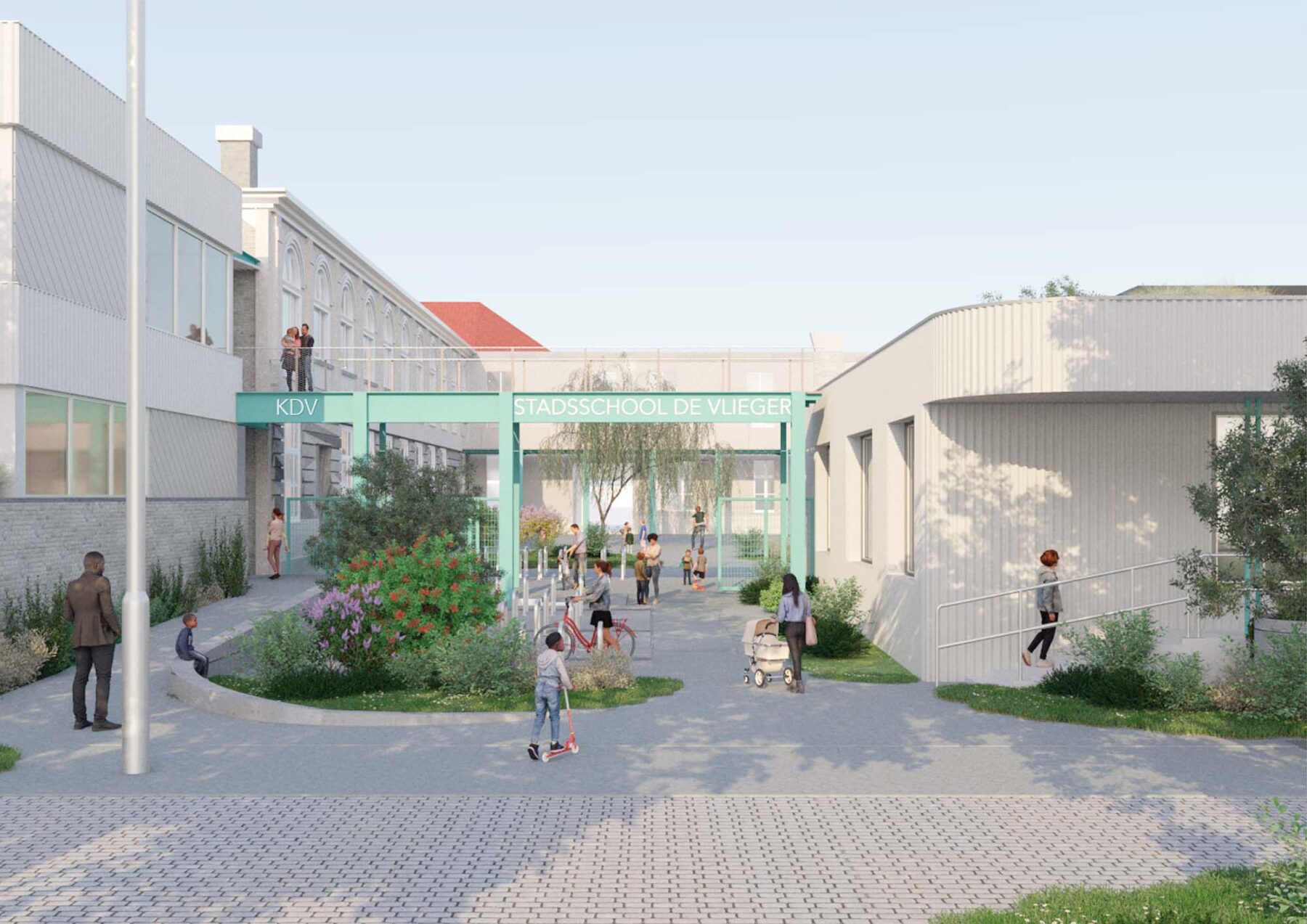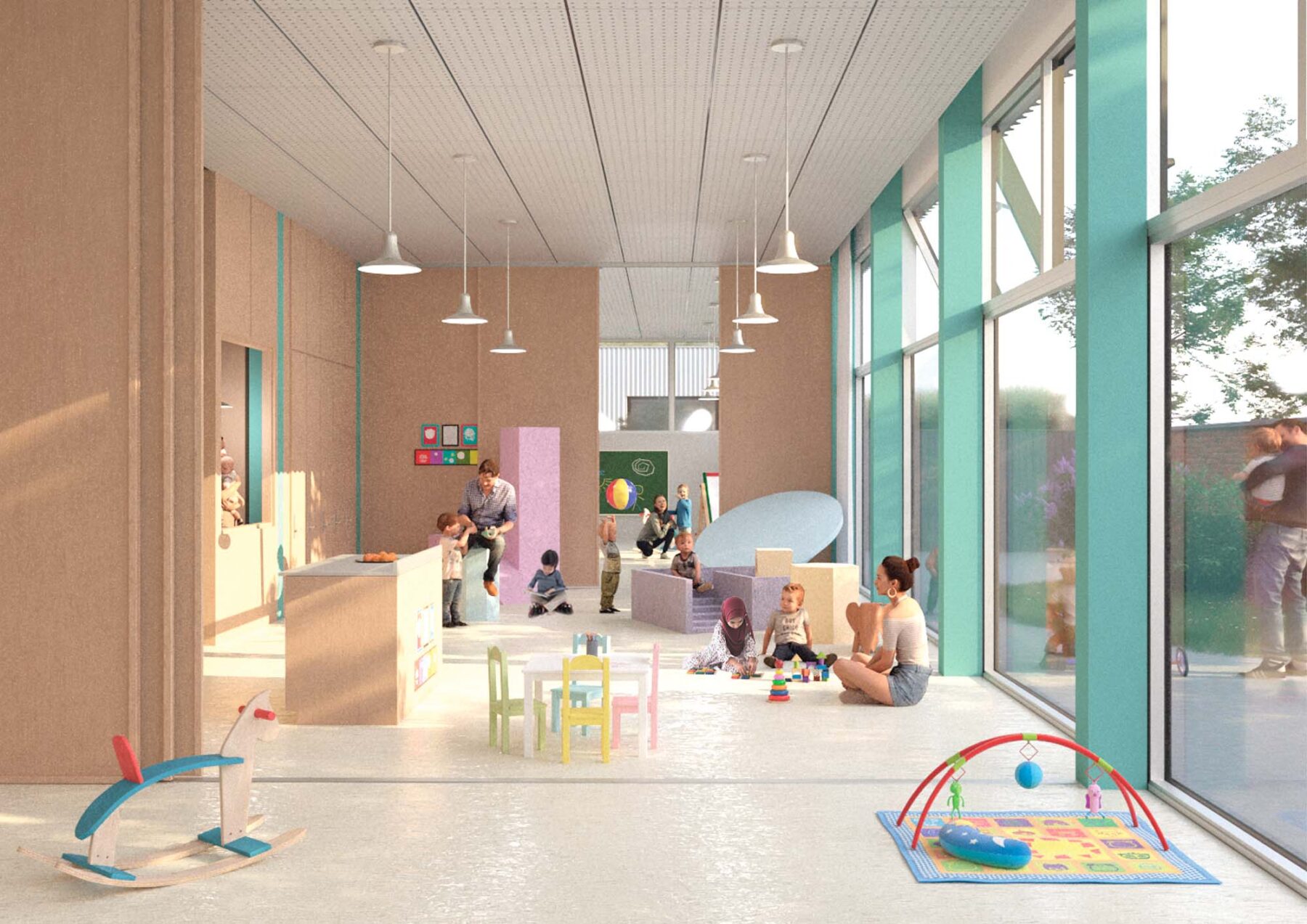
In the densely populated neighbourhood around Ghent’s Dampoort station, there is a shortage of childcare places for young children. To address this shortfall, the city council commissioned NWLND Rogiers Vandeputte and Havana architectuur, via a competition, to design the Dampoort Nursery within the Freinet School De Vlieger. The intervention by the two firms optimises the school’s operations and completes the transformation of the school site into a place where children and young people can spend time and meet.
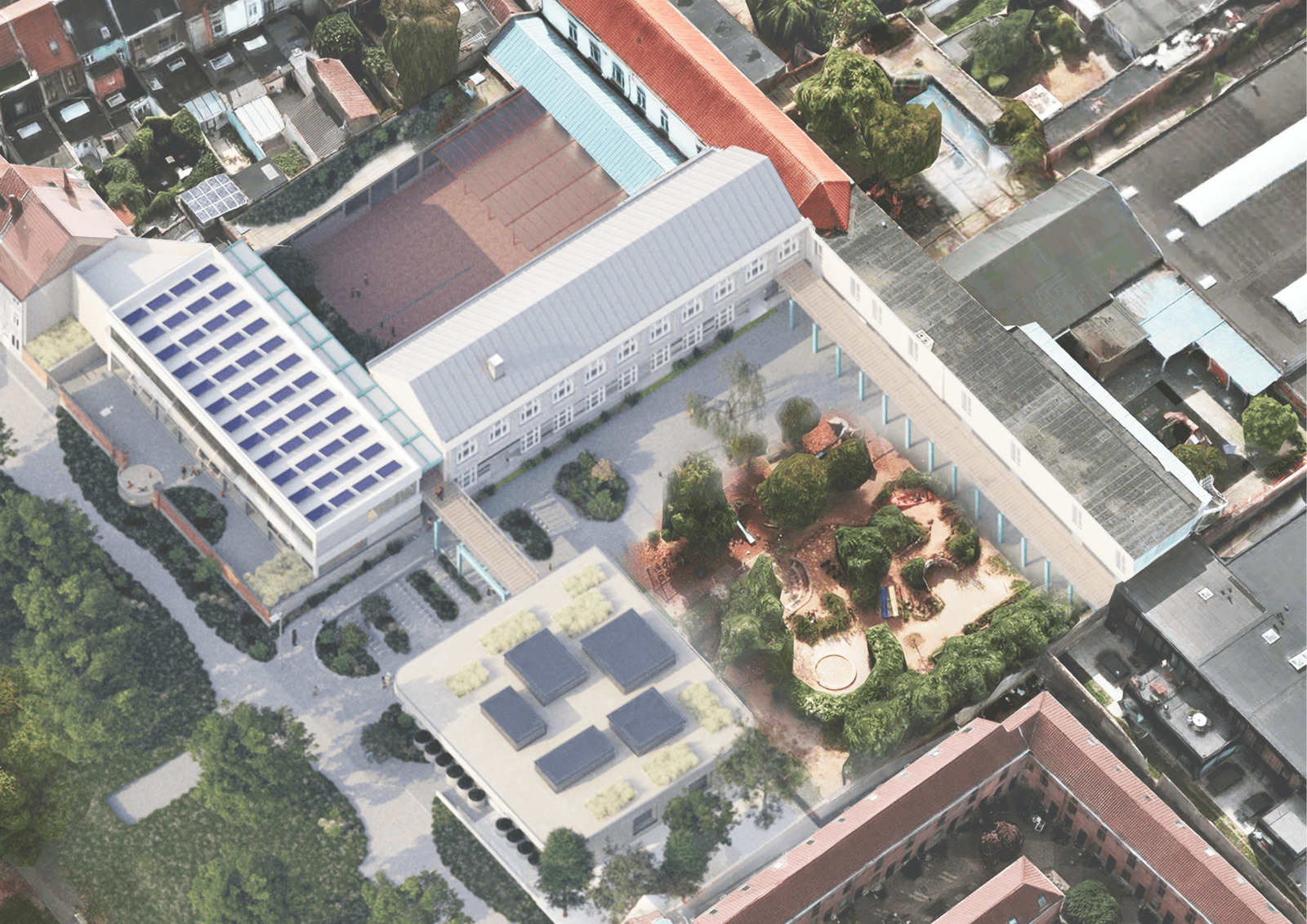
The buildings housing the Freinet School were designed from 1882 onwards by city architect Charles Van Rysselberghe. They are situated in the centre of a dense block between Dendermondsesteenweg and the small park on Wasstraat. The school is a cross-shaped complex nestled amongst the houses in the block and extending towards three surrounding streets. Along its eastern side, bordering the neighbourhood park, the block was never enclosed and the school site was never screened off from the street. Van Rysselberghe’s typological design remained unreadable on one side. In 2017, the first step was taken towards the ‘completion’ of the block when the De Wasserette community centre opened, designed by Architectenbureau Bart Dehaene and architect Peter Geldof. With the completion of KDV Dampoort, a comprehensive layout has finally been created around the school, whilst subtly emphasising the historical context.
The new buildings do not conceal the school. On the contrary, they make the school more visible in the street and the park. KDV Dampoort and De Wasserette are both situated some five metres from the building line, whilst the gate to the school grounds is located twelve metres further on. This creates a funnel-shaped formation, a piece of public land that is already situated within the block. The two buildings, like the playground, are on the same level as the park. It is possible that the low-traffic section of Wasstraat will eventually be raised, creating a barrier-free connection between the school and the park, which will enrich the surrounding area.
The simple addition by NWLND and Havana is a nod to the layout of the historic school. In the school, classrooms are arranged along long corridors and open onto the playground on the other side; in the nursery, three living groups are situated between the external circulation and a small front garden. The design team has explicitly oriented the rear of its units towards the park, in full view, thereby reversing the logic of the school. The front garden is separated from the public space by an existing wall on the building line. Retaining the wall emphasises the building’s urban design gesture.
Together with the addition of the crèche, the design team also transforms the school’s operation. It brings together the administrative spaces of both organisations within the historic building, allowing that building to function in a more streamlined manner. The floor above the living groups serves as an expansion space. Thanks to the multi-purpose space, the school can grow, classes can be expanded and the school’s optimal functioning remains guaranteed, even during potentially extensive renovation works in the future. A walkway is being built along the school’s long wing. This allows the classrooms on the upper floor to be accessed directly, including from the playground. The design team has also left its mark on the Freinet School, though this remains very understated and their intervention clearly complements Van Rysselberghe’s design.
In form, the nursery resembles the school, but in construction and appearance the difference is significant. The building consists of a steel structure in which timber-framed partition walls separate the living groups from one another. Between large ribbon windows, the façade is finished with undulating fibre-cement panels. The nursery alludes to the corrugated-sheet-clad concrete façade of the Wasserette, yet remains true to its own circular logic. In its own distinctive way, the nursery forms both a synthesis of the buildings on the site and a fitting link between the internal operations and the neighbourhood.